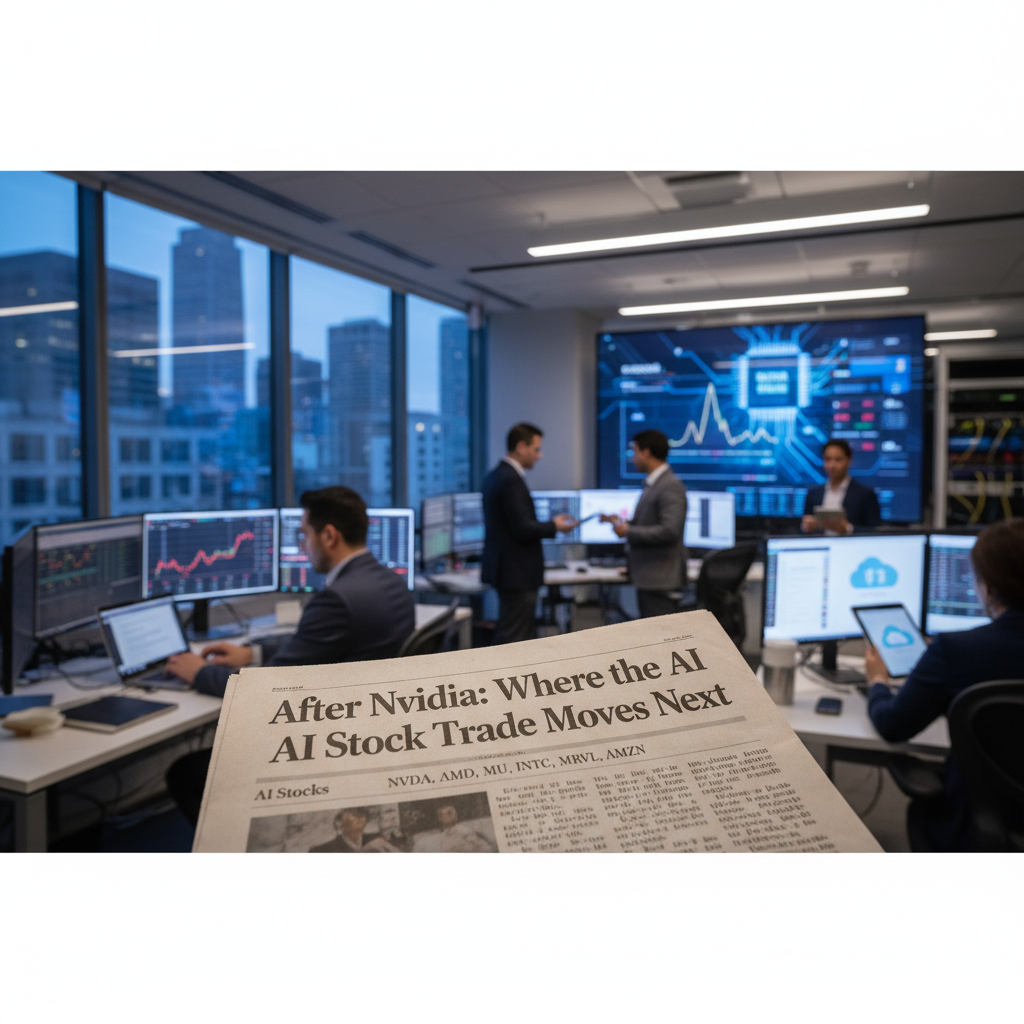
Nvidia is the headline and the moat. That doesn’t mean it’s the only game in town.
The last five years rewired computing. General‑purpose CPUs ceded ground to GPUs, and those GPUs spawned a multi‑billion‑dollar market for training and inference. Now things are fragmenting again. Export controls, valuation hangovers and hard scaling limits are nudging workloads toward specialized accelerators, different memory stacks, and cloud‑optimized systems. For investors trying to catch the next leg of AI returns, that shift matters.
Why the trade is shifting
- GPUs still run the largest models, but custom silicon—TPUs, Trainium and a raft of ASIC‑style startups—is grabbing share on cost per inference.
- Memory constraints (HBM, DDR5) are as meaningful as raw FLOPS. Training rigs are ravenous for bandwidth and capacity.
- Networking and interconnects—high‑speed fabrics and switch silicon—are becoming a multi‑hundred‑million‑dollar multiplier for datacenter clusters.
Signals to watch
- Memory. Micron is the clearest U.S. play on rising HBM and DDR5 spend. More memory per node pushes ASPs up and makes orders stickier.
- Foundational GPUs. Nvidia remains the safest big‑cap exposure, but it trades at a premium and faces real geopolitical export risk.
- Competitors and accelerators. AMD offers a viable GPU+CPU combo, while cloud providers and custom silicon firms chase lower cost per token.
- Networking and silicon IP. Companies like Marvell are quietly benefiting as demand for switch silicon and interconnects grows.
- Legacy players. Intel is a turnaround to watch—its accelerator bets and advanced packaging could matter if they scale, though execution risk is nontrivial.
A few counterpoints
- Open‑source models could cut either way. They might increase experimentation and fine‑tuning, driving more spend. Or, if more efficient architectures win out, they could reduce demand per workload.
- Verticalized stacks—cloud providers building chips for their own clouds—could capture value ahead of public suppliers and compress margins for independent chipmakers. That’s a real risk.
How to think about allocation
- Lower volatility: keep a core position in a big cap such as Nvidia or a cloud AI leader to capture broad adoption.
- Upside: overweight memory, interconnect and niche accelerator specialists. If AI capex keeps climbing, these names have clearer earnings leverage.
- Risk management: monitor export controls, fab capacity cycles and the pace of model scaling. Any of those can swing demand quite dramatically.
Final thought
This is not a binary bet on one ticker. The smarter way into AI today looks like a barbell: established platforms for stability, plus targeted suppliers—memory, networking and niche accelerators—for asymmetric upside. The hardware story is still unfolding. Think system‑level winners, not just the most famous chip in the rack.