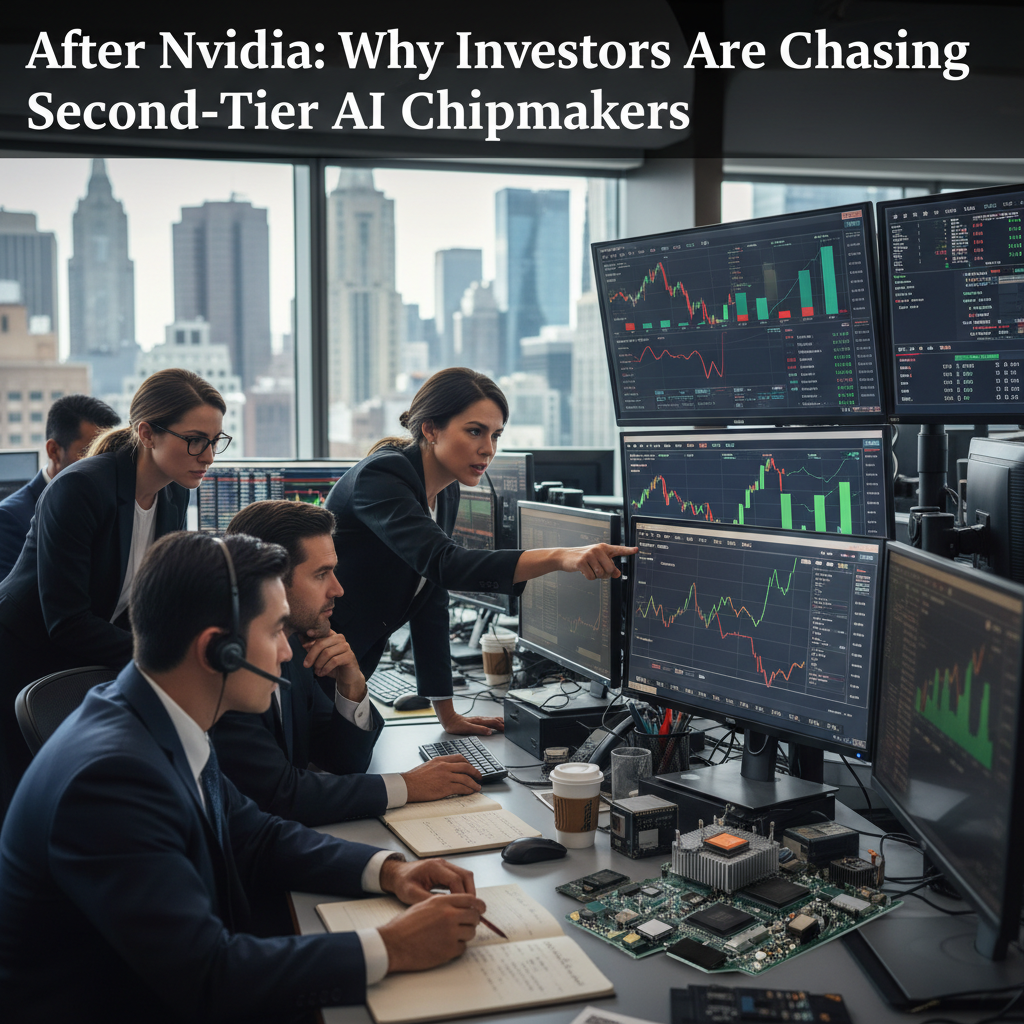
The short version: Nvidia ran so far and so fast that it left a hole between hype and actual capacity. Smaller chipmakers are sprinting into that gap. That creates genuine trading opportunities — and some traps — for anyone trying to catch the next wave of AI spending.
Why this matters now
Nvidia still dominates the headlines, but a familiar market pattern is in motion: when one name hoovers up capital, others get a chance. Smaller chip designers and IP vendors — the teams that sell parts of the AI stack rather than whole servers — look attractive because they trade at cheaper multiples, can rerate quickly, and often have more visible revenue ramps. What’s interesting here is how quickly capital repositions; in practice, though, the story is messier than the neat charts suggest.
Who's in the spotlight
- NVDA (+5.8): the benchmark. Its architecture sets expectations, and its product cadence has a big say in how tight supply feels across the sector.
- AMD (+2.3): a fast follower with growing data-center credentials and some recent wins on inference workloads.
- MRVL (+4.1): plays the logic and connectivity angle; benefits as AI networking needs rise.
- AMBA (+6.0): niche vision processors and edge AI designs feeding surveillance, automotive, and smart cameras.
- ASML (+1.8): the lithography bottleneck—an indifferent gatekeeper that still controls how fast capacity expands.
What traders are thinking
Three overlapping narratives are pushing money into these names:
- valuation hunt — investors stretching beyond Nvidia’s premium multiple;
- supply-chain play — equipment makers and IP vendors standing to gain as data centers scale AI out;
- product cycles — specialized inference chips and edge accelerators are entering customer hands faster than hyperscalers can roll out whole new fleets.
These aren’t mutually exclusive. They often pile on at the same time, which makes moves steeper and reversals quicker.
Catalysts to watch
- earnings that hint at margin improvement or confirm design wins with hyperscalers;
- supply-chain data showing GPUs and wafer capacity loosening or tightening;
- software integrations — a popular AI framework or SDK tie-up can re-rate a smaller vendor almost overnight.
Risks and counterpoints
- concentration risk is real. A big revenue miss at Nvidia, or a shift in model architectures, could scramble demand patterns fast.
- execution risk at smaller firms matters. Many have glossy road maps but lack scalable production, so hype can evaporate quickly.
- geopolitics and export controls remain wildcards. Access to advanced lithography and wafers is still subject to policy, not just economics.
A bit of history
This isn’t new. When PCs took off, Intel’s dominance spawned whole ecosystems — motherboards, memory, peripherals — that benefited as Intel set the pace. The AI phase feels similar, only faster and more software-dependent. That means winners will likely be the ones that pair silicon with sticky developer communities, not just a neat chip spec on paper.
What to do now (editorial take)
If you want exposure without putting everything on Nvidia, think diversification but be tactical: keep a core Nvidia position, add a couple of mid-cap suppliers with proven design wins, and tuck a small stake into niche edge players. Size those positions with execution risk in mind. Treat earnings and design-win announcements as moments to rebalance, not as signals to double down blindly.
Where this leaves you
Nvidia remains the axis of the AI economy, yet capital is drifting sideways to pick up extra exposure. That sideways trade can pay off, but it requires active management, conviction about execution timelines, and a tolerance for headline-driven volatility. If you like the story, layer your bets and expect a few false starts along the way.