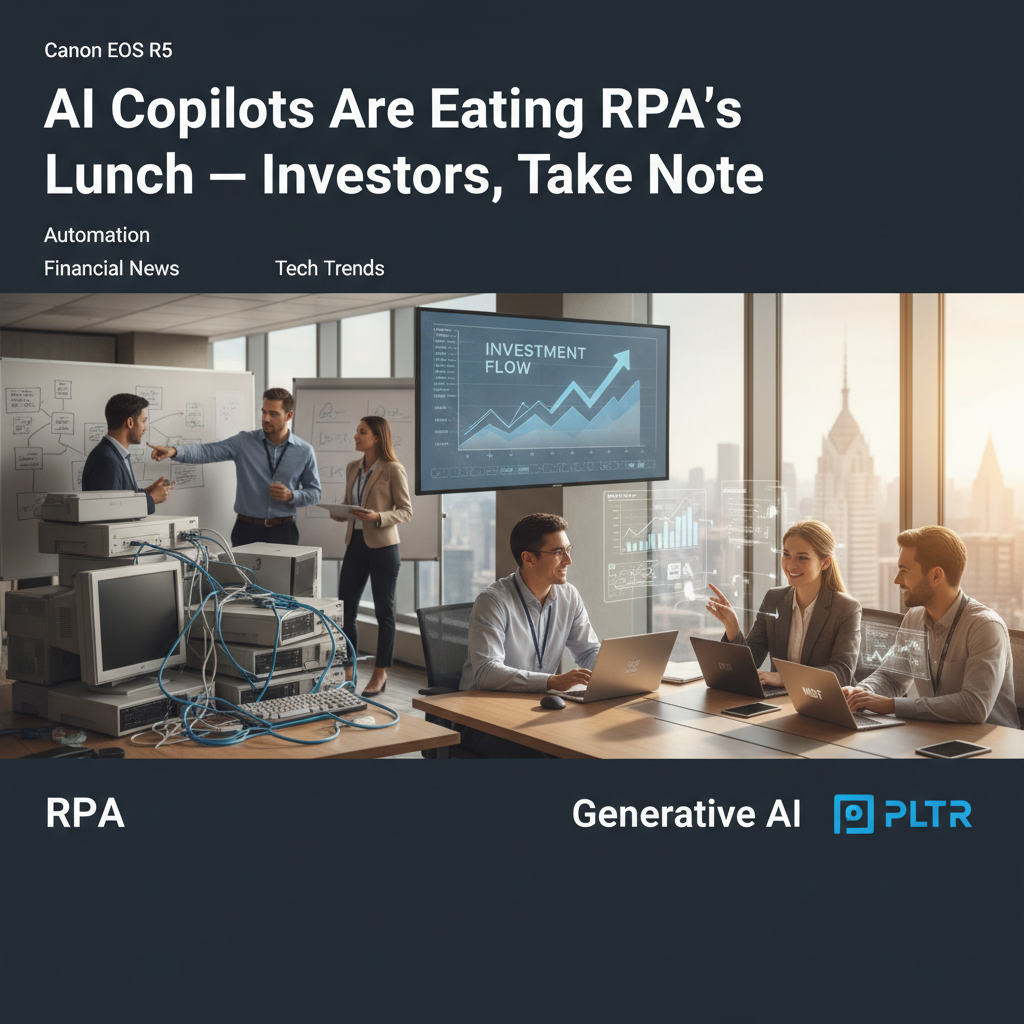
A pivot you can see from space. For a decade RPA — the rule-based bots that mimic clicks — promised cheap automation. It delivered cost cuts, sure, but mostly in tidy, predictable tasks. Now something different is scaling: generative AI copilots that synthesize documents, answer questions, and make judgment calls where brittle rules break down.
Why this matters now
- Copilots pair language understanding with workflow connectors. They don't just follow steps; they decide which steps to take. That can collapse a dozen RPA scripts into one conversational interface — which sounds tidy until edge cases appear.
- Major cloud and enterprise vendors are folding copilots into suites. Automation becomes a built-in feature, not a one-off implementation, and that changes procurement behavior.
What's interesting here is how those two trends interact: better language models plus native connectors mean firms can automate gray-area work that used to need a human. In practice, though, the story is messier.
Real-world flashpoints
- A mid-size insurer I spoke with replaced about 120 RPA scripts for claims intake with a single AI-driven pipeline. Manual triage fell roughly 40 percent. But accuracy dipped on complex claims at first, so they had to fallback to human review while the models were tuned.
- Retail contact centers are moving away from brittle IVR menus and macros. Copilots that summarize past orders, propose remedies, and even draft personalized discounts are improving first-contact resolution — and simultaneously raising compliance and audit concerns.
Investment implications
- The winners will be the companies that combine connectors, governance, and model monitoring into a coherent product. Pure-play RPA vendors are racing to embed LLMs; platform companies that host models and workflows (cloud plus apps) are positioned to capture the bulk of enterprise spend.
- For investors: focus on ARR growth tied to AI modules, not just seat-based licenses. Margins expand when vendors sell automation as recurring cloud services instead of one-off bot projects.
A quick caveat: some RPA vendors will adapt. Others won't. Market share is not a given.
Counterpoints and risks
- RPA is far from dead. For stable, rule-driven processes — payroll runs, certain reconciliations — lightweight bots remain cheaper and less risky.
- Generative models bring hallucination, data leakage, and auditability problems. Compliance teams and regulators will demand controls. That increases implementation effort and can slow return on investment.
Historical echo
Think ERP in the 1990s: huge promises, messy deployments, then consolidation that favored platforms with deep integration and capital for long sales cycles. The AI automation shift feels structurally similar — only faster, because cloud infrastructure and pre-trained models shave away years of bespoke engineering.
Short checklist for CIOs and CFOs this quarter
- Measure transaction-level accuracy, not only throughput.
- Negotiate contracts with model-update clauses and service-levels around hallucination or error rates.
- Favor vendors with credible cloud partnerships; it matters for both trust and margins.
- Define human fallbacks and instrument every input so you can trace mistakes.
We are moving from many brittle bots toward fewer, smarter copilots. That shift rewrites vendor economics and redirects where enterprise dollars flow. For investors the practical play is clear: prefer platforms that sell governed, subscription automation and discount those built on one-off RPA professional services.
Further reading
- Short pilot checklist: define fallbacks, instrument inputs, benchmark against human comparators.
This is as much a consolidation story as it is a tech story. Firms that get governance right will win the market — and the multiples.