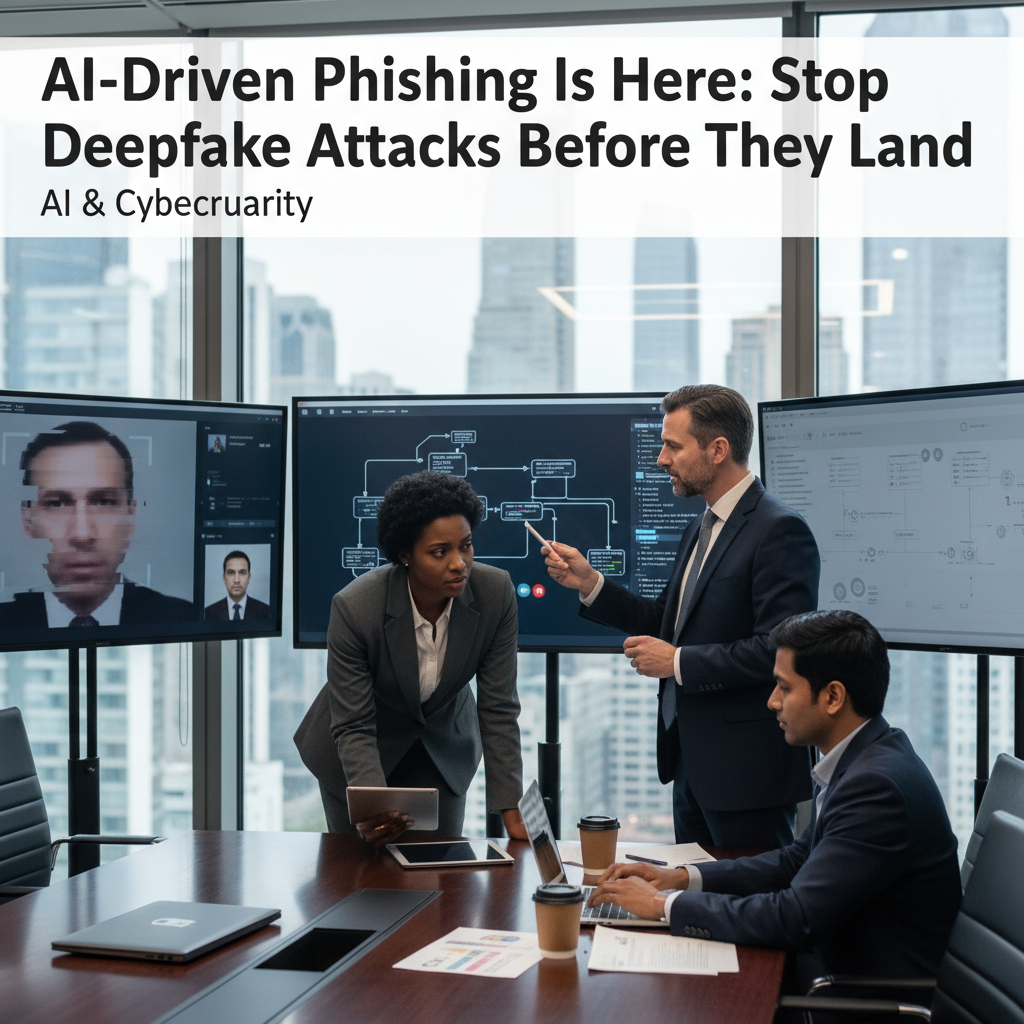
Every security team I talk to now has one new worry: AI makes social engineering believable at scale. The headline risk isn’t a zero-day exploit; it’s a human-sounding lie — delivered by voice, video or a tailor-made email — that gets past the defenses we thought were reliable.
This isn’t hypothetical. We’ve moved beyond one-off deepfakes into automated phishing kits that stitch together large language models for messaging, voice synthesis for executive impersonation, and cheap synthetic identities to open footholds. Think of it as the industrialization of fraud: what once demanded research and time rolls out now from an LLM prompt and a synthetic-voice API.
Why this matters now
- Speed and scale. AI cuts the time to craft spear-phishing from days to minutes.
- Quality. Modern models produce context-aware text; voice and video tools create assets that sound and look right to a distracted human.
- Accessibility. Ransomware-as-a-service and off-the-shelf phishing kits now bake in AI, so small criminal groups can punch above their weight.
A brief historical note: early voice scams relied on lucky recordings and bespoke effort. In 2019 a European company paid after a convincing voice impersonation — rare and expensive at the time. Today a malicious actor can scrape public profiles, prompt an LLM for a scenario that fits, synthesize a CEO’s voice, and run a multi-channel campaign for a few hundred dollars with little expertise.
Where defenses are falling short
Many organizations still treat phishing as an employee training problem. That misses the technical shift. Filters tuned to keywords and simple heuristics miss AI-crafted messages that mirror corporate tone. MFA helps, but SIM-swapping and clever social engineering still undermine naive deployments. And perimeter-first architectures assume attackers will be noisy — convincing impersonations are anything but.
Practical steps that actually help
- Deploy detection that reasons about behavior and intent, not just signatures. Look for unusual access patterns and subtle anomalies.
- Harden identity and attestations. Move beyond SMS MFA, require phishing-resistant FIDO2 keys where it counts, and use adaptive, risk-based checks.
- Make high-value requests out-of-band. Payments and wire transfers should have recorded, multi-party approval processes before funds move.
- Shrink the attack surface. Limit what leaders expose publicly, lock down autofill and data leakage, and watch for synthetic identity creation on consumer platforms.
- Test against the real thing. Phishing simulations should use LLMs and voice synthesis so your people and tooling face the same tactics adversaries will use.
Business and market implications
Vendors that bake AI-aware detection into identity-first controls will see stronger demand. Keep an eye on companies that merge endpoint telemetry with behavioral models — big endpoint players and identity specialists alike matter. CrowdStrike, Palo Alto, Okta — these names aren't the whole story, but they illustrate the types of capabilities investors and buyers will prize.
A caveat: not every AI-driven attack succeeds. Human processes and institutional friction still stop many schemes. Finance teams insisting on dual approvals, or simply a security-conscious culture, blunt a lot of campaigns. Still, relying on culture alone is wishful thinking; attackers are automating faster than many defenders.
A note for CISOs and boards
This is a people-process-technology problem. Prioritize phishing-resistant identity, telemetry-rich visibility, and regular tabletop exercises that include synthetic-AI scenarios. Boards should stop treating phishing as HR’s problem and recognize it as a board-level risk. The tools on both sides are now AI-augmented — the question is who adapts faster.