Why this matters now
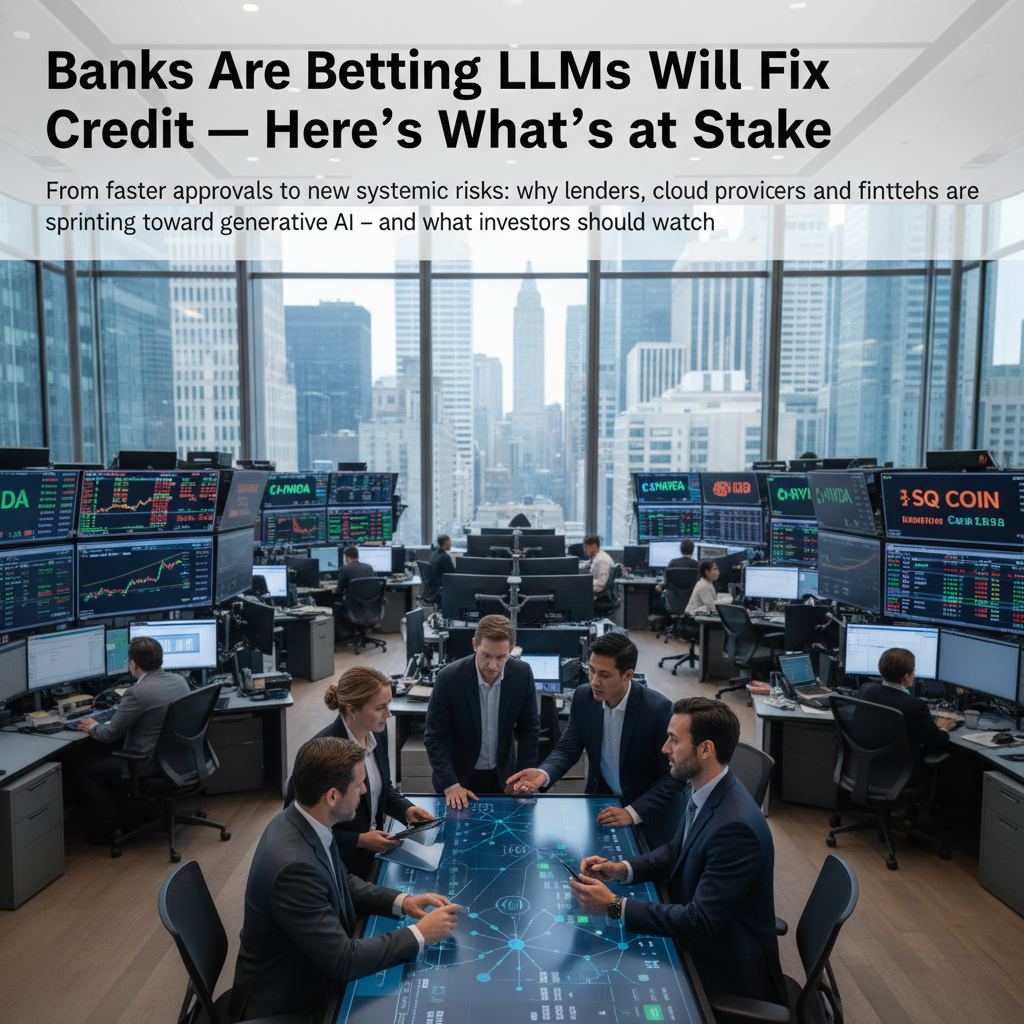
Large banks and fast-growing fintechs are moving past experiments and putting large language models into production. That’s a big shift because credit decisions sit at the messy intersection of profit, fairness and regulation. The upside is straightforward: faster underwriting, cheaper customer service, smarter fraud detection. The downside is knotty: explainability problems, model drift, and a regulatory horizon that already smells like pushback.
A short historical frame
Algorithmic underwriting itself is not new. Credit scoring went mainstream with FICO decades ago; algorithmic trading taught markets both efficiency and fragility. What’s new is scale and opacity. LLMs can ingest many more data sources than older models, but they’re also much harder to interpret.
What banks and fintechs are actually doing
- Rapid triage. LLMs summarize documents, check income statements and flag inconsistencies far faster than manual teams.
- Risk scoring augmentation. Models provide alternative signals to supplement traditional scores — useful for thin-file borrowers or gig workers.
- Compliance automation. Generative tools draft suspicious activity reports and speed case routing.
These are practical, revenue-adjacent uses that cut operational cost and shorten time-to-decision. In practice, though, they also amplify subtle biases and create new operational hazards.
The upside — and why a few players matter
This is leaning toward winner-takes-most. Banks still need chips, cloud capacity and model access. That funnels economic value to infrastructure and compute providers — GPU suppliers, cloud inference services, enterprise LLM vendors. So investors ask two simple questions: do you own infrastructure, or do you own a fintech that can productize superior credit signals without tripping the regulators? Either path can pay off, though the risks differ.
Risks to watch in the next 12–24 months
- Explainability and fair lending enforcement. Regulators could require disclosures or curtail models if lenders can’t demonstrate non-discriminatory outcomes.
- Model drift and adversarial gaming. LLMs can degrade or be manipulated in ways that classic credit models seldom face.
- Concentration risk. If a handful of cloud and model providers power most lenders, a single outage or policy change would ripple through credit markets.
A few counterpoints
Some critics are right: structured credit models still outperform on measurable predictive metrics for core, high-volume consumer lending. That hasn’t changed. But on the edges — small-business microloans, gig-worker credit, cross-border remittances — LLM-driven signals can create differentiation. So it’s not that LLMs replace everything; they reshuffle where gains are found.
Regulatory backdrop
Expect more scrutiny rather than blanket bans. Regulators tend to prefer guardrails and testing regimes. The practical result: pilots drag on, compliance costs rise, and fast-moving teams that skip rigorous validation risk enforcement headaches.
Signals worth tracking
- Announcements of bank-wide LLM deployments or major vendor tie-ups.
- New guidance from banking regulators about model validation or explainability.
- Earnings commentary from infrastructure providers on enterprise LLM demand.
Also watch product-level shifts: where firms start applying LLM signals versus where they rely on traditional scores. That gap will be revealing.
Where this leads
LLMs are not a magic wand for credit. They’re an efficiency multiplier with both offensive and defensive uses — and with structural risks that could reset competitive dynamics. For investors, infrastructure and compliance plays look safer. For executives, the priorities are rigorous validation, redundancy and transparent governance.
These choices matter beyond the next quarter. The way banks and fintechs adopt these models will shape lending economics and who gets credit for years to come.