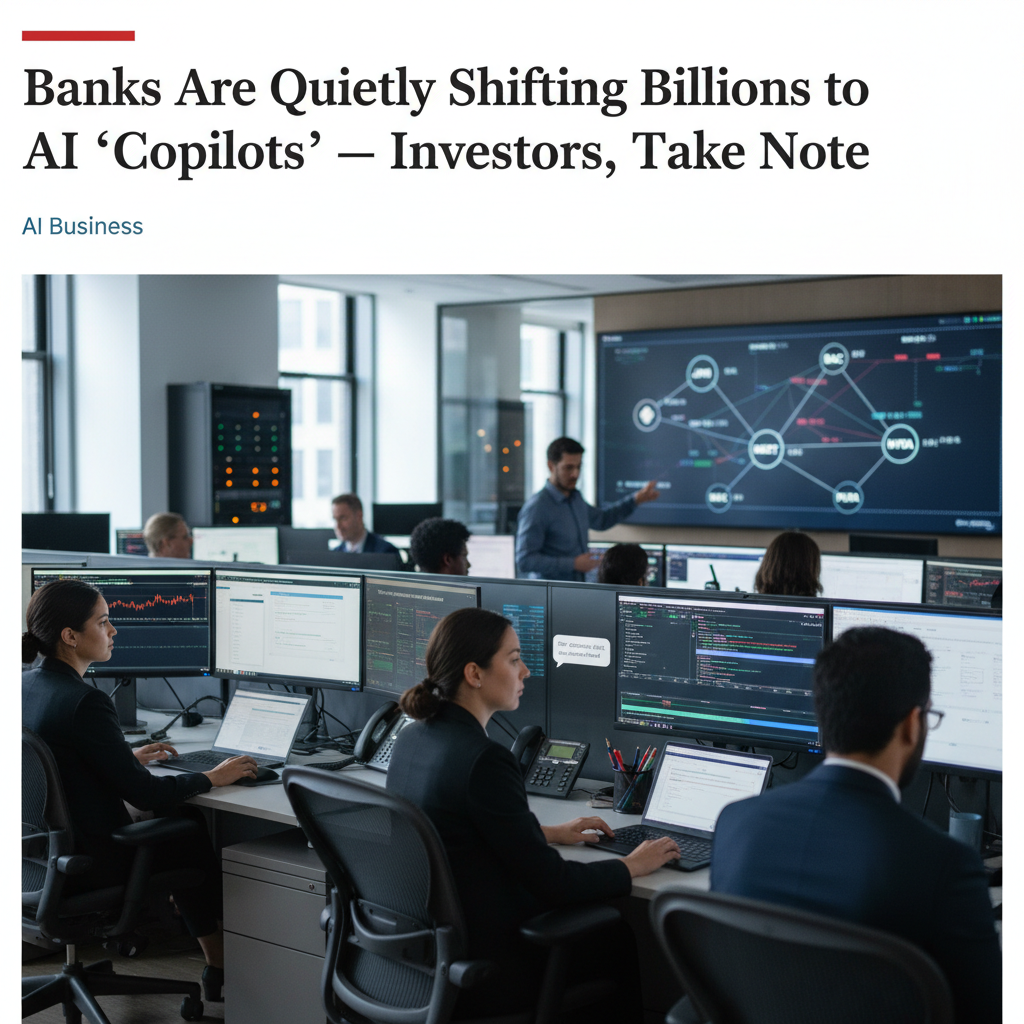
Banks are doing something they rarely advertise: quietly shifting big chunks of tech spending to build internal AI copilots. Not flashy consumer apps or PR chatbots — practical assistants that help traders scan markets, let loan officers underwrite faster, help compliance triage suspicious flows, and give contact centers the context to resolve difficult calls without escalation.
This is not vaporware. It’s the next bend in a decade‑long trend: from automated back‑office rules and algorithmic trading to dropping large language models and multimodal systems into human decision loops. Think of it less as automating a desk and more as outsourcing part of a brain.
Why now?
- Margins are thin and labor is expensive and sticky. Copilots promise productivity gains without the PR and political fallout of mass layoffs.
- Cloud providers and high‑performance chips finally make running these models practical. Banks can spin up capacity on Azure, AWS, or private clouds and lean on Nvidia‑class hardware instead of building new data centers.
- Competitive pressure from Big Tech and nimble fintechs. When challengers can say yes to a loan in minutes or offer noticeably better personalization, incumbents have to respond.
Where banks are placing bets
- Trading desks: copilots surface patterns, sketch scenario ideas, and compress mountains of research. They don’t replace strategists — they accelerate them.
- Credit and underwriting: models pre‑fill analyses, flag edge cases for human review, and run counterfactuals to stress decisions.
- Compliance and AML: AI helps filter noise from millions of alerts, classifying and prioritizing leads so investigators see the handful that matter.
- Client service: advisors get real‑time briefing notes tailored to a client’s portfolio and recent market moves. Handy, but messy in practice when data isn’t clean.
Underappreciated risks
- Vendor concentration. A small set of cloud and chip suppliers dominates the stack. That creates single‑point‑failure risk and bargaining leverage that’s easy to underestimate.
- Model risk and governance. Banks know how to validate credit scores and market models; governance for generative systems is still coming together.
- Regulatory scrutiny. Expect supervisors to narrow in on transparency, bias, and consumer protection as deployments scale.
- Operational surprise. Generative models hallucinate. When their output feeds front‑line decisions, that’s more than an annoyance — it can break things.
A bit of history helps. ATMs, algorithmic trading and robo‑advisors each promised efficiency and indeed created new business models — plus new failure modes. Copilots are different because they touch judgment, not just execution. That’s why the internal fight over ownership — IT vs. the business vs. risk/compliance — is so heated. People care about who gets to decide when the model is providing guidance versus making a decision.
Signals investors and executives should watch
- CapEx/OpEx shifts: rising cloud and chip line items, but headcount in routine processing areas staying flat or declining.
- Partnership choices: banks that run hosted models on Azure/AWS are buying speed; those building private stacks are buying control. Neither path is universally right.
- Vendor deals and M&A: expect acquisitions of firms focused on model governance, data labs, and verticalized copilots.
- Earnings language: companies will start reporting productivity metrics — cycle times, AML false‑positive rates, or the share of advisor‑client interactions answered by AI.
The consequence? This is not just another tool. It changes banking economics — faster decisioning, a different vendor map, and a new layer of model risk. Winners will be those that combine deep data, solid governance, and a clear cloud/compute strategy. Regulators, meanwhile, face a hard question: can supervision keep up with systems that make judgment calls every night?
One last thought: adoption won’t be uniform. Regional banks will move cautiously; the big banks will experiment more — not because they’re always smarter, but because they can absorb failed pilots. The real surprises are likely to come from midsize lenders that use copilots to undercut incumbents on speed and price. If history is any guide, surviving incumbents won’t be the most conservative — they’ll be the ones that start treating AI as part of their operating system, not an optional add‑on.