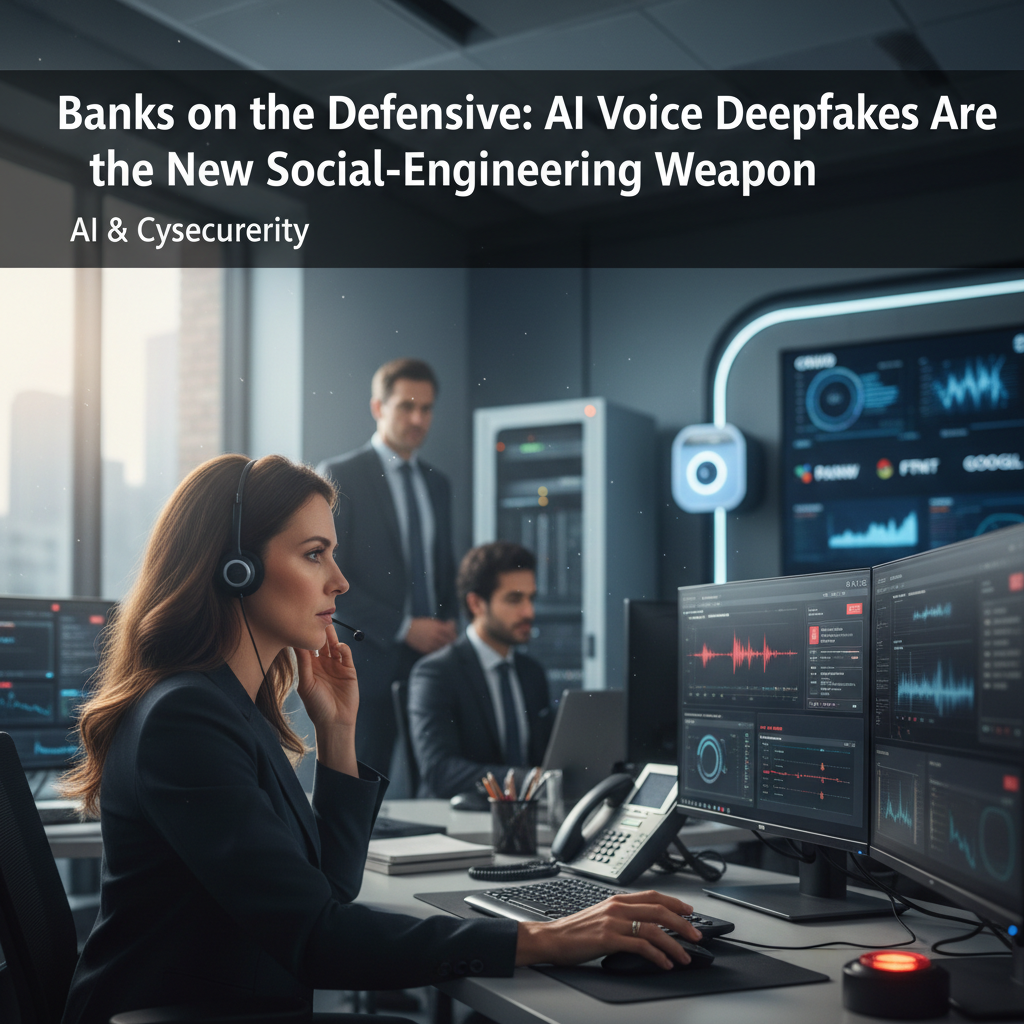
A quiet escalation
Banks thought they had phone fraud under control with voice biometrics and strict call scripts. That certainty is fraying. Widely available voice‑cloning tools can now mimic customers, executives, even account holders with chilling accuracy. This is not science fiction — it’s the latest turn in a decades‑long duel between social engineers and financial institutions.
Why this is happening now
- You no longer need a studio or advanced training; consumer tools can synthesize a believable voice from minutes of recording.
- Many call centers and legacy multi‑factor flows still treat a matching voiceprint as near‑proof of identity. That assumption is getting risky.
- These tools scale: once a voice model exists, attackers can automate calls, refine phishing scripts, and hit many targets quickly.
A quick detour: what’s interesting here is not only better impersonation. It changes the baseline for how people trust voice interactions.
A short history
Social engineering follows tech. In the 1990s it was spoofed caller ID and forged checks; in the 2010s it migrated to spearphishing and SIM swaps. Voice deepfakes are the next step, mixing old psychological tricks with machine precision. The consequence isn’t just more convincing lies; it’s that voice can become the new default for trust — and that default is fragile.
Where banks and fintechs are exposed
- Overreliance on a single channel: a matched voiceprint can be the only barrier between an attacker and a wire transfer.
- Old call scripts and payout incentives reward speed over caution, so front‑line staff often respond to urgency rather than verification.
- Regulation has not kept pace; compliance programs seldom require active liveness checks for voice authentication.
What defenders are doing (and can do better)
- Use liveness and spectral checks that hunt for synthetic artifacts, not just similarity scores.
- Shift to multi‑channel confirmation: a voice match should prompt an out‑of‑band check via app push, an SMS token, or a callback to a verified number.
- Add friction for high‑risk moves: cooling periods for transfers, dual authorizations, and mandatory in‑branch verification for large withdrawals.
- Fight tech with tech: defenders are training detectors to spot cloned audio signatures and odd calling patterns.
In practice, however, implementation lags. These controls work, but they add complexity and often collide with targets like call‑time metrics and customer convenience.
A measured take
Deepfaked audio is powerful, but not infallible. Synthetic speech still struggles in long, unscripted exchanges, and decent operational controls will stop many attempts. Still, the economics have shifted. Cheap scalability means tiny gaps can become openings for widespread fraud.
Practical advice — customers and executives
- Customers: don’t authorize big transfers on a single phone call. Ask for written confirmation or an in‑app approval.
- Executives: be careful with public speeches and interviews; short audio clips are fuel for cloning.
- Treasury and ops: require delays and multi‑party signoffs for unusual transfers.
Who stands to gain
Vendors with strong behavioral analytics and synthetic‑audio detection will get busier. Large cloud providers and fintechs that bake advanced voice‑fraud defenses into their stacks will have an advantage. Banks that treat security as part of the customer experience can turn safety into a differentiator.
Bottom line
Voice deepfakes are the predictable next move in social engineering. The necessary mindset shift is simple, if not always easy: do not treat one biometric or one channel as decisive. Layer signals, change incentives on the front line, and use detection tools to spot synthetic voices. Ignore this and the next call you answer could cost you more than money — it could cost your institution’s credibility.