Nvidia is not the whole story. Nvidia still dominates the conversation — and the benchmarks — but the next phase of AI adoption will reward a broader set of suppliers: the folks who power data centers, edge inference, and the software stacks that layer on top.
My take: markets have moved past single-name mania into more selective positioning. That opens opportunities — and traps. Valuations are tighter now, so the practical questions are about durable revenue exposure, margin levers, and who actually benefits when AI workloads migrate from prototype to full-scale production.
Why the shift matters
- GPUs sparked the era, yes. But cost, power and latency leave room for specialization. Expect growth in domain-specific accelerators, chiplets, and silicon tuned for inference.
- Networking and storage stop being mere line items. High-performance interconnects and memory bandwidth are the pipes that make large models usable in practice.
- Software and systems integration often determine the economics. Companies that bundle hardware with firmware, deployment tools and real-world support tend to capture more value.
A quick historical lens helps. In past compute cycles the visible star got most of the attention: CPUs in the 1990s, servers and virtualization in the 2000s, GPUs in the 2010s. Each wave produced a handful of long-term winners and many forgotten suppliers. This time the ecosystem is larger and more fragmented — which both multiplies opportunity and raises execution risk.
Names to watch and why
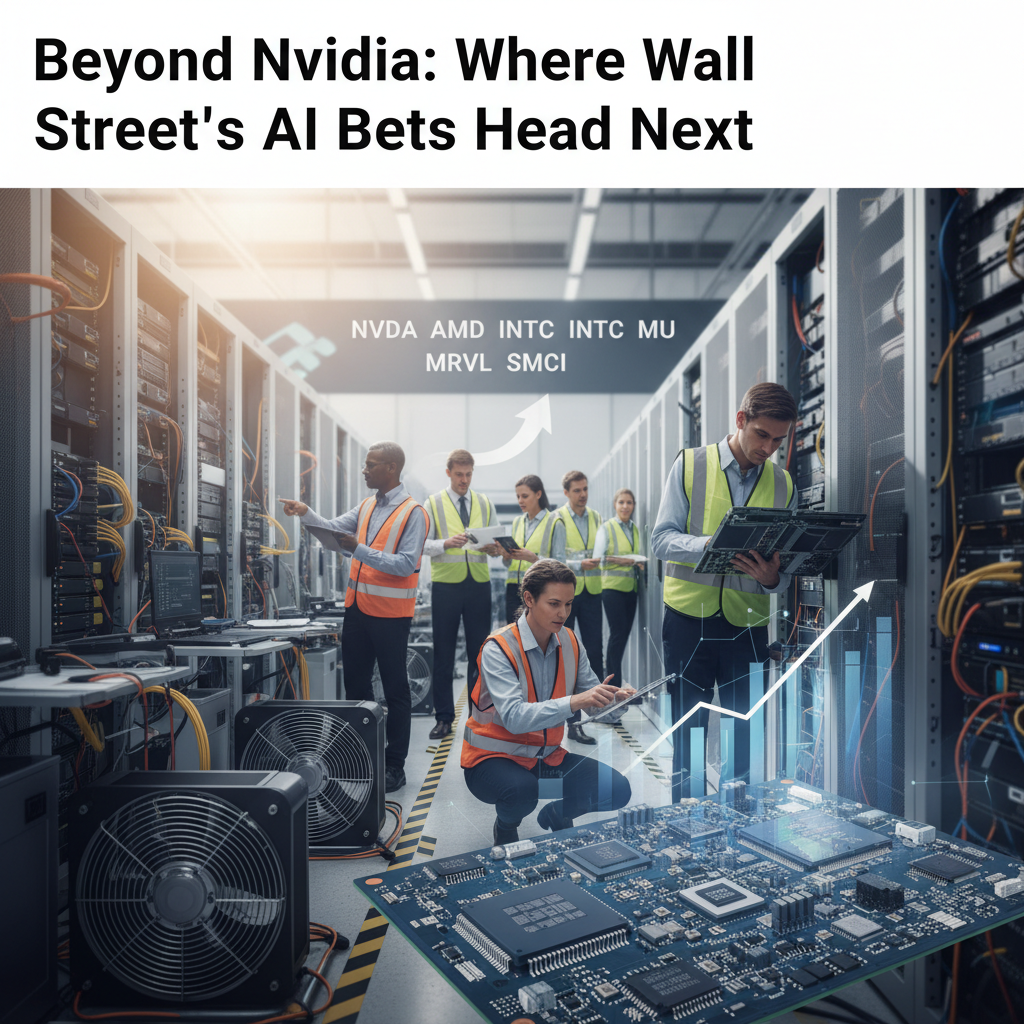
- NVDA: Still the benchmark for training. Main risks are concentration and any pause in hyperscaler spend.
- AMD: A clear upside if the MI-series gains traction. Cheaper GPU alternative and a play on aggressive server wins.
- INTC: Betting on a data-center rebound and custom accelerators; execution and cadence will determine relevance.
- MRVL: Networking silicon is underrated; lower-latency fabrics matter as model sizes and parallelism grow.
- SMCI: Server OEM exposure to AI racks — a way to play rising hardware consumption without being single-chip dependent.
- MU: Memory demand is a supporting trend as models balloon in parameter count and working-set size.
Counterpoint: a lot of small AI chip upstarts promise tailored performance, but adoption hurdles are steep. Integrating into existing datacenters, fitting into tooling ecosystems, and persuading hyperscalers to standardize on new silicon are nontrivial barriers.
Practical moves
- If you lack high-conviction insights, consider diversified exposure via AI or semiconductor ETFs rather than making single-stock bets.
- For individual stock picks, favor companies with visible revenue from AI workloads, active partnerships with hyperscalers, and growing software stacks that raise switching costs.
- Watch gross margin trajectories. Pure hardware sellers can see volatile results; firms that add software, services or system integration tend to defend margins better.
I remain skeptical of winners built on narrative alone. The most profitable opportunities will probably come from companies quietly solving cooling, power, networking and deployment — the plumbing behind the headlines. If you want to own AI for the long run, look past the GPU logo and into the systems that make massive models run reliably and cheaply.