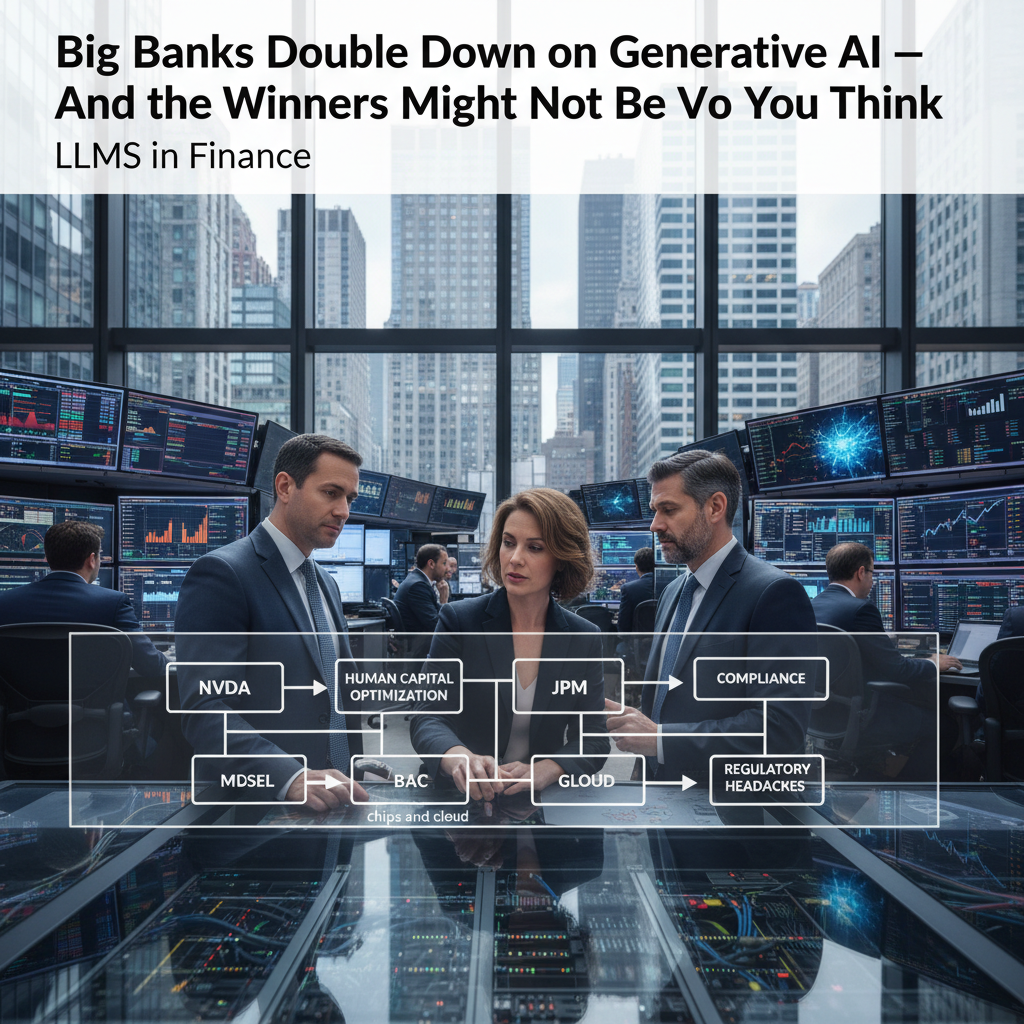
Banks are no longer experimenting — they're industrializing generative AI. What began as quiet proofs of concept over the past 18 months has turned into enterprise-wide rollouts: customer-service bots, credit-workflow automation, idea generation for traders, faster regulatory reporting. At first glance it looks like incremental efficiency. But that slow accretion can reallocate profit pools across investment banks, regional lenders and fintech partners.
Why this matters right now
Scale is finally meeting capability. Models are cheaper to run and more useful: fine-tuned LLMs can summarize contracts, flag suspicious transactions and draft research notes with a speed and nuance that would have sounded fanciful five years ago. For banks with sprawling data and heavy compliance needs, the ROI is immediate in ways past automation never was.
Then there is the chip-and-cloud squeeze. Demand for high-performance GPUs and cloud instances has jumped. Good news for hardware and cloud providers in the near term. Less good for banks that become dependent on a few suppliers — concentration risk is rising.
A brief historical frame
If you think back to the 2010s digitization wave — online trading, robo-advisors — that shifted specific product economics in retail. This moment is broader. Instead of one product moving, AI is creeping into every back-office ledger, every trader workflow and every compliance checklist. Previous automation ate manual tasks; generative models are starting to replace cognitive work. That difference matters.
Winners and losers — and why it’s not automatic
Short-term winners: chipmakers and cloud vendors. Banks tend to buy compute before they buy fancy software. So the companies selling GPUs and hosting win first. Legacy enterprise software vendors? They’re less well positioned if customers decide to stitch together models and data themselves.
Long-term winners will be firms that marry proprietary data, real domain expertise and disciplined model governance. A well-run regional bank with great customer data and tight model controls can outcompete a big bank that treats AI like just another cost line.
Potential losers include middlemen and low-margin service providers. If an LLM can draft a credit memo or reconcile ledgers, outsourced teams and old BPO contracts look fragile.
Regulation is catching up, but unevenly
Regulators have started amplifying model-risk guidance, yet they remain reactive. The same tools that speed compliance reporting can also introduce new auditability problems: hallucinations, data leakage, subtle bias in credit decisions. Expect banks to spend heavily on governance — explainability layers, rigorous data lineage and external audits. That spending will be real and it will slow some technologists down.
Three practical changes to watch this quarter
- Banks will start itemizing capital spends and strategic partnerships tied to LLMs on earnings calls. These will read more like infrastructure investments than software subscriptions.
- More M&A among smaller enterprise AI vendors and regional banks hunting white-label solutions.
- Regulators sharpening their attention on data residency and third-party concentration.
A useful caveat: AI does not mean instant margin lift
There’s a market tendency to conflate AI adoption with immediate margin expansion. Reality is messier. Integrating LLMs into mission-critical systems brings transition costs, retraining, slower release cadences under governance, and a heightened cybersecurity surface. Banks that rush without disciplined pilot-to-production playbooks will pay — in outages, in fines, in reputational damage.
What investors should watch
- Near term: chip and cloud providers hosting financial workloads. They will show the clearest revenue bumps from bank spending.
- Medium term: banks with clear data advantages and public commitments to model governance. Those institutions are the ones likely to turn pilots into higher RoE, not just one-off cost savings.
- Key risks: vendor concentration, regulatory friction and feedback loops that could amplify model errors across the system.
The practical read
Generative AI in finance isn’t a single product story; it’s a systems shift. Expect hardware and cloud to be the early winners, a messy but profitable phase for disciplined banks, and an increasingly tight regulatory environment as projects move from experimental to operational. Smart investors will think in layers — buy chips and cloud exposure now, then position around proprietary data and governance for the next cycle.