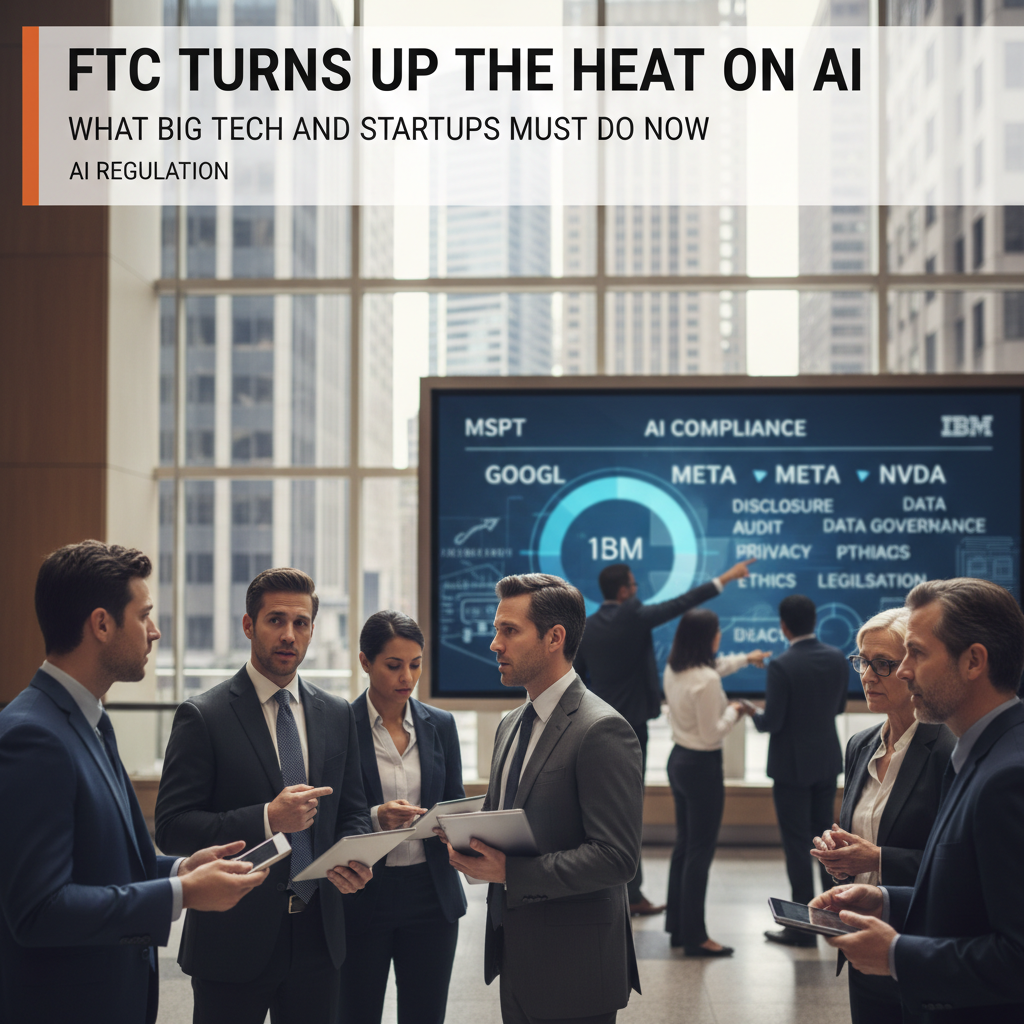
The shift is no longer theoretical. The Federal Trade Commission has moved beyond advisory memos and is now using targeted enforcement against companies that deploy opaque or misleading AI systems. For businesses and investors, compliance has to be treated as an operational function — not a one-off checkbox.
Regulatory context
Regulators have widened their focus in the past two years. Privacy was the easy entry point; now algorithmic harm and transparency are center stage. The FTC, long a consumer-protection agency, is increasingly treating unlabeled generative models and hidden bias as unfair or deceptive practices.
Pressure is coming from multiple directions. The SEC is watching how AI factors into financial advice and disclosures. The CFPB has its eye on automated credit decisions. State legislatures are proposing disclosure rules for hiring and surveillance. These efforts don’t always line up neatly, but they add up.
Why this matters now
Enforcement raises more than legal exposure; it raises the cost of bringing models to market. Explainability isn’t an academic exercise any more — it’s a potential subpoena, a civil penalty, or the basis for an injunction. That shifts product timelines and budgets.
For investors, governance and compliance spending should be treated as a differentiator. Firms that can show audit trails, data provenance and robust red-team testing will attract better valuations and face lower legal tail risk.
Concrete examples and risks
- Digital advertising: an AI-generated celebrity endorsement used without disclosure — whether political or commercial — looks like deception and will draw FTC scrutiny.
- Fintech: robo-advisors and automated underwriters that rely on proxy variables can create disparate impact and transparency problems; expect both FTC and CFPB attention.
- Startups using third-party models: vendor opacity plus weak internal controls is a compound risk. Liability multiplies when you don’t know what’s inside the black box you relied on.
A short history lesson
This is not a sudden fluke. Think of early algorithmic bias cases in the EU and U.S., then add high-profile deepfakes and the emergence of the EU AI Act and NIST standards. Enforcement typically trails technology, but once regulators identify bad actors, penalties and precedent follow faster than many expect.
What companies should do this quarter
- Treat model risk like financial risk: keep immutable logs for training-data provenance and model versions.
- Label AI-generated content and automated decision outputs as a mandatory operational step.
- Run independent fairness and safety audits; keep red-team results and mitigation steps on record.
- Tighten procurement: require transparency and indemnities from model vendors.
- Brief the board on AI exposure and maintain a dedicated incident-response playbook.
Investor playbook
- Re-score companies that disclose strong governance and third-party audits more favorably.
- Watch compliance spend as an early signal. Rising costs can mean disciplined risk management — or they can indicate business-model stress. Context matters.
- Prefer firms building explainability tools, model registries and governance platforms. These appear to be becoming essential infrastructure rather than optional overhead.
Counterpoints and trade-offs
Some rules, if too prescriptive, could slow innovation and hand advantage to competitors in jurisdictions with looser requirements. Enforcement is also uneven across agencies, which creates real uncertainty for multinational firms until standards align.
So what now?
Regulatory behavior has shifted toward enforcement. Executives must choose between speed and stronger governance — and those trade-offs will shape who survives regulatory scrutiny and market corrections. Companies that treat AI compliance as a productized capability, not a legal afterthought, will almost certainly be in a better position when the next storm arrives.