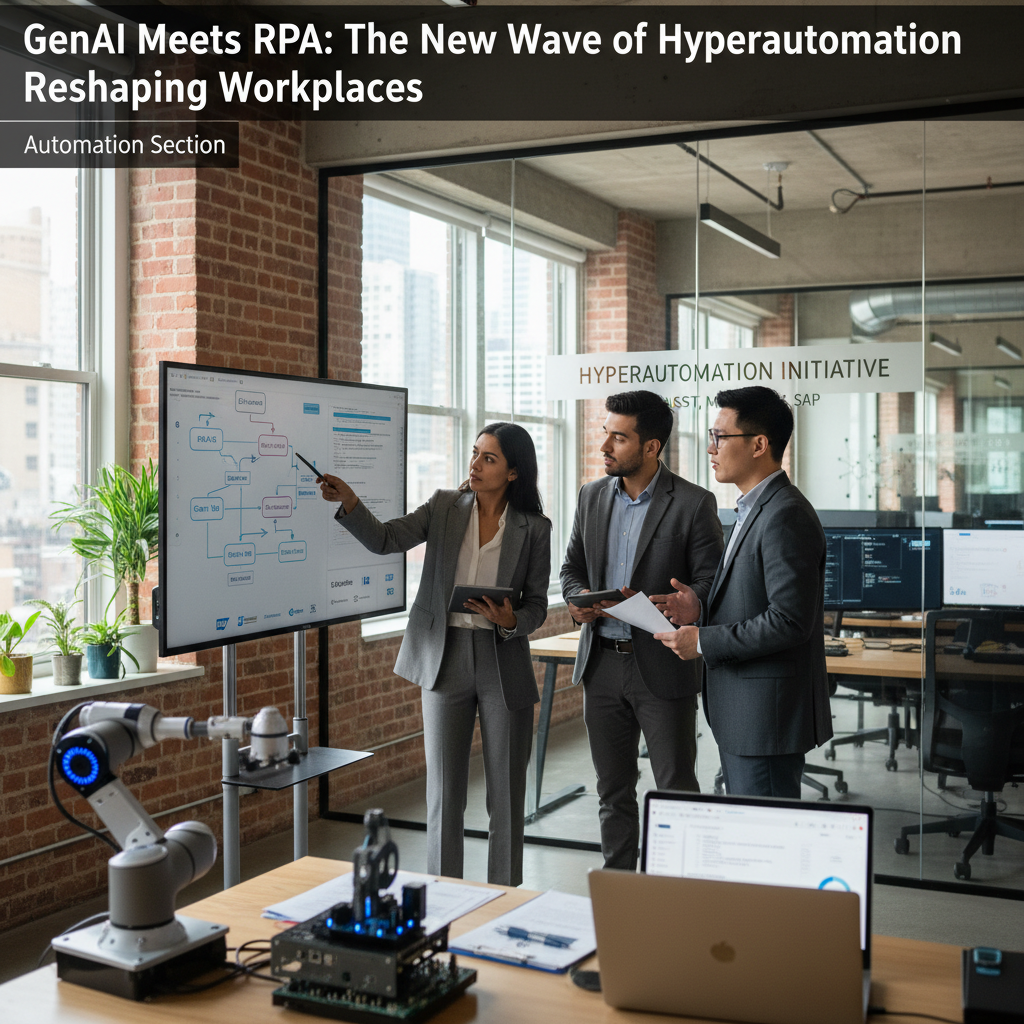
A surprising pivot. What used to be a steady, years-long crawl toward efficiency — rule-based bots that click, copy and paste — has turned into a sprint. Generative AI is being grafted onto RPA platforms and vendors now call the result hyperautomation. These systems no longer just execute tasks; they can read documents, draft responses and nudge workflows to change as they run. Strange to say, the automation world just got messy in a useful way.
Why this matters now. Two enablers collided: cheap cloud compute and accessible large language models. The practical consequence is that nondevelopers can train automation with plain-language prompts, cutting deployment from months to days. That matters — a lot — for finance teams with long backlogs, call centers swamped by routine tickets, and compliance units that can’t keep up.
Concrete wins and quick payoffs. Companies report real reductions in cycle time on repetitive but expensive work:
- Accounts payable: automatic invoice ingestion, validation and exception routing, which removes many manual checks.
- Loan servicing: models parse supporting documents to prefill decision packets for underwriters.
- Customer support: hybrid bots draft replies for agents to edit, boosting throughput while keeping humans in the loop.
These are not lab curiosities. They save time, free up people for higher-value work, reduce late fees and speed up customer response.
But there are caveats. Generative models hallucinate, and business processes often carry legal or regulatory consequences. So:
- Human-in-the-loop controls remain required for higher-risk flows.
- Data governance needs rethinking: prompts and model outputs can leak sensitive data if unmanaged.
- Auditability gets harder when decisions arise from learned behavior instead of explicit rules.
In practice, that last point is the one that keeps compliance teams awake at night.
A short history lesson. RPA started as a desktop trick — macros on steroids — and over a decade became enterprise orchestration. Gen AI is not replacing RPA; it extends RPA into ambiguity, into the places where rules fail and language dominates. Think less photocopier and more junior analyst who can read a messy form and summarize it.
Who gains and who is exposed. Winners will be organizations that pair automation with clear governance and retraining programs. Small and midsize firms stand to benefit because low-code copilot features lower the technical bar. In the near term, frontline workers aren’t necessarily the most at risk; it’s the middle-tier roles that act as repeatable information transformers who are most exposed.
Regulatory and security lens. Regulators will adapt unevenly. Financial firms will face pressure to show explainability and provenance for automated decisions. Security teams should treat models like another vendor: enforce access controls, log prompts, and sanitize any inputs used for training.
Where vendors and investors are looking. Big automation players are embedding generative features — think platform bets from UiPath and feature integrations from Microsoft Power Automate — which has pushed this onto boardroom agendas. Investors will watch adoption metrics and enterprise subscription trends as signs of staying power.
Watch for a few demand signals: standardization of audit trails for model-driven decisions, a rise in automation insurance and contract clauses around AI liability, and new service firms that tune and certify automations for regulated industries.
The upshot: generative AI is a force multiplier for task automation, but the winners will be the systems that pair speed with guardrails. Expect fast uptake, messy early projects, and then consolidation as best practices and regulation settle.
If you run operations, start mapping repetitive processes today. Classify them by risk. Pilot a human-in-the-loop generative automation on a low-stakes workflow. The quickest path to value is iterative improvement, not wholesale replacement.