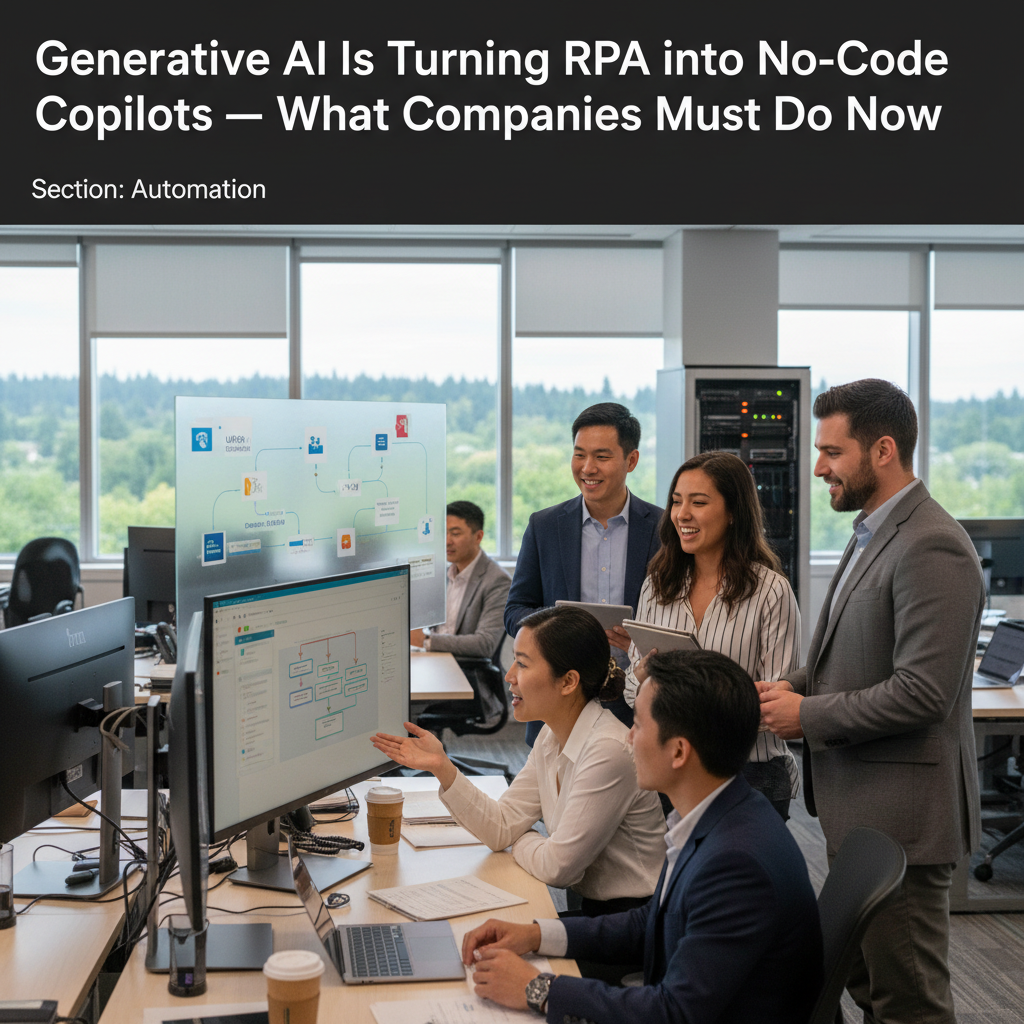
The first wave of robotic process automation promised bots that could mimic keystrokes and shave hours off repetitive tasks. The second wave, driven by generative models, is less about mimicry and more about judgment: reading emails, classifying claims, summarizing contracts and suggesting next steps. That shift turns RPA from a developer toolbench into a no-code copilot for line-of-business teams.
Why it matters now
- Large language models embedded in automation platforms blur the line between tidy, structured workflows and messy real-world inputs.
- Vendors from Microsoft Power Automate to UiPath are treating LLMs as native elements, so nontechnical users can assemble automations with prompts instead of scripts.
- For the US enterprise market this means faster pilots and wider uptake — and, yes, a new wave of governance headaches at the same time.
Concrete examples (not buzzwords)
- An insurer routes customer emails through a generative layer that extracts intent, suggests coverages and pre-fills claim forms for a human to approve. The older RPA approach would have needed brittle rules and months of tuning.
- A finance team builds a no-code flow to reconcile invoices: the model reads vendor emails, the bot checks ledgers, and exceptions are flagged with a plain-language rationale for auditors.
What's interesting here is how much of the grunt work disappears, but also how much responsibility shifts to designing good checks.
What CIOs and CFOs should watch
- Accuracy versus explainability. These models are excellent at fuzzy matching, but they can also hallucinate. Better to treat outputs as proposals — suggest actions, don’t let models make irreversible changes without review.
- Governance and traceability. Logs, change controls and model-version tagging matter almost as much as API keys; think of models and prompts as code that needs the same discipline.
- Skill shifts. Expect fewer monolithic workflows coded from scratch and more demand for process designers who understand prompts, data lineage and monitoring.
Risks and caveats
- Gains are real but uneven. Low-variance, high-volume tasks are straightforward wins; complex judgment work still needs humans.
- Security and compliance remain weak spots. Sending sensitive data to third-party models can trigger regulatory constraints, which is pushing some companies toward private or on-prem deployments.
- Cultural friction is real. Citizen developers can accelerate helpful change — and create shadow automations that IT can’t manage unless governance catches up.
A short playbook for pilots
- Start hybrid: automate extraction and routing, but require human review for high-risk decisions.
- Measure outcomes by business metrics, not just bot uptime. Track error-rate, cycle time and auditability.
- Treat prompts like code: version them, test edge cases and keep a prompt library.
- Build fallbacks: if model confidence is low, route to a human or a deterministic rule.
- Retrain staff: process design, prompt work and monitoring become core competencies.
Do not expect overnight perfection. Expect iteration, surprises and the occasional rollback.
Longer-term implications
Generative models are making automation as accessible as spreadsheets once made accounting approachable. That lowers technical barriers and will probably benefit nimble teams and midmarket firms faster than large, monolithic IT organizations that resist reorganizing around modular, observable workflows. The competitive gap may widen between quick adapters and legacy-heavy incumbents who don’t change how they operate.
This is not a passing startup fad. The companies that combine bold pilots with disciplined operational controls — and that treat prompts and models as governable assets — will be in the best position to win.
Pedro Marini