Why this matters now
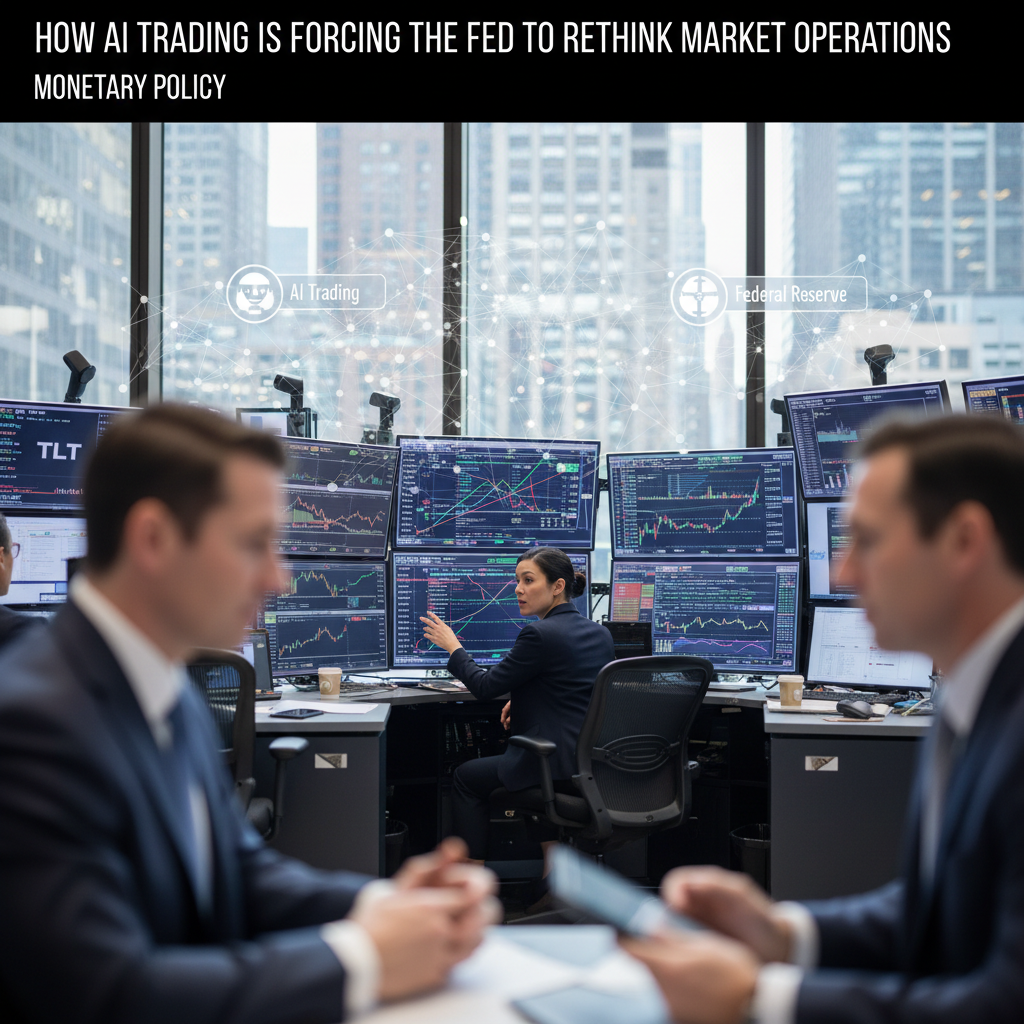
Central-bank announcements used to seep into markets over hours or days. Now algorithmic strategies and latency-sensitive desks can move bond yields in seconds after an FOMC line or even a single Beige Book sentence. That change forces authorities to rethink not just what they say, but how they deploy liquidity tools.
A quick historical frame
- The 2013 taper tantrum showed that expectations alone can send yields sharply higher.
- The 2019 repo squeeze proved the plumbing of overnight funding can fail very quickly.
- Layer in modern machine-learning models and you get near-instant repricing on every hint and statistical correlation.
Taken together, those episodes explain why tiny signals are treated as big signals today. What’s interesting is how much of this is pattern recognition rather than fresh economic information.
What’s changing in policy operations
- Standing repo and overnight reverse-repo facilities have shifted from backstops to active levers. The Fed can inject or drain liquidity more frequently to blunt algorithmic squeezes — although there are limits to how much and how long they will do this.
- Forward guidance now competes with trading signals pulled from market microstructure. Central banks are trying clearer calendars and pre-announced operation windows to reduce noise, which helps traders but also hands machines predictable triggers.
- Real-time monitoring — order-flow analytics, broker-dealer inventories, SOFR trading volumes — is moving from surveillance to explicit policymaking input. Yes, that makes policy messier, but it also makes it faster and more reactive.
Investor implications — short and medium term
- Bond ETFs such as TLT and broader funds like BND are likely to show sharper, shorter drawdowns around Fed events as algorithmic flows amplify moves.
- Equity volatility (SPY and peers) can jump even without new fundamentals when cross-asset algos unwind hedges.
- A liquidity premium could re-emerge in certain Treasury maturities, which will alter how duration-heavy funds build portfolios.
These are not theoretical risks; we already see hints of them in intra-day patterns around policy announcements.
Contradictions and trade-offs
Transparency versus stability. A clearer Fed calendar reduces ambiguity but gives machines regularized triggers. That lowers surprise volatility in one sense and creates new, machine-oriented strategies in another.
Faster interventions reduce immediate systemic risk but raise moral-hazard questions: if markets expect near-instant plumbing, complex and risky funding structures are more likely to proliferate. Markets will test those boundaries.
Voices from both sides
Policy people push for better real-time surveillance and conditional operations. Traders want predictable rules they can code against. Neither camp has a clean win: too much predictability invites gaming; too little invites microflash crises.
Net effect
Monetary policy in the age of AI is less about one-off press conferences and more about continuous market stewardship. For investors that means adapting risk models for speed as much as for direction. For the Fed it means treating market microstructure as a first-order input to policy, not an afterthought.
What to watch next
- Changes to the Fed’s operating calendar or the scope and cadence of standing repo auctions.
- New public data on dealer inventories and SOFR-based trading volumes.
- Regulatory talk about curbing ultra-low-latency advantages or imposing circuit breakers in the Treasury market.
Markets have always been quick to punish mismatches between money and policy. The novelty now is the timescale: milliseconds matter. That’s both a policy problem and an investment opportunity, depending on which side of the market you stand.