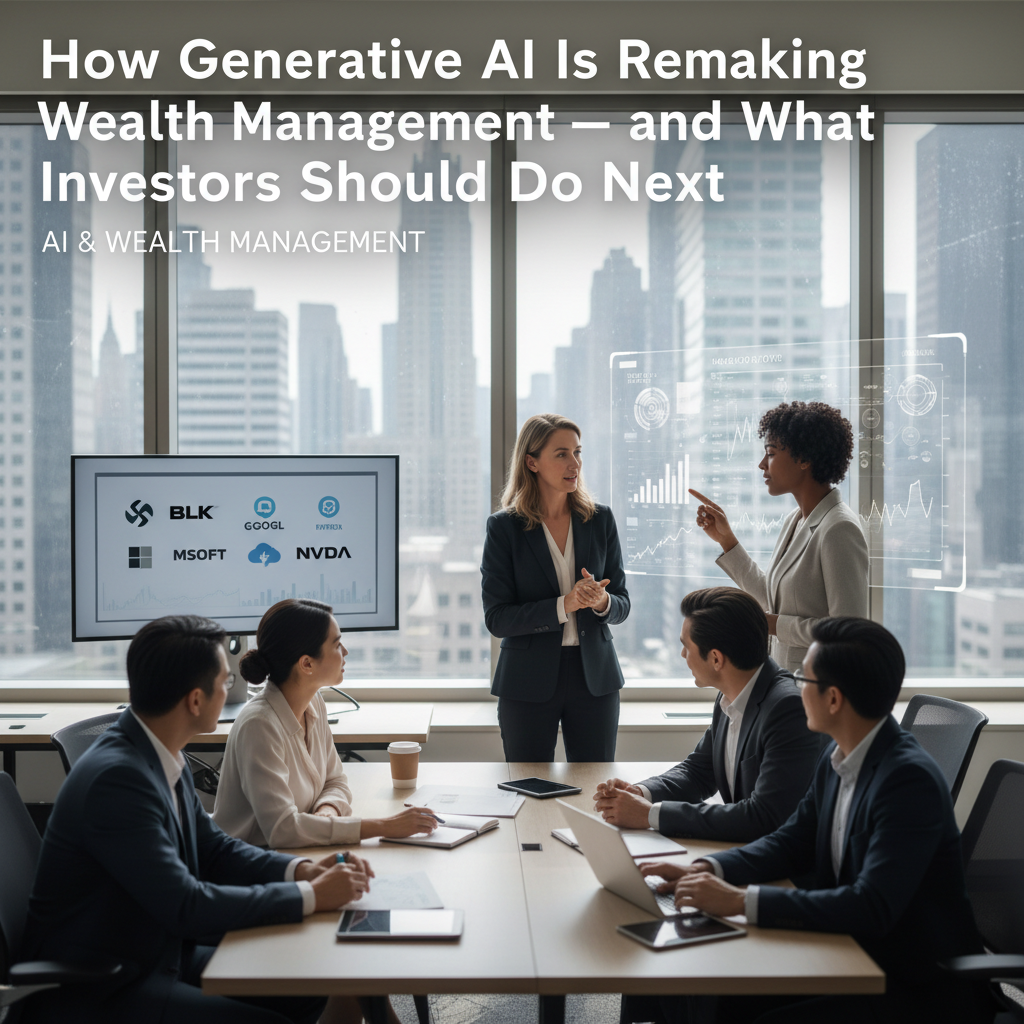
The shift is not incremental — it feels like a new business model.
Wealth managers learned automation once when robo-advisors simplified portfolio construction. Now generative AI is doing something different: moving past rebalancing rules to produce tailored scenarios, plain-language recommendations, and client narratives at scale. It’s a familiar pattern, but faster and more disruptive.
Why this matters now
- Large language models let advisers simulate tax-aware trades, run life-event scenarios, and draft client communications in minutes rather than weeks. That cuts down labor and lets advice feel more personalized.
- Major custodians and midsize RIAs are rolling out AI toolkits on public clouds. That shifts competition toward who controls the data, who tunes the models, and who manages model risk over time.
Where value is being captured
- Front office: quicker financial plans, deeper client conversations, and more concrete upsell opportunities tied to bespoke advice.
- Operations and compliance: automated KYC, trade surveillance, and clearer audit trails — if implemented carefully, these can shave overhead.
- Fees: as basic advice becomes cheaper and more widely available, pressure on traditional fee models increases and client expectations rise.
Trade-offs and real risks
- Model risk is real. LLMs hallucinate; bad outputs in finance can be costly. Human review is not optional — it’s the safety valve.
- Vendor concentration matters. Relying on a handful of cloud and model providers creates exposure to outages, licensing changes, and sudden price moves.
- Regulation will tighten. Expect tougher questions about accountability, explainability, and consent for data use. Firms that treat AI as a black box will be exposed.
A quick historical perspective
A decade ago robo-advisors removed cost from basic portfolio management and pushed incumbents to add value through advice and service. Generative AI repeats that story but accelerates it: automation eats middle-office time while making bespoke advice scalable. The market is splitting — boutiques sell differentiated service, larger firms compete with integrated tech stacks — and both approaches can work, for different reasons.
What this means for investors and advisers today
- For investors: demand transparency. Ask how an adviser uses AI, who reviews outputs, and how recommendations are validated. Insist on data protections.
- For advisers: focus on explainability, rigorous audit logs, and diversifying vendors. Train people to turn model outputs into defensible, client-ready advice.
Practical moves that actually change outcomes
- Start small and focused: tax-loss harvesting, cash-flow scenario testing, or KYC automation are good initial bets.
- Build golden datasets for model tuning so outputs match fiduciary standards and institutional practice.
- Use layered controls: backtest before deployment, monitor in real time, and schedule periodic third-party audits.
The practical point: generative AI is not a drop-in replacement for fiduciary judgment, but it can be a force multiplier. Firms that combine disciplined risk management, clear client communication, and a pragmatic vendor strategy will gain disproportionate benefit. Firms that treat AI as merely a cost-saving button risk client harm and regulatory trouble.
If you manage money or entrust someone to do it, the relevant question is no longer whether your adviser uses AI. It is how they use it, who watches the models, and how your outcomes are protected.