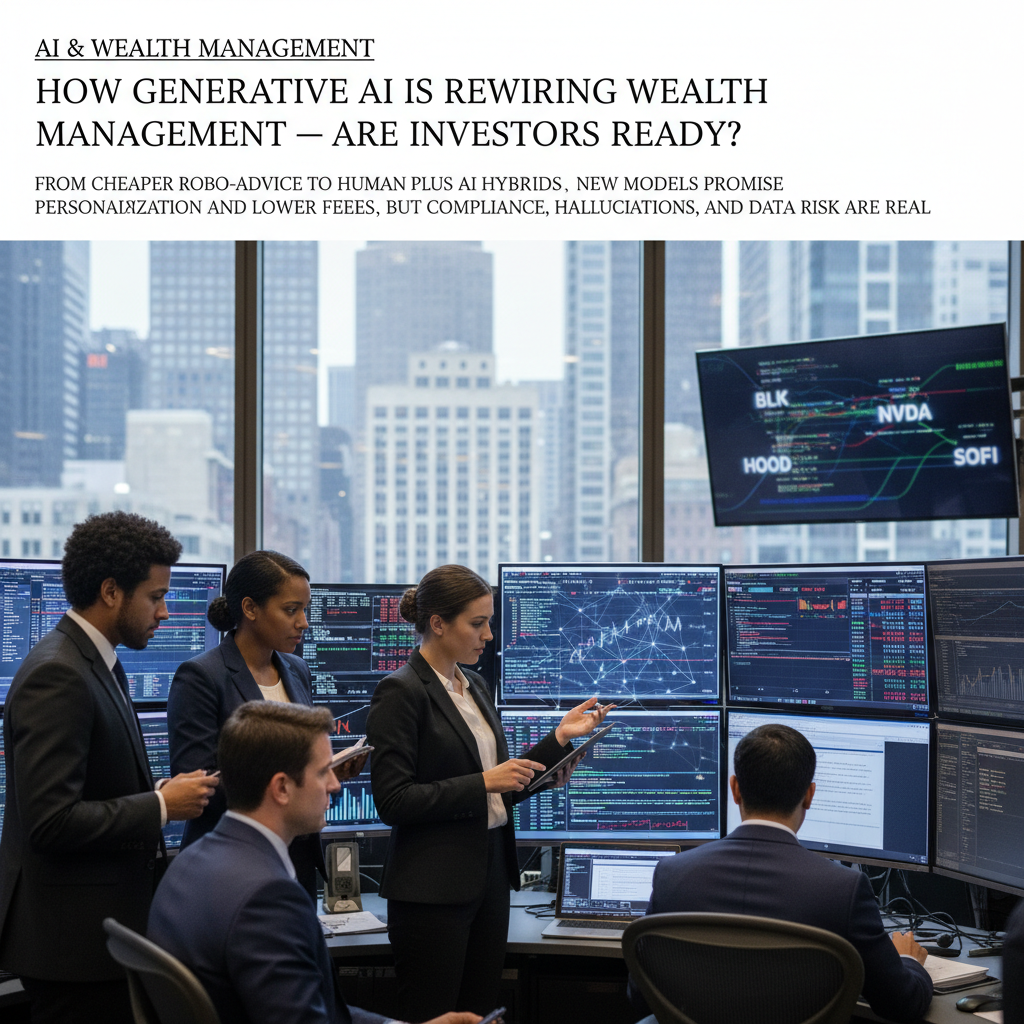
The moment feels familiar
First came discount brokers, then ETFs. Now generative AI is forcing the same kind of rethink about who gets paid for financial advice — and why.
What changed
Robo-advisors already drove fees down by automating portfolio construction. The new wrinkle is large language models and generative systems adding personalization that used to be expensive or impractical at scale. Imagine tax-loss harvesting that understands a client’s supplier-chain exposure, or a retirement income plan drafted in plain language at 2 a.m. — and good enough for a large swath of clients.
Why this matters for investors
- Lower ongoing fees. Automating labor-heavy tasks squeezes advisory margins. Expect more flat-fee or subscription offerings aimed at younger clients.
- Finer personalization. Behavioral nudges, goal-focused prompts, and conversational financial plans are now realistic for mass-market users.
- Faster product iteration. Models can reprice or re-evaluate funds and new tax rules in days, so portfolios can be updated far sooner than before.
The tradeoffs — and why they matter
This is not just faster software. Three risks stand out.
- Hallucination and explainability. Models sometimes sound confident while being wrong. That is not theoretical when sequence-of-returns risk can derail a retirement.
- Data and privacy exposure. Conversational planners need client records to be useful. How firms store, index, and vectorize that data changes the risk profile.
- Regulatory and fiduciary uncertainty. Regulators are watching, and an algorithmic mistake could spawn litigation over whether adequate human oversight existed.
One useful way to think about the change: it’s less like the arrival of online brokerages and more like online brokerages and index funds arriving together. Cost compression plus mass personalization amplifies the effect.
Concrete things investors should look for
- Does the advisor validate models with out-of-sample stress tests and keep a record of that validation?
- Is there a real human escalation path for tail-risk or unusual scenarios, not just a chatbot fallback?
- How is client data used, stored, and anonymized when it’s fed into models or vector databases?
A quick read on the market
Large asset managers and custodians are mostly embedding these tools into platforms, not replacing advisors overnight. Expect partnerships and licensed tools instead of sweeping layoffs. Fintech challengers will push on price and user experience, using chat layers to speed onboarding and to nudge clients toward additional products. Independent advisors can win by pairing AI-driven operations with hands-on judgment for complex tax, estate, and behavioral issues.
What to do now
- Ask your advisor whether recommendations are produced or aided by machine-generated outputs, and how those outputs are validated.
- Be alert for shifting fee structures — more subscription or performance-linked models are coming.
- Treat these tools like any third-party vendor: demand incident reports and a clear escalation protocol for mistakes.
Final thoughts
These systems will lower costs and broaden access to decent financial planning, but they also concentrate risks that aren’t obvious on a quarterly statement. A pragmatic stance makes sense: accept the benefits — better service, lower fees — but insist on accountability, human review, and evidence that models hold up under stress.
The upshot: the way advice is delivered will change. The underlying value of careful planning does not. Investors who test tools, ask direct questions, and favor advisors who combine automated capabilities with solid governance will probably come out ahead.