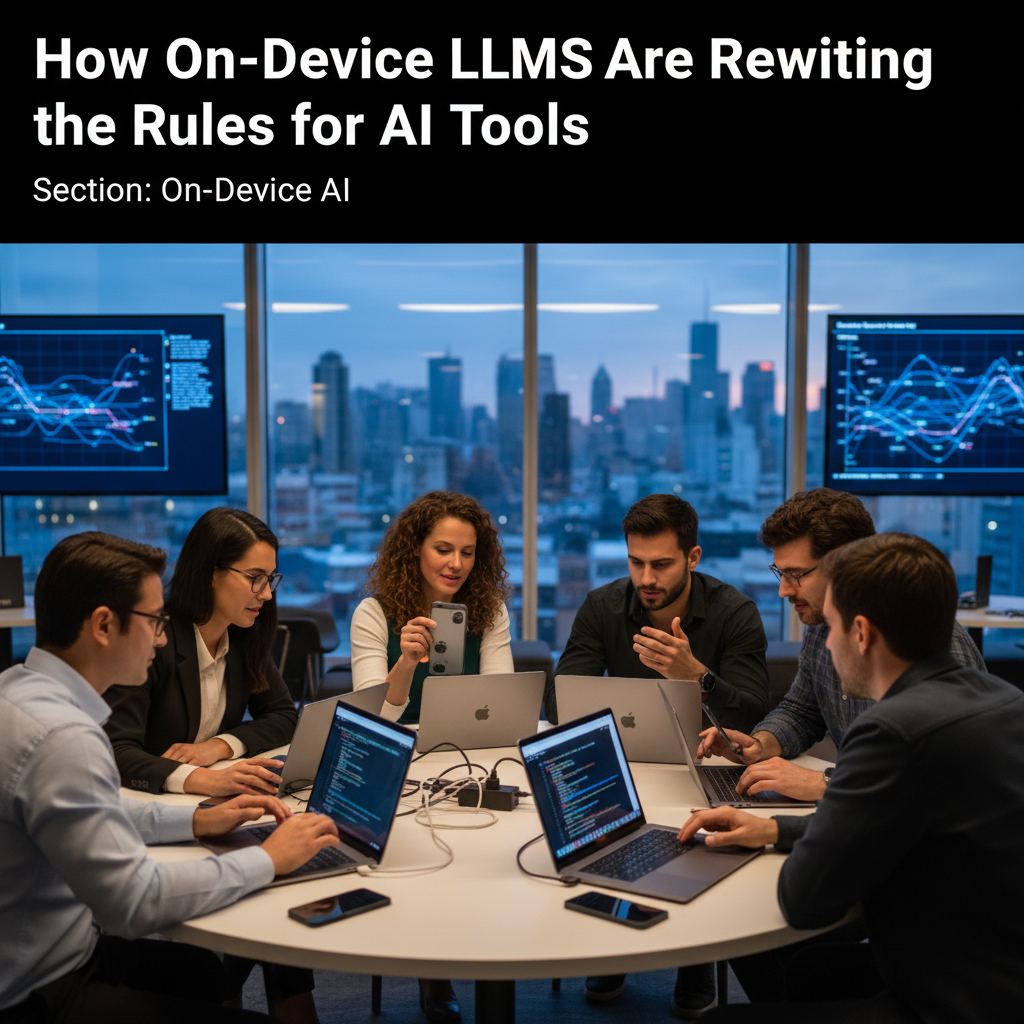
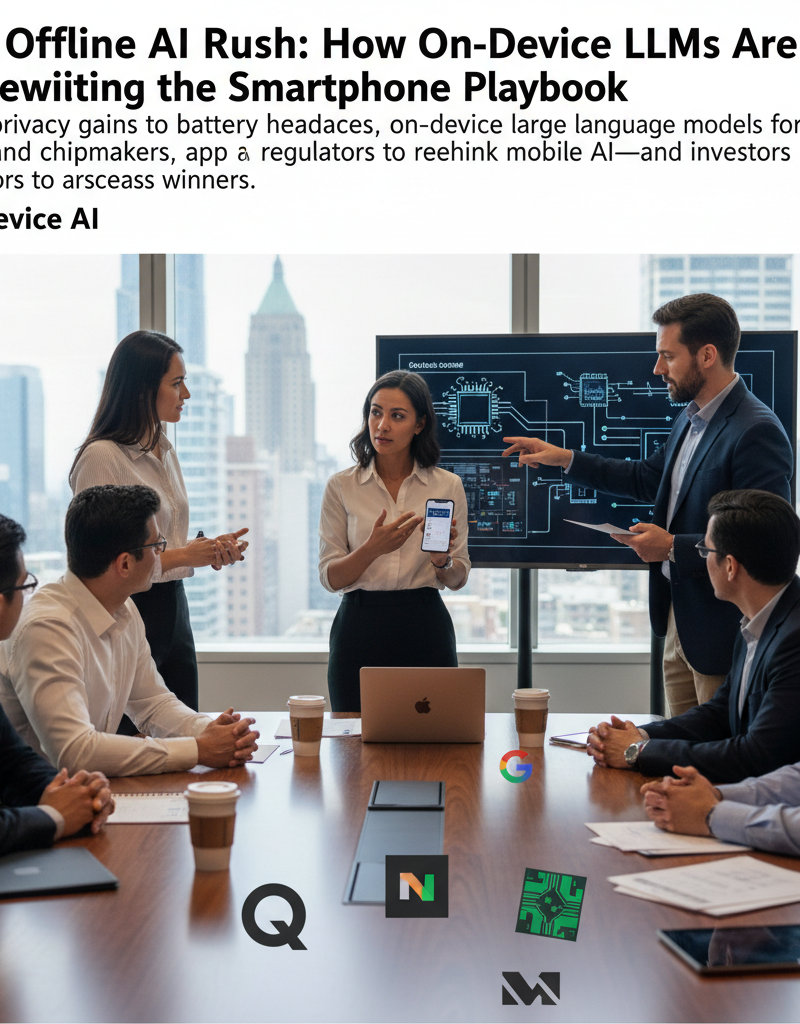
The biggest shift in AI tools right now isn’t a flashier demo — it’s where the models run. For years the conversation lived in the cloud, dominated by ever-larger hosted models. Quietly, though, a migration is under way: capable language models are being pushed to phones, laptops, and office endpoints.
This matters because it changes cost math, privacy posture, and product choices. Running locally isn’t just a technical novelty — it alters go-to-market economics and the regulatory risk profile for any business that handles personal or sensitive data.
Why on-device models are actually happening now
- Model openness and compression. Open releases like Llama 2 and toolchains such as llama.cpp made local inference practical. Distilled, quantized models keep a lot of usefulness while fitting consumer hardware.
- Better silicon. Modern phones and PCs now ship with neural accelerators and ML-optimized blocks. The hardware finally matches the software ambitions.
- Simple economics. Cloud inference bills scale with usage. For persistent, low-latency tasks — live transcription, always-on copilots — local inference can be meaningfully cheaper.
A few product-level consequences (not exhaustive)
- Privacy-first features become real competitive advantages. If text never leaves the device, compliance and customer trust improve in ways that marketing alone can’t buy.
- Much lower latency. Instant suggestions, real-time call summaries, offline assistants — they stop feeling like gimmicks and become usable.
- New UX patterns. Private long-term memory, personal copilots that maintain context without constant server sync, always-on features that don’t rack up API costs.
Winners, losers, and the fuzzy middle
- Hardware makers gain leverage. Companies that control silicon and firmware — mobile OEMs, certain GPU vendors — can become strategic partners for app makers.
- Cloud providers stay relevant. They still host the largest models, run training jobs, and provide cross-device sync and analytics that many businesses need.
- SaaS vendors face a fork: ship lightweight local models or keep the cloud-first API model and watch margins compress as on-device alternatives appear. There’s no single right answer, and many teams will sit in the messy middle for a while.
Trade-offs that actually matter
- Capability versus size. Smaller models punch above their weight, but the biggest models still win on complex reasoning and creative generation.
- Update friction. Pushing fixes or safety updates to millions of devices is harder than flipping a cloud switch. Expect patch management and versioning headaches.
- New security surface. Local models can be reverse-engineered; offline agents with file access create attack vectors we don’t fully appreciate yet.
Concrete use cases
- Field tech and healthcare: offline assistants that consult repair manuals or patient forms without needing a network.
- Knowledge workers: drafting, private summarization, meeting recaps that never hit third-party servers.
- Consumer apps: voice assistants that manage sensitive info — passwords, financial notes — without cloud round trips.
Signals product teams and investors should track
- App-maker partnerships with silicon vendors. Exclusive optimizations can produce fast followers and narrow moats.
- Advances in distillation and quantization. Better compression widens what’s feasible on-device.
- New pricing experiments. Expect hybrid models: routine assistance stays local, heavy lifting moves to the cloud, and vendors test one-time or tiered pricing.
This isn’t a binary cloud-versus-device fight. Think instead of an architectural rediscovery: systems that used to be centralized are becoming hybrid, and that hybrid changes feature design, margin dynamics, and who controls the user relationship. If you’re building or buying productivity tools this year, ask not just which model powers a feature but where that model runs.
Quick checklist for teams exploring on-device models
- Identify high-frequency, privacy-sensitive flows that would benefit from local inference
- Calculate cloud inference cost per active user and model on-device amortization scenarios
- Design update and patching processes for distributed model deployments
If you assume AI equals cloud forever, you’re missing the subtler, more disruptive story: AI is learning to live on the device, and that shifts who owns the user, the data, and the value.