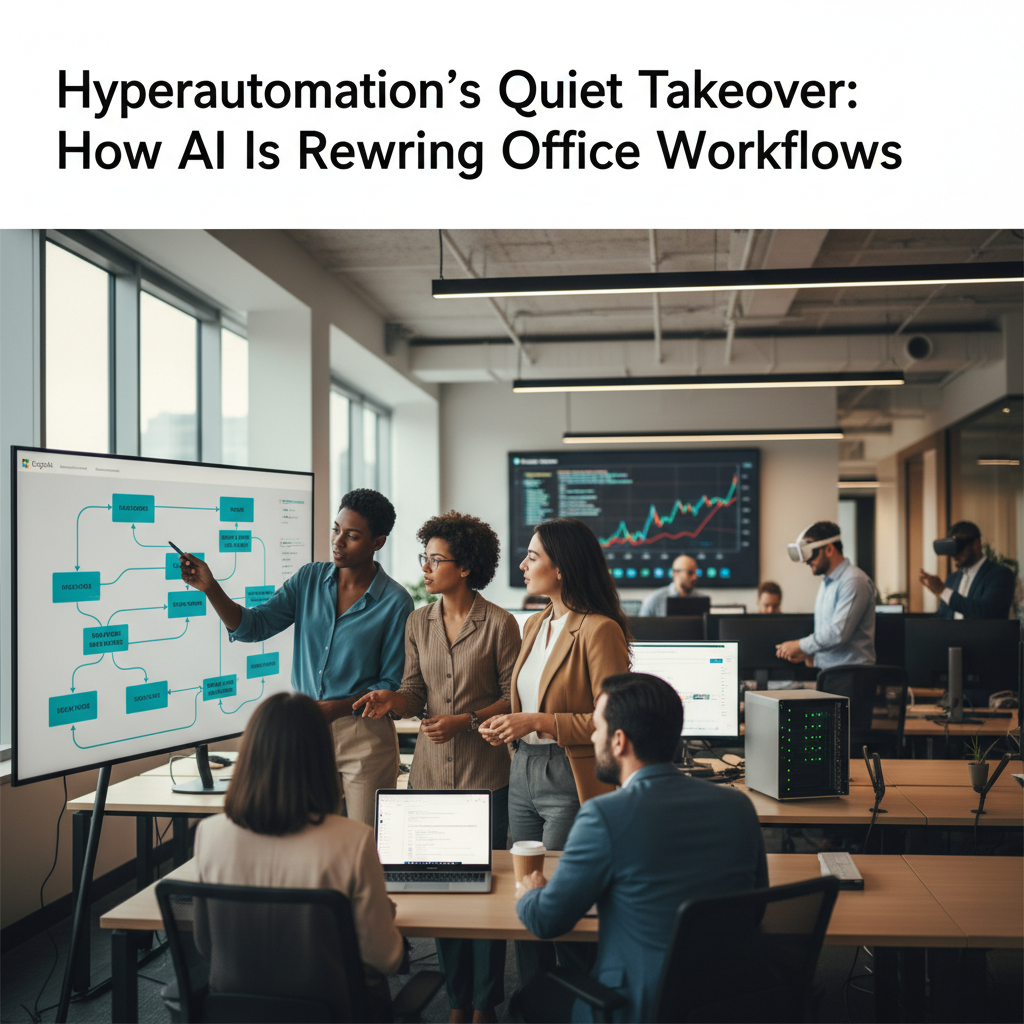
A new phase of automation is arriving quietly — not a single dramatic event, but a string of small, often painful efficiency wins. Where classical RPA used to stitch screens together, AI-native automation layers reasoning on top of repetitive work: emails, reconciliations, claims triage, compliance checks. It feels less like robots on an assembly line and more like judgment migrating from people into software.
Why it’s happening now
- Big cloud vendors are folding generative models into orchestration tools. Power Automate and similar workflow platforms can now call large language models as a built-in step, not just as a separate assistant.
- The cost of hardware and inference has come down enough that running models inside enterprise flows is actually feasible for many teams.
- After years of brittle integrations, companies are sick of expensive fragility. Models tolerate ambiguity better than screen-scraping scripts, which shortens deployment cycles in practice.
Concrete impacts for firms and people
- Productivity gains will show up unevenly. Banks and insurers can handle cases faster and expect fewer FTEs on rule-driven work. But that headline hides the real shift: jobs often fragment rather than disappear. Routine tasks contract; oversight and exception handling expand.
- New roles are moving from niche to mainstream: automation architects, model validation specialists, domain-facing AI integrators. Think of the old RPA developer evolving toward a data-aware systems engineer.
- Explainability and audit trails become battlegrounds. When a model routes a loan one way and a human might have decided differently, firms need explainability baked into the workflow, not bolted on later.
A short example
A regional lender uses an AI-augmented workflow to extract documents, flag missing clauses, and surface only the ambiguous files to underwriters. Turnaround drops from days to hours. But the underwriter’s job shifts: less form-filling, more judgment on edge cases. That matters — and it isn’t trivial to retrain teams for it.
Risks and friction
- Hallucinations and fragile edge cases are real. If you automate around a model’s interpretation without human checks, customer harm follows.
- Vendor lock-in hides in APIs and workflow plumbing. Systems built around a single model provider are harder to rewire than old on-prem scripts.
- The simple “people lose jobs” story is incomplete. Some roles shrink, others appear. The political and social costs of those transitions are real and often underestimated.
Where to focus now
- CIOs should treat automation like a product: set measurable KPIs, maintain error budgets, and run continuous validation. Don’t ship model-driven steps without monitoring in place.
- CFOs can reframe investments as cycle-time reductions and risk controls rather than only headcount cuts. Budgeting for reskilling has to be part of the ROI math.
- Individual contributors should learn the grammar of automation: process mapping, basic model risk concepts, and vendor-agnostic orchestration tools.
This wave resembles past automation cycles, but there’s a qualitative difference. The code can reason now, which speeds up implementation and complicates governance. The firms that do well will combine bold deployment with sober controls and a real human-in-the-loop design ethic. Expect messy trade-offs — and a lot of learning on the job.