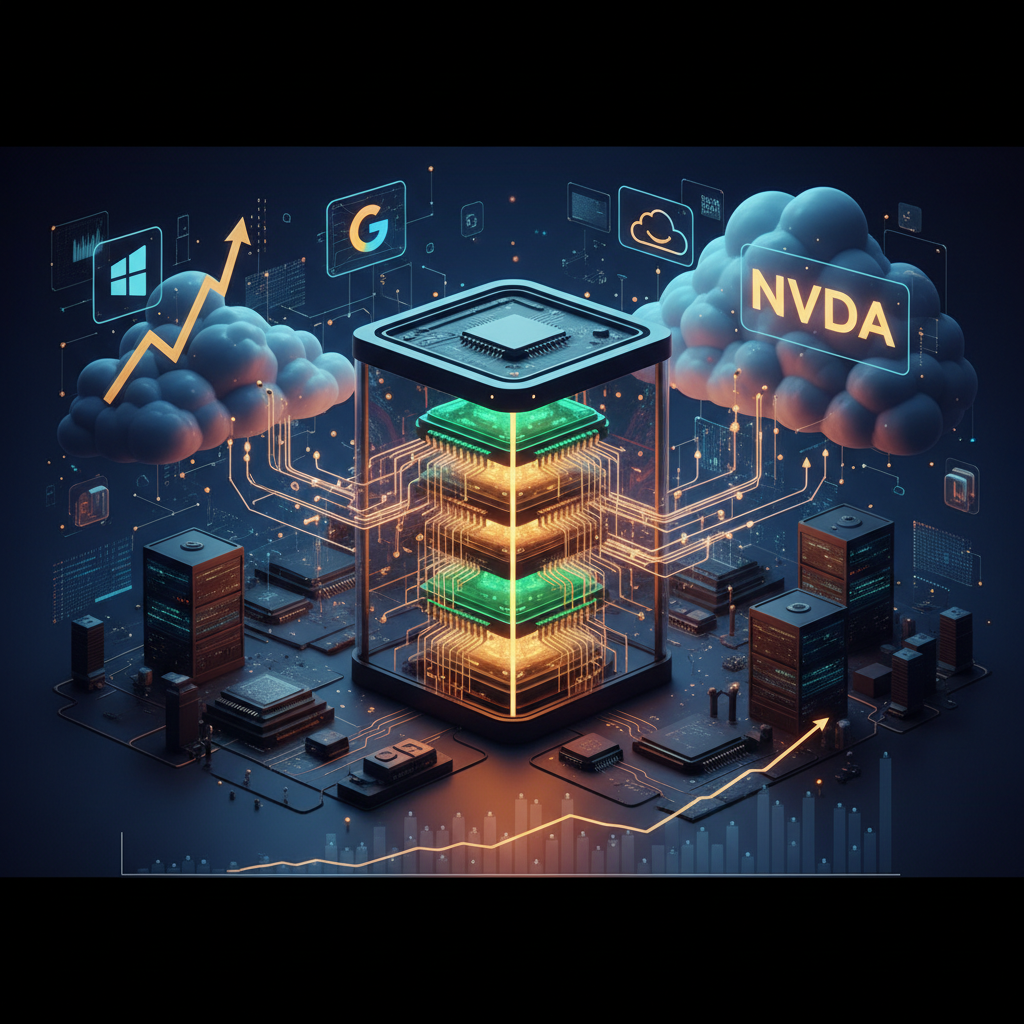
Demand for Nvidia's artificial intelligence (AI) semiconductors remains elevated, driven by ongoing capital expenditure increases from hyperscale cloud providers. Companies like Microsoft, Google, and Amazon are allocating significant resources towards data center expansion and AI infrastructure development.
Microsoft's recent earnings call indicated a substantial increase in capital expenditures, projecting approximately $14 billion for the current fiscal quarter. This figure represents a notable acceleration compared to previous periods, primarily directed towards scaling out AI computing capabilities and cloud services.
Similarly, Google's parent company, Alphabet, has outlined plans for increased spending on technical infrastructure. The company's management has communicated a focus on supporting the growing demand for Google Cloud and its AI initiatives, which necessitate the deployment of high-performance AI accelerators.
Amazon Web Services (AWS), a dominant player in the cloud market, is also contributing to the strong demand environment. While specific quarterly capex figures vary, AWS continues to invest heavily in its global data center footprint, with AI-driven services representing a key area of expansion.
These collective capital allocations by leading hyperscalers underscore a sustained investment cycle in AI infrastructure. Nvidia, as a primary supplier of the graphics processing units (GPUs) essential for large-scale AI training and inference, is well-positioned to benefit from these expenditure trends. The company's H100 and upcoming B100/GB200 platforms are critical components in these expanded data center deployments.
The strategic importance of AI has led these technology giants to commit substantial financial resources, influencing the broader semiconductor landscape. Analysts project this trend of elevated AI-related capital expenditure to continue through 2024 and potentially into 2025, providing a strong tailwind for AI chip manufacturers.
The continued investment in AI by hyperscalers is viewed as a foundational shift, rather than a cyclical trend, indicating long-term growth prospects for companies providing core AI enablement technologies.