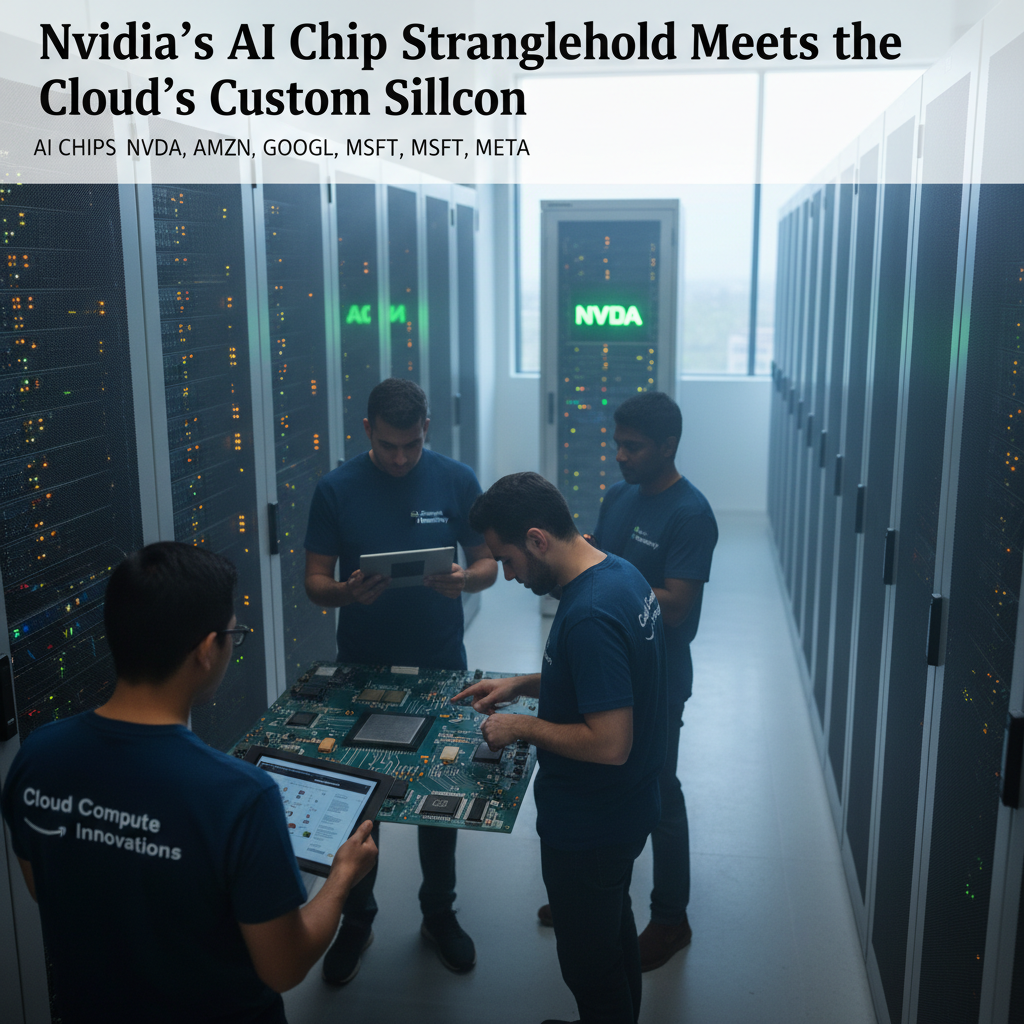
Short version: Nvidia still sets the tone for training large models. But a rising cohort of cloud-built and vertical accelerators is beginning to push back — and that shift matters to investors and CIOs.
For the last five years GPUs were the fastest route from prototype to production, and Nvidia rode that wave. CUDA and an enormous developer moat, plus early-mover pricing power, turned technical preference into durable advantage. Yet scale economics and tighter software–hardware coupling are changing the incentives.
Big cloud providers and the largest compute buyers are building chips for obvious reasons:
- lower long-run cost when you operate at hyperscaler volumes;
- the ability to tune silicon for inference versus training so you don’t waste cycles;
- tighter control of the stack for latency-sensitive services.
Examples are already in the field. Amazon’s Trainium and Inferentia show up in its cost playbook for generative workloads. Google’s TPUs keep being pulled closer into TensorFlow and its internal models. Meta, Tesla and Apple have poured resources into accelerators tailored to their workloads. Startups such as Graphcore, Groq and SambaNova are pushing different architectures aimed at narrow but valuable niches.
That looks worrying for Nvidia. And yet the counterargument is strong. Nvidia’s software ecosystem — CUDA, cuDNN, TensorRT and a raft of optimized libraries — is not something you buy with a chip order. Developers, labs and production pipelines are deeply embedded. Swapping hardware often means rewriting or porting large bodies of code, revalidating models and retraining teams. It’s costly. Slow. Painful.
So what’s the plausible path forward?
- Near term: Nvidia keeps the crown for massive training jobs. If you need best-in-class throughput, you’ll still reach for top-tier GPUs.
- Medium term: hyperscalers and their close customers will move much inference and many production workloads to custom silicon to shave costs and meet latency targets.
- Long term: expect a bifurcated market — Nvidia’s high-performance, general-purpose GPUs on one side, and a mosaic of specialized accelerators tuned for scale, latency or price on the other.
For investors, the implication is straightforward: Nvidia remains a core way to play model training demand, but its invulnerability is overstated. The runway for margin expansion narrows as custom silicon adoption grows. For CIOs, the pressing question is placement: which workloads actually justify Nvidia’s premium and which should be benchmarked on a cloud provider’s bespoke chips?
A useful historical echo is Intel’s CPU dominance. The fall wasn’t overnight — it came when software and alternative designs made switching practical and economically sensible. Nvidia’s software lead is bigger, yes, but the pattern — incumbents losing ground to tailored competition — is familiar.
Practical takeaways:
- If you do large-scale training, keep buying Nvidia for now.
- If you handle millions of inference calls a day, benchmark the cloud providers’ custom chips — they might be cheaper and fast enough.
- For investors, spread exposure across cloud operators and specialized chipmakers instead of only owning Nvidia.
This isn’t a knockout blow. It’s a slow structural shift. Nvidia’s lead is real, but when volume economics meet software lock-in and bespoke engineering, dominance gets contested.