Short version
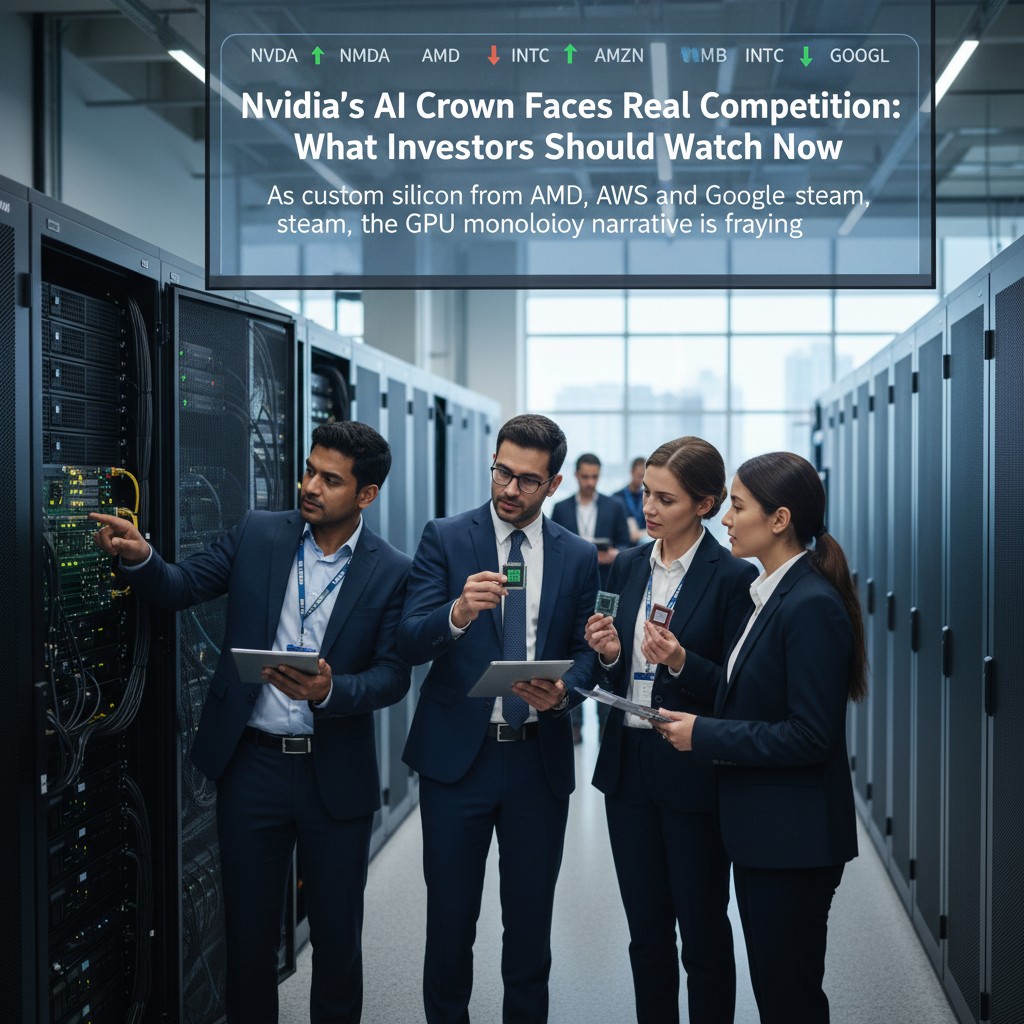
Nvidia built the current AI boom — GPUs plus a software stack developers actually want. That edge is real. Still, fault lines are appearing: AMD’s MI300, hyperscalers’ custom silicon, and better software portability are chipping away at parts of Nvidia’s advantage. This is not a sudden overthrow. Think instead of a multi-year shift that matters for how you position a portfolio.
Why this matters now
- Demand for AI compute is exploding across search, recommendations and generative models — and the market already prices a lot of that growth.
- Supply is diversifying. Hyperscalers are scaling their own chips and AMD is pushing into both inference and training.
- Valuations on the leader are stretched. That premium leaves little room for execution stumbles.
A couple of quick asides: investors tend to focus on raw performance, but cost-per-workload and software fit are often the deciding factors in practice.
A bit of history
GPUs jumped from gaming into deep learning because they offered parallel throughput CPUs couldn’t match. Nvidia cemented that lead with CUDA and an ecosystem of libraries, which created high switching costs. Still, ecosystems break down when economics and software portability line up — remember how x86 dominated desktops, yet ARM took over mobile. Patterns repeat, though not instantly.
Who’s competing, and how
- AMD: MI300 is a credible performance-per-dollar play, backed by ROCm, which is getting real traction. Not flawless yet, but closing gaps.
- Hyperscalers: AWS’s Trainium and Inferentia, plus Google’s TPUs, move workloads off general-purpose GPUs where it pays. Vertical integration lowers per-inference costs and gives cloud providers strategic control.
- Startups and custom ASICs: lots of niche chips aiming for lower power and cheaper inference at the edge or in consumer devices.
What’s interesting is that none of these alternatives need to beat Nvidia on every metric to matter. Winning a slice of workload types — inference at scale, particular model families — is enough to change demand dynamics.
Investor implications — a practical playbook
- How to think about Nvidia (NVDA) as a core: If you believe CUDA stays dominant, Nvidia remains the safer long-term bet. But big size usually means slower percentage growth and much bigger penalties for execution errors.
- Diversify selectively: AMD gives direct hardware upside. Cloud leaders such as Amazon (AMZN) or Google (GOOGL) are indirect ways to capture cloud-native AI economics without betting on one chip vendor.
- Time cycle exposure: suppliers and equipment makers often spike when capex rounds start, then face margin pressure as chips commoditize. There’s timing risk here — not just structural risk.
Small qualification: these are portfolio tilts, not shout-it-from-the-rooftops convictions.
Risks and counterpoints
- Software moat still matters. Developer mindshare and highly optimized frameworks make migration costly and slow.
- Scale advantages are real. Nvidia’s production volumes and specialized SKUs are hard to replicate quickly.
- External shocks — export controls, geopolitics, fab outages — can reshuffle winners fast. Don’t assume a straight-line outcome.
Concrete examples
- A media company moved inference from general GPUs to TPUs and saw lower per-query costs on certain models. That kind of workload-specific win is what shifts buying decisions.
- An AI startup standardized on ROCm to avoid lock-in, only to hit performance gaps on a few architectures. The result was a messy trade-off between portability and peak throughput.
These stories show the middle ground: choices are rarely binary.
Key takeaways
- Nvidia leads, but it is not invincible; competition is growing in meaningful ways.
- Short-term winners will depend on workloads: training still mostly favors GPUs; inference is fragmenting.
- For investors: keep a core NVDA stake if you trust CUDA’s inertia, but complement it with targeted exposure to AMD and cloud providers. Track software portability and real customer case studies — they often tell you more than benchmark numbers.
Watchlist for the next 12–24 months
- How quickly AMD MI300 gets picked up in hyperscale and enterprise data centers.
- Benchmarks that measure end-to-end deployment cost, not just raw FLOPS.
- Hyperscaler announcements around deeper vertical integration or new third-party partnerships.
This market isn’t about a single winner so much as who captures which slices of a rapidly expanding pie. Owning the story is not the same as owning the economy that story describes.