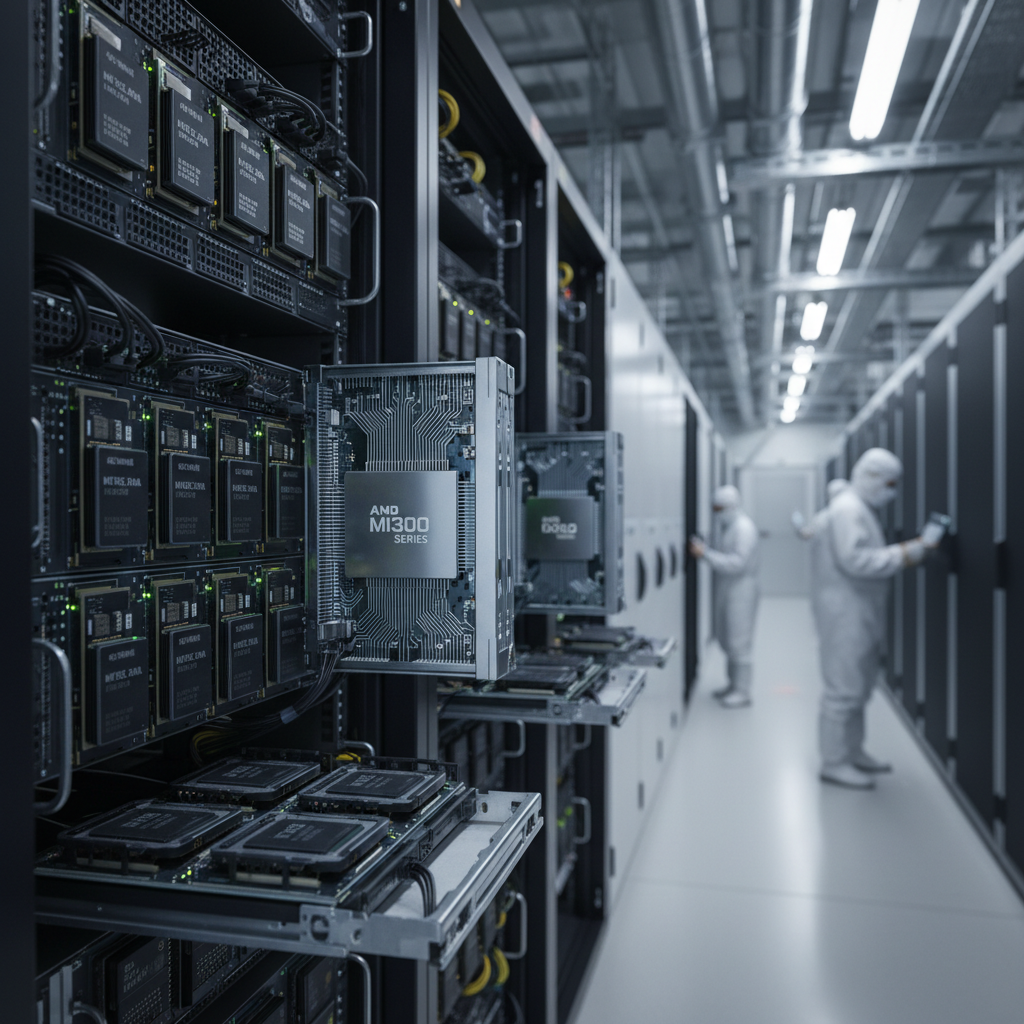
Nvidia has led the AI accelerator conversation for years, but that lead looks less unassailable than it did a year ago. AMD's MI300 family, improving options from Intel, and rising custom efforts from cloud providers have turned what felt like a one-horse market into something more contested.
Why this matters now
- Demand hasn't faded. Generative AI still drives massive data-center growth, but hyperscalers are more cost-conscious and actively hunting for cheaper training and inference dollars.
- Supply and chip architecture are shifting. Chiplets, tighter memory/compute integration, and real efficiency gains are closing some of the raw-performance gap that once protected Nvidia.
MI300 versus H100 — a quick, high-level read
- Architecture and cost: AMD chose a chiplet approach and stacked HBM to push memory bandwidth without copying Nvidia's single-die route. That can be cheaper to produce at scale and easier to yield, which matters when foundry capacity is the scarce resource.
- Software and ecosystem: Nvidia still has the edge with CUDA, a mature toolchain, and a huge base of models already tuned for its stack. AMD's software has caught up faster than many expected, though — and enterprise buyers increasingly judge platforms by total cost of ownership, not just peak FLOPS.
- Energy and cooling: MI300-class parts narrow operational advantages. Efficiency improvements change the calculus for hyperscale deployments more than raw chip benchmarks suggest.
Not just a rerun of the CPU wars
The AMD–Intel CPU story is a useful analogy, but imperfect. Software lock-in here is steeper. Moving off Nvidia means retooling models, retraining engineers, and untangling commercial deals. Those are real frictions that slow wholesale shifts.
That said, hyperscalers change the dynamics. Amazon, Microsoft, and Google can, and will, push for custom silicon when it makes financial sense. Their willingness to design or co-design accelerators is a direct pressure point on Nvidia's margin narrative.
Signals investors should actually watch
- Cloud deployments and customer wins. A multi-region hyperscaler commitment to AMD or Intel would be a material revenue signal.
- Price per training hour and energy per inference in independent tests. CFOs and operators care about those numbers more than peak FLOPS.
- Nvidia’s gross margin and average selling price trends. Persistent margin compression would indicate structural pricing pressure, not a one-off discount.
- Foundry capacity — TSMC, wafer allocation, and the downstream effects on availability when demand spikes.
Consequences for each player
- Nvidia: Still the leader. The moat is real but showing cracks. Expect premium multiples to persist unless margins or growth disappoint.
- AMD: A credible challenger with an attractive cost story for hyperscalers and cost-sensitive enterprises. The upside hinges on software traction and landing large cloud orders.
- Intel and cloud providers: Wildcards. Intel could win on integration with CPUs and on-prem stacks; cloud builders can sidestep both incumbents with bespoke accelerators.
Risks and counterpoints
- Software lock-in remains the single biggest barrier. CUDA, optimized libraries, and the ecosystem around them are not easy to replace overnight.
- Benchmarks lie if you let them. Synthetic scores are seductive, but real workloads, licensing, and post-sale support matter far more in production.
Where this leaves us
Nvidia is not being dethroned tomorrow. But the market structure is shifting enough to temper assumptions baked into valuations. Investors should avoid blind enthusiasm and reflexive pessimism. Watch for concrete, observable signs: cloud deals, margin moves, and independent performance/efficiency metrics.
Watchlist for the next 6–12 months
- Management commentary on data-center ASPs and revenue mix in earnings calls
- Any multi-region cloud deployments announced by AMD or Intel
- Independent third-party benchmarks covering training and inference efficiency
- Foundry and capacity updates from TSMC and ASML
If this feels like deja vu from the CPU wars, that's fair. The stakes are higher now, and the timelines shorter. The safest bets will be on companies that pair compelling hardware economics with believable paths to software adoption.