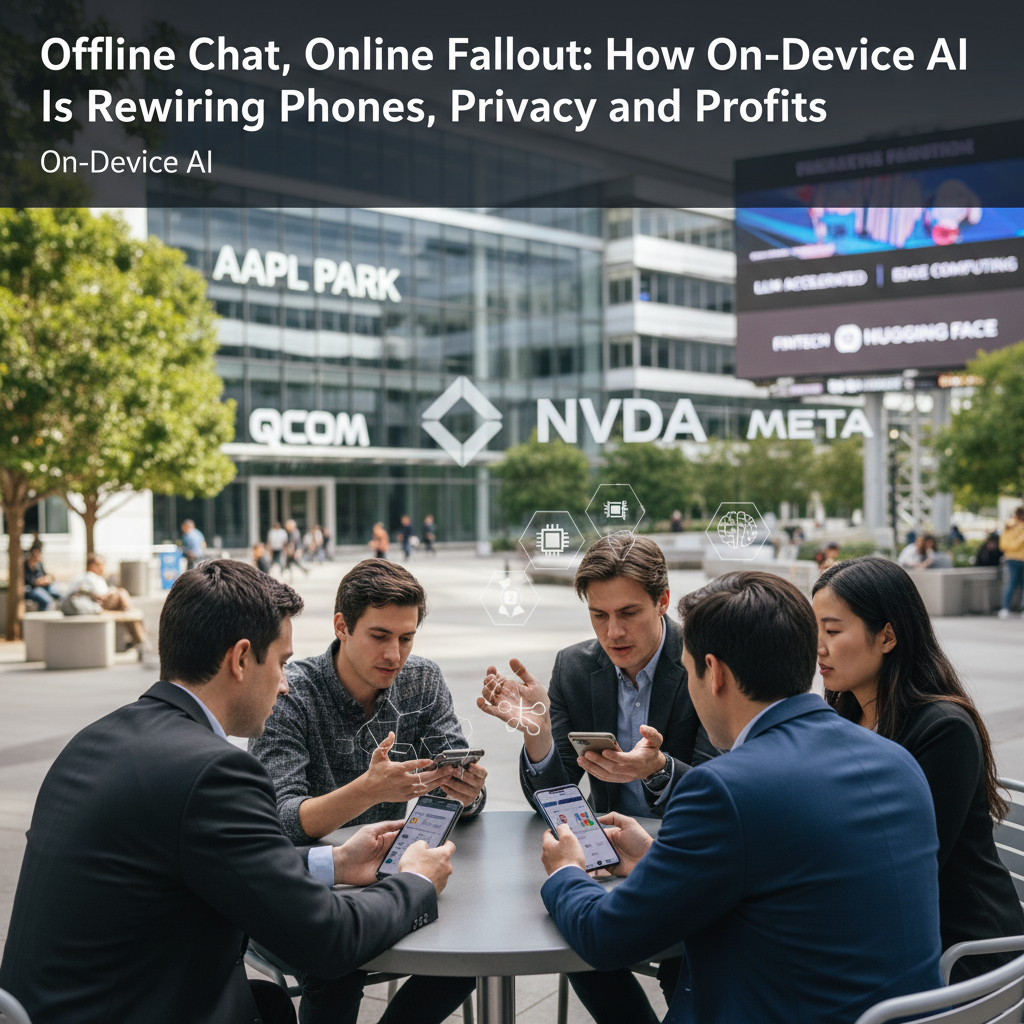
The headline is simple: phones are quietly becoming self-sufficient AI labs
At WWDC and across developer communities this year, the ability to run genuinely useful language models on-device stopped being just a demo and started showing up in consumer-ready form. That matters for more than latency. It shifts who controls data, who collects the revenue, and which chips end up dominant.
Apple’s Neural Engine plus a burst of efficient model tooling mean phones can now summarize long emails, answer personal finance questions, or redact sensitive details without a roundtrip to a server. Open-source work — Llama and the ecosystems around it, from quantization libraries to llama.cpp-style runtimes and Core ML converters — has pushed down the compute and memory costs that once confined offline LLMs to hobbyists.
Why this matters now
- Instant responses, more like native features than cloud add-ons. No waiting, no spinner; conversational search feels immediate.
- Privacy implications are concrete. Keeping prompts and context on-device reduces regulatory exposure and reputational risk for banks, healthcare apps, and enterprise tools.
- New business models become plausible. If inference happens locally, you can imagine subscriptions, one-time model purchases, or in-app model marketplaces replacing per-token API billing.
The trade-offs
Local models are necessarily smaller and often more narrowly tuned. That brings less factual breadth than a large cloud model and a higher chance of confidently wrong answers when the model is under-parameterized. Battery and thermal limits are real constraints. Shipping models with apps also creates a new attack surface — corrupted or malicious weights pushed via app updates are an obvious concern.
Who to watch
- Chip vendors. Apple and Qualcomm are the obvious fronts. Apple’s tight hardware-software integration gives it a real advantage for consumer features; Qualcomm’s NPUs matter because of Android’s scale.
- Cloud incumbents. NVIDIA still dominates datacenter training, but value is shifting toward specialized edge silicon and teams that can squeeze model size without losing too much capability.
- Software plumbing. Hugging Face, open runtimes, and conversion tools are the infrastructure that determines how fast on-device features spread. Their ecosystems matter more than any single app.
Everyday examples you’ll start to see
- Finance apps running risk checks and summarizing spending locally so transaction data never leaves the phone.
- Email clients indexing mail on-device to produce fast, private summaries.
- Note-taking and research tools keeping private vector stores locally for quick, offline retrieval-augmented answers.
Regulatory and security angles
On-device inference helps with data residency, but regulators will soon ask about model provenance and update integrity. Expect guidance that requires developers to prove secure model delivery and to verify the origin and integrity of weights — think of signed OS updates as the precedent.
A historical comparison
Think back to the camera moment. Computational photography made modest optics look impressive; similarly, models will make phones seem smarter than their spec sheets suggest. Consumers get a clear benefit. Markets will sort winners and losers based on who owns the software hooks and the silicon underneath.
A cautious, pragmatic take
I’m skeptical of anyone claiming everything will run fully offline tomorrow. Still, the momentum is real. Expect a phased rollout where hybrid approaches — light models on-device with cloud fallbacks when heavier compute or broader knowledge is needed — dominate early deployments. That mix helps preserve battery life, control costs, and keep accuracy when the situation calls for a larger model.
For readers: watch WWDC follow-ups, chip roadmaps, and developer tools that promise easy quantization. Those milestones will show when offline AI moves from interesting experiment to everyday feature.
Author: Pedro Marini