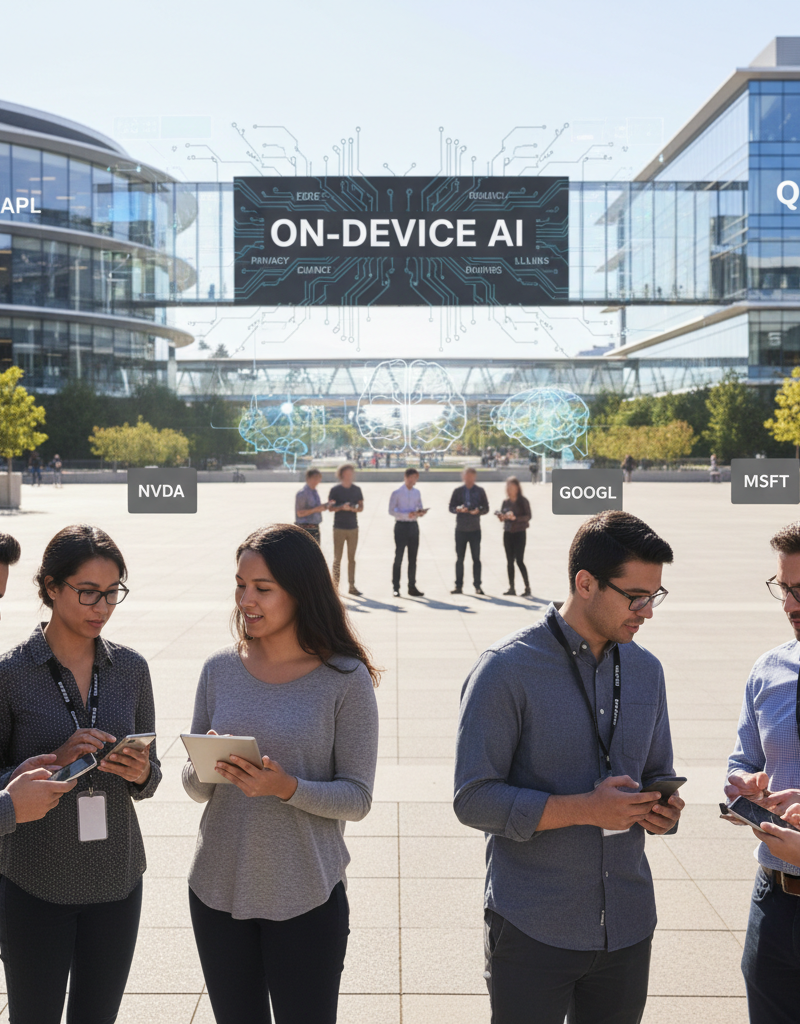
The shift is quieter than a headline but far more consequential. For the past few years the AI story has been dominated by huge cloud models and the data centers that power them. Now a different pattern is emerging: model compression, lean runtimes, and steadily better NPUs in phones and laptops are pushing capable models out to the edge. That changes how we think about performance, privacy, and where the money flows.
Why this matters now
- Smaller models plus smarter quantization mean useful language models can fit within the memory and power limits of modern devices.
- Apple, Qualcomm, and others have been adding serious neural hardware; for many tasks developers can hit single-digit latency without a round trip to the cloud.
- Open-source work and optimized runtimes — think efficient C++ implementations, not just research papers — have made hobby demos into features you can ship.
What’s interesting here is how quickly user expectations shift once latency and privacy improve. That shift matters more than it first appears.
Practical wins and awkward trade-offs
On-device AI brings obvious benefits: less lag, offline operation, and a privacy story that users understand. The trade-offs are real, though, and a little messy.
- Compressing models strips some nuance; you’ll see more prompt tricks and hybrid fallbacks to the cloud to cover edge cases.
- Battery life and thermals impose limits that feel arbitrary to users who assume unlimited cloud compute.
- App store rules and proprietary NPUs fragment the experience. A capability on one phone may be weaker or missing on another.
Think of it as the camera-chip moment for AI. Computational photography moved HDR, night mode, and portrait effects onto phones and made those devices noticeably better. On-device AI can do the same for summarization, personal copilots, and private search — but it also kicks off a platform and hardware arms race.
Who wins, who loses
- Platform owners that control silicon and model distribution stand to pocket more of the value. That’s an advantage for Apple and Android OEMs that integrate hardware and software closely.
- Cloud providers retain an edge for the largest, most creative models and for tasks that need huge context windows. Expect hybrids: the device handles short interactions; the cloud handles the heavy stuff.
- Startups get a new opening. Niche, privacy-first copilots that run locally can appeal to enterprises with sensitive data and to consumers who prefer speed and privacy over marginal gains in model quality.
Regulatory and security angles
On-device AI reduces data leaving the device, which simplifies some compliance questions. It also complicates oversight. Regulators who audited cloud logs now face millions of opaque models running on user devices. Security concerns shift too: model theft, tampering, and ensuring secure update channels become much more important.
Concrete examples you may already have or will soon
- Offline summarization and note-taking that never sends text to a server.
- Real-time translation on a phone with minimal lag, even in noisy places.
- On-device copilots that index your files and suggest actions without exposing content to third parties.
What to watch next
- Better quantization and sparsity techniques that let midsize models retain more reasoning power while fitting mobile constraints.
- New APIs from Apple and Android vendors that decide who gets priority NPU access and how easily developers can use it.
- Business experiments: subscription copilots, hardware-plus-software bundles, and enterprise on-device solutions for regulated industries.
The technical pattern is familiar: hardware enables new software behaviors, and that software changes the market. On-device AI will not replace cloud models. It will, however, reroute value, reset product expectations, and force companies to pick sides in the chip and control contest. If you care about latency, privacy, or margins, this is one of the clearer inflection points in recent memory.
Three quick points
- Expect hybrid workflows: devices for short, private interactions; clouds for scale and heavy lifting.
- Firms that control both silicon and distribution gain leverage; fragmentation helps incumbents with integrated stacks.
- For users the immediate wins are speed and privacy; for developers and regulators the hard work is only beginning.