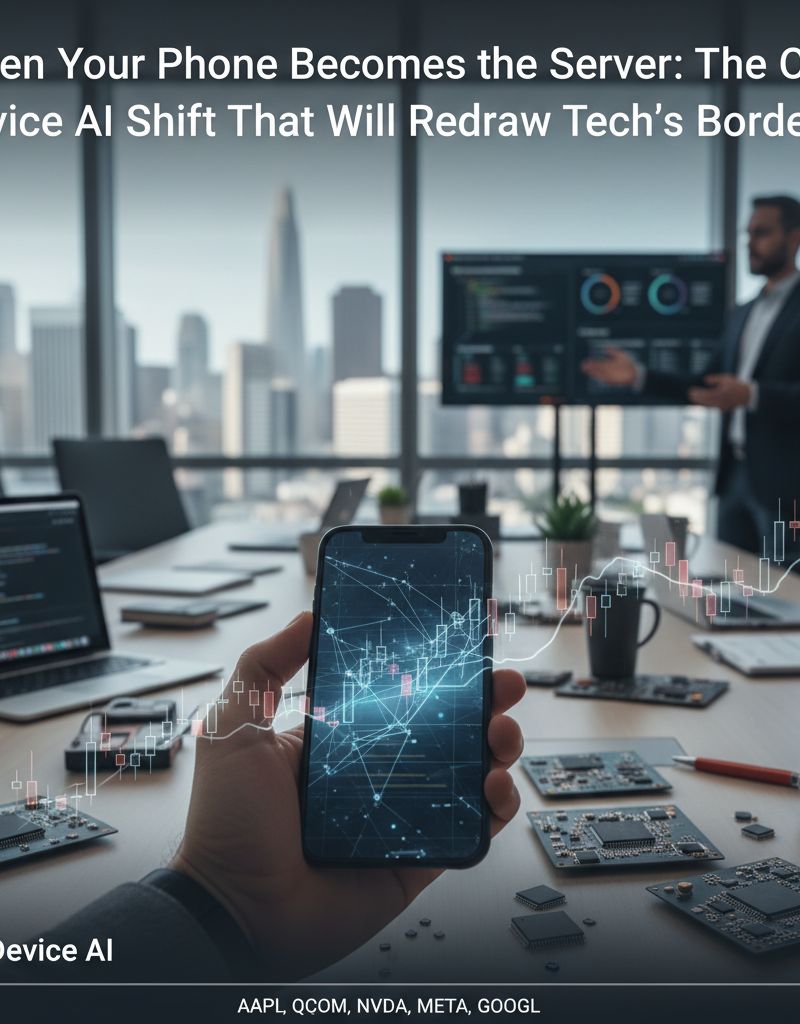
The headline is simple: the cloud is starting to lose its monopoly on intelligence. After years of hype, a mix of smaller foundation models, aggressive quantization, faster NPUs and better developer toolchains has finally put genuinely useful generative AI into phones, laptops and other edge devices.
This is not just a rerun of the cloud-versus-edge argument. The practical change is this: on-device models now run with acceptable latency, manageable battery impact and accuracy good enough for many real-world tasks that consumers and businesses care about.
Why now — the tech and economic drivers
- Smaller, more focused models. Distillation and purpose-built architectures mean everyday tasks — summarizing messages, suggesting code completions, running personal assistants — can be handled by models that actually fit on-device.
- Bold quantization and pragmatic runtimes. Open-source projects and vendor SDKs have made 4-bit and mixed-precision inference usable on mobile NPUs, not just in lab demos.
- Dedicated silicon. Modern phones and PCs ship with NPUs and DPUs optimized for matrix math. Some chips are surprisingly capable; others lag — there’s real variance across the market.
- Privacy and regulation. Stricter data rules and growing user unease about sending everything to a server make local inference not merely convenient but often the safer, default choice.
What's interesting here is how these forces stack: none of them alone would be enough, but together they make on-device AI practical.
What this looks like day to day
- Productivity that actually feels faster: local summarization of messages, instant offline search, and autofill that stays on your device.
- Media and creativity tools that no longer need roundtrips: near realtime style transfer, image-editing primitives and offline image generation seeds.
- Finance and retail features that protect data: on-device fraud checks, instant credit hints based on local profiles, and personalized budgeting suggestions that don't require sharing raw records.
Winners and losers — a pragmatic take
This shift helps chip designers, device makers and privacy-minded SaaS vendors. It complicates the cloud provider playbook. Large cloud GPUs will still be essential for training, big fine-tuning jobs and the heaviest generative workloads — blockbuster models and massive enterprise data lakes — but a surprising share of user-facing features will move to the edge.
Implications to keep in mind
- Chipmakers that publish realistic NPU throughput and developer support gain bargaining power with software teams that need low-latency AI.
- App developers trade cloud bills for new headaches: model rollouts, security patches, and supporting a wide variety of devices.
- Cloud vendors will lean into hybrid services — orchestration, hosted model development and fine-tuning pipelines — rather than selling pure inference time alone.
Risks and trade-offs
- Accuracy ceilings: smaller models do not replace the largest LLMs; hallucinations and domain-specific gaps persist.
- Fragmentation: a messy device ecosystem raises deployment and QA costs.
- Battery and thermals: continuous on-device workloads still tax power budgets unless engineers optimize carefully.
Signals to watch over the next year
- SDKs that actually standardize deployment across different NPUs (developer uptake matters more than glossy demos).
- New model formats that prioritize execution speed and memory footprint over raw parameter count.
- Regulatory nudges and procurement guidelines that favor local processing for sensitive data.
- Partnerships between OEMs and SaaS vendors that carve out sensible hybrid flows.
A short, practical editorial
Think of on-device AI like electric cars reaching price parity with hybrids: it does not kill the cloud, but it changes everyday behavior and the surrounding industry. The smart move for product teams and investors is not to pick cloud or device as a binary choice, but to map which parts of the experience belong where and design hybrids accordingly.
If your app needs privacy, low latency or offline capability, on-device AI is an opportunity, not a threat. If you run the server room, expect continued demand for training and fine-tuning services even as inference drifts closer to users.
Signals to trade on
- Track chip firms that publish concrete NPU benchmarks and show real SDK adoption.
- Watch startups that turn academic quantization techniques into production-grade tooling.
- Follow major mobile OS updates that add explicit local ML hooks — and measure whether developers actually use them.
This is still early. But the architecture of AI is shifting in a quiet, meaningful way. The next wave of user-facing improvements will not come only from cheaper cloud cycles — many will arrive because our phones and laptops are getting smarter at the silicon level.