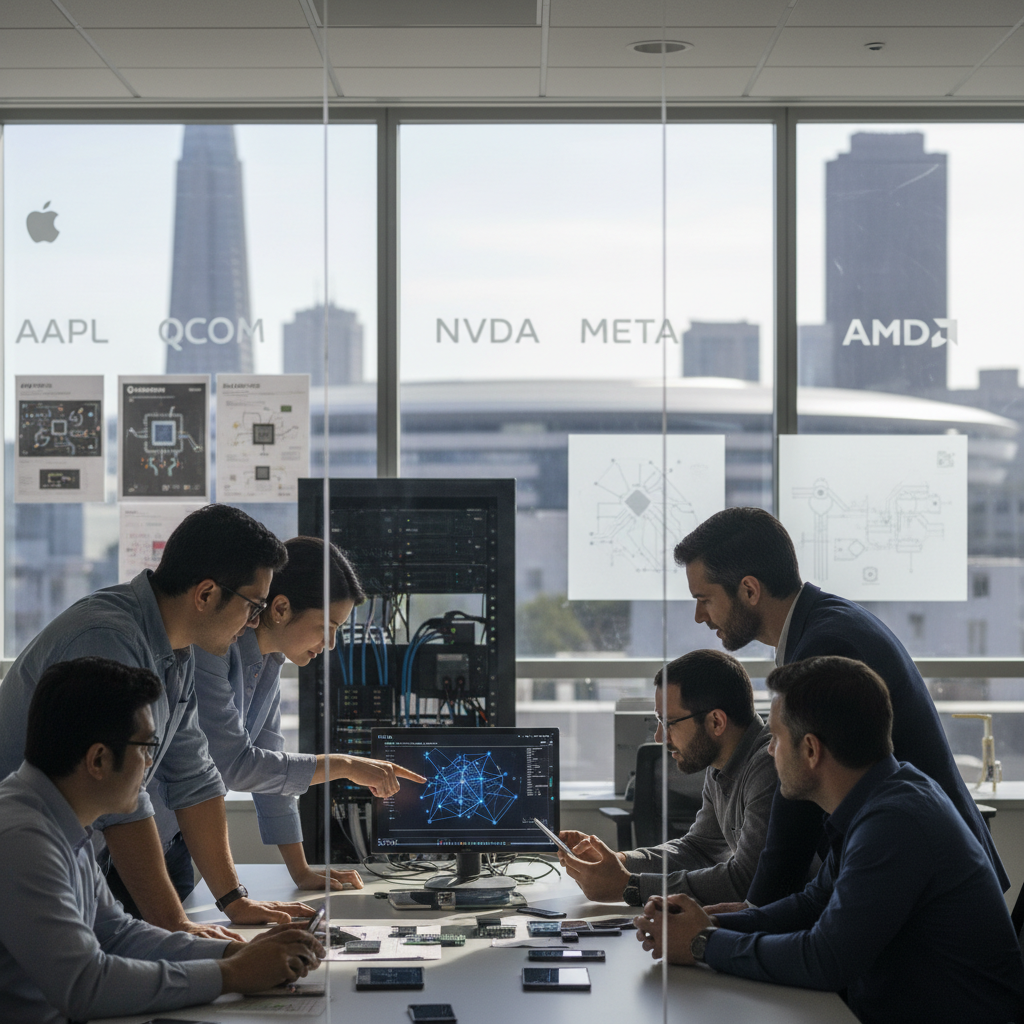
Short version: on-device AI — no longer a tinkerer’s curiosity but a practical capability — is quietly changing how people use phones, how apps get paid for, and who wins when intelligence runs locally instead of in the cloud.
The last two years brought a predictable combination: algorithmic slimming (quantization, pruning, distillation) paired with smarter silicon (Neural Engines, DSPs, dedicated NPU blocks). The result is simple and a bit surprising: LLM-style assistants that would have needed a server can now run on flagship phones with usable latency and battery behavior.
Why this matters now
- Privacy, without the vague hows. Running inference on the device cuts out most of the messy data plumbing that powers cloud personalization. For users who care about where their data lives, on-device is easier to explain — and to trust.
- Speed that feels immediate. No round trip to a data center when you want a quick rewrite, a caption, or a calendar summary. Offline-native features feel snappier, and they actually work when the connection is bad.
- Different cost math. Cloud vendors bill by token or compute minute. Shift inference to devices and the cloud bill shrinks. Margins migrate toward chip designers and handset makers.
Think back to computational photography. Once phones stopped boasting about megapixels and started doing computation-first imaging, winners were decided by software and silicon, not sensor size alone. On-device AI looks like the same arc: tight coupling of model and hardware beats raw cloud scale for many day-to-day tasks.
Winners, losers, and the messy middle
- Winners: NPU teams and chip designers, OS vendors that provide model frameworks, and app builders who can monetize robust offline features.
- Losers: parts of the cloud stack that sell per-inference hooks, and ad businesses built on server-side profiling.
- The messy middle: startups that built cloud-first APIs now face a harder engineering problem — they’ll likely need dual architectures, supporting both on-device and cloud models. That’s not just code overhead; it’s a go-to-market headache.
Technical realities and limits
Smaller models are helpful, but they are not magic. Expect trade-offs. Hallucinations remain a risk. Complex, multi-step reasoning still favors large cloud models. Sustained workloads also draw real energy. That said, 4-bit and 8-bit quantization, structured sparsity, and adapter layers have pushed quality forward. For tasks like summarization, rewriting, classification, and local search, the user-facing quality is already good enough for broad use.
Business and regulatory ripple effects
- App stores may start favoring apps that do more locally because users perceive real privacy value.
- Regulators in the U.S. and EU who want data minimization will have a new carrot: encourage local inference rather than simply banning services.
- Advertising has to change. Centralized cross-site profiling becomes harder; expect more contextual ads and permissioned on-device audience signals to fill the gap.
Concrete, subtle examples
A note-taking app that summarizes meetings on-device reduces legal exposure for companies. A messaging client that flags scams locally avoids sending sensitive texts to third-party classifiers. A photo app that generates captions without uploading images keeps trust intact while still delivering utility. These are small shifts on the surface but they add up.
So where does this leave us
On-device AI is not a wholesale replacement for cloud supermodels. Instead, it relocates much of the everyday intelligence to devices while leaving research-grade, multi-modal reasoning and huge retrieval jobs in the cloud. Watch for shipments of new NPUs, the maturity of frameworks that make local models easy to deploy, and the first mainstream apps that charge for robust offline features — those will be the clearest signals.
If you care about privacy, latency, or who captures AI’s economics, this matters. It’s less a single breakthrough and more a steady migration that could reshuffle winners the way computation-first photography did a decade ago.