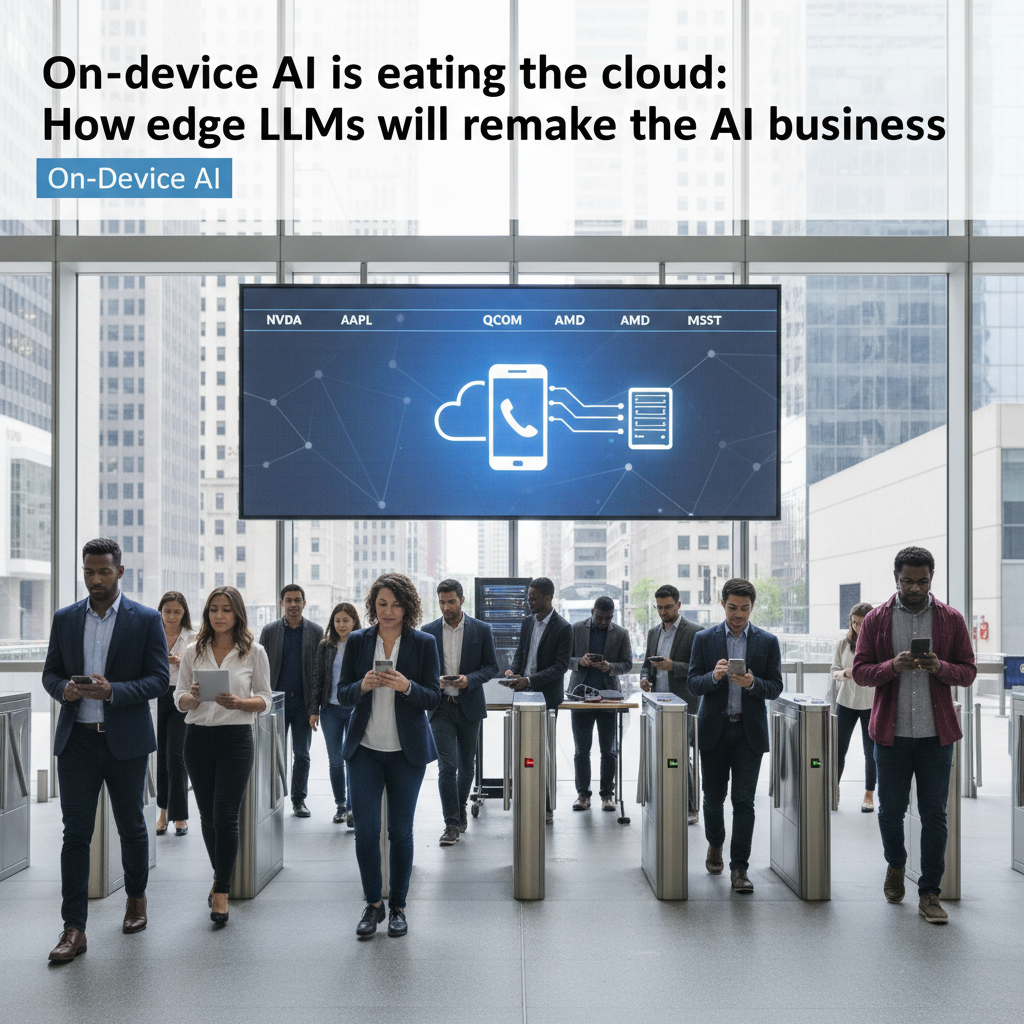
Big idea, up front. The economics of generative AI are shifting not because cloud algorithms suddenly got magical, but because silicon improved and models got small enough to run on devices. It sounds pedestrian. It matters anyway — for investors, startups, and anyone paying a monthly AI tab.
Why now
- Mobile chips finally pack enough compute to run usable language and vision models locally. This is not incremental; it changes latency and cost dynamics.
- Open weights, pruning, and quantization have shrunk capable models so they actually fit on phones and edge gateways.
- People want instant replies, lower latency, and stronger privacy guarantees — things pure cloud setups struggle to promise.
This creates a tug-of-war: cloud providers sell breadth and constantly updated models; device-first approaches sell speed, privacy and predictable cost. The real business question is which of those values you can monetize — via subscriptions, hardware premiums, or tooling for developers.
Who gains, who loses
Hardware makers win if demand shifts away from GPU-hour bills toward silicon-integrated inference. Expect attention to NPUs and efficient on-chip inference rather than chasing raw GPU TFLOPs. Platform players that make device-plus-cloud work smoothly — updates, telemetry, secure rollouts — will capture disproportionate value. Cloud vendors are far from obsolete. Heavy training and large-scale data aggregation still belong in the data center, but the low-margin, commodity inference business is under pressure.
Business-model fallout
Companies built on consumption-based cloud billing face a real rethink. Billing by the million GPU-second could be replaced with models such as:
- one-time device or app purchases that include local AI features;
- hybrid subscriptions bundling device upgrades and cloud sync;
- enterprise licenses focused on model orchestration and secure updates.
Each path changes margins and scaling behavior. For VCs and CFOs, the old assumption of near-infinite software gross margins needs revisiting. There will be winners among those who can reprice experience rather than compute.
Regulation and trust
On-device inference is attractive to privacy-sensitive sectors like health and finance, but it complicates oversight. Regulators can subpoena cloud logs; inspecting a model running on a handset is harder. Expect a new market for compliance tooling — remote attestation, cryptographic proofs of model behavior, and services that certify updates without exposing raw data.
Notable caveats
- Some models simply won’t fit on a phone. Large foundation models will still require data-center scale for advanced tasks.
- Device heterogeneity slows rollouts. Fragmented chipsets and OS versions make uniformly reliable behavior harder than the single API experience cloud vendors offer.
Signals from the field
You can already see the change: faster voice assistants, offline transcriptions, and image-editing that works without a network hop. For firms, that means cheaper token costs and lower per-user expense. Investors should watch NPU roadmaps, licensing shifts, and the rise of orchestration platforms that manage hybrid deployments. Operators need to decide whether to wring more revenue from cloud inference or to partner with device makers for bundled offerings.
What matters now is designing business models on the assumption that inference can live anywhere — cloud, edge, or both — and charging for the experience, not the compute cycle. Expect a messy transition. The winners will be revealed less by model size and more by integration smarts and go-to-market discipline.
Pedro Marini