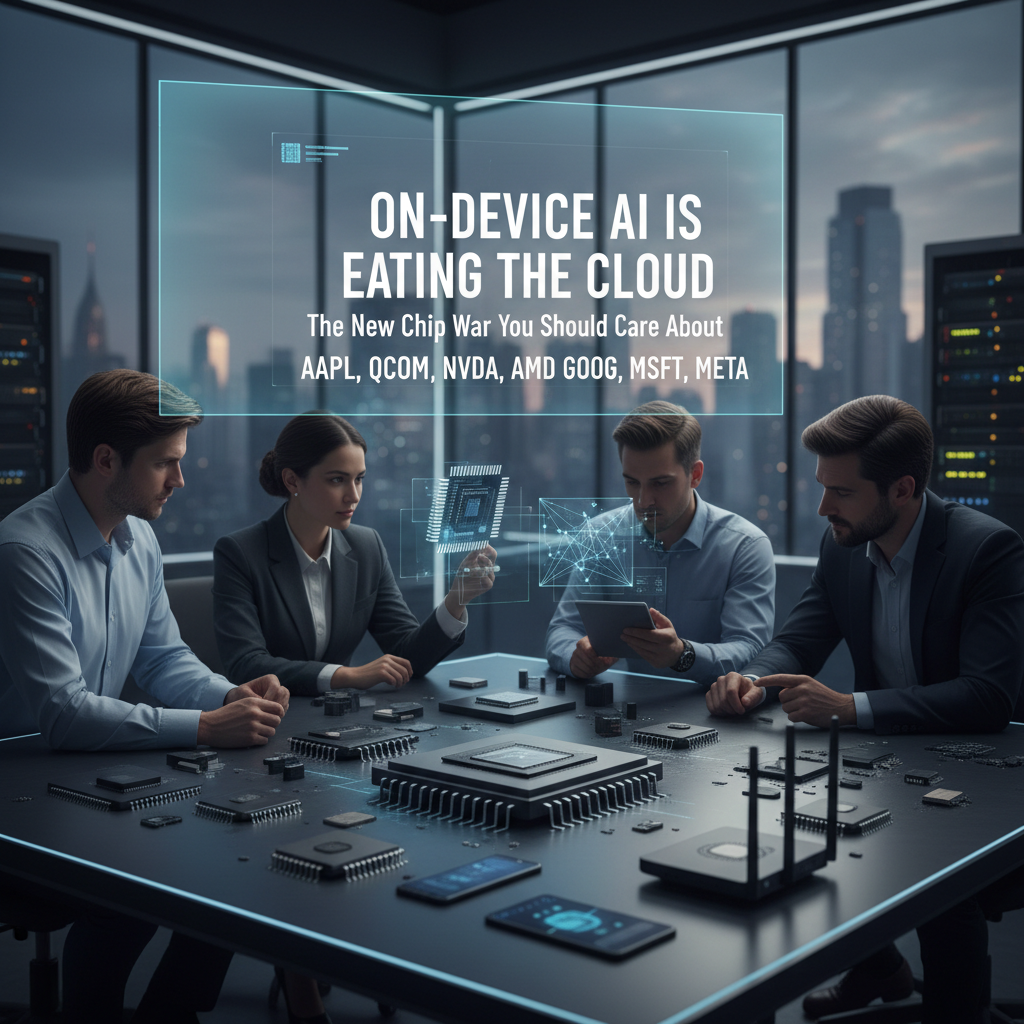
The shift to on-device AI is less about novelty and more about territory. For years the AI story has been dominated by vast data centers and elastic GPU farms. Now the quieter, faster scramble is happening at the silicon level: getting capable models to run where people actually are — on phones, in cars, on routers and even tiny IoT sensors.
Why this matters now
- Mobile chips finally do the heavy lifting. Modern NPUs and neural engines in phones can handle tasks that once needed racks of servers: speech recognition, image understanding, even compact LLM inference.
- Privacy and latency sell. People and regulators prefer local processing for sensitive data, and businesses want instant responses for things like offline transcription or real-time driver assistance.
- The tooling caught up. Techniques such as quantization, pruning and distillation make large models usable on small hardware without completely neutering their capabilities.
Not everything flips to local overnight. Some features will stay cloud-native. But the balance is shifting, and that shift changes who captures value.
Who wins — and why it’s messy
Apple has an obvious edge: tight hardware–software integration. Its Neural Engine plus Core ML give developers a path to fast, private features. Qualcomm wins by volume, supplying chips to hundreds of Android OEMs. Nvidia still matters because of its data-center strength and growing bets on edge accelerators like Jetson, plus partnerships that enable hybrid cloud–edge setups.
Then there are curveballs. Startups and open models — think Llama derivatives — are driving down costs and enabling offline assistants that don’t need platform approval. The result is fragmentation: some capabilities will live locally, others in the cloud, and the biggest winners will be the vendors who make hybrid flows feel seamless.
What’s interesting here is how business models split. Offline features can be sold as one-time purchases; cloud-grade services remain subscription- or usage-based. Companies that stitch hardware, software and developer economics together will shape who gets paid for edge intelligence.
Real examples you probably already use
- Recent phones transcribe speech and translate without touching servers. That saves bandwidth and keeps personal data closer to the device.
- Niche apps are shipping offline generative features by running distilled LLMs on-device or by sending only minimal context to private servers.
Business and investor implications
- Chipmakers: Expect a premium on NPUs and the IP that lets devices do low-power inference. This is an engineering marathon, not a quarterly blip.
- Cloud providers: Their moat for training and massive inference stays intact, but they’ll increasingly offer hybrid toolchains and inference-as-a-service targeted at edge deployments.
- App developers: New monetization options appear — pay once for on-device features, subscribe for cloud-tier capabilities, or mix both.
Limitations and risks
- Energy and thermal constraints still limit model size. A phone is not a datacenter for large-scale generative workloads, at least not anytime soon.
- Updating and governing models across millions of devices is messy compared with controlled cloud deployments.
- Security trade-offs shift. On-device processing reduces some attack surfaces but opens others, especially around physical tampering and local exploitability.
The upshot: on-device AI does not replace cloud AI. It creates a new front in the fight over where value is captured.
Keep an eye on a few signals
- New chips that publish explicit NPU performance-per-watt numbers
- More partnerships between cloud vendors and OEMs to support hybrid deployments
- Consumer features that explicitly market offline intelligence as a premium
Investors should look past raw model hype and focus on integration, distribution and the economics of updates. The edge has stopped being cute; it matters.