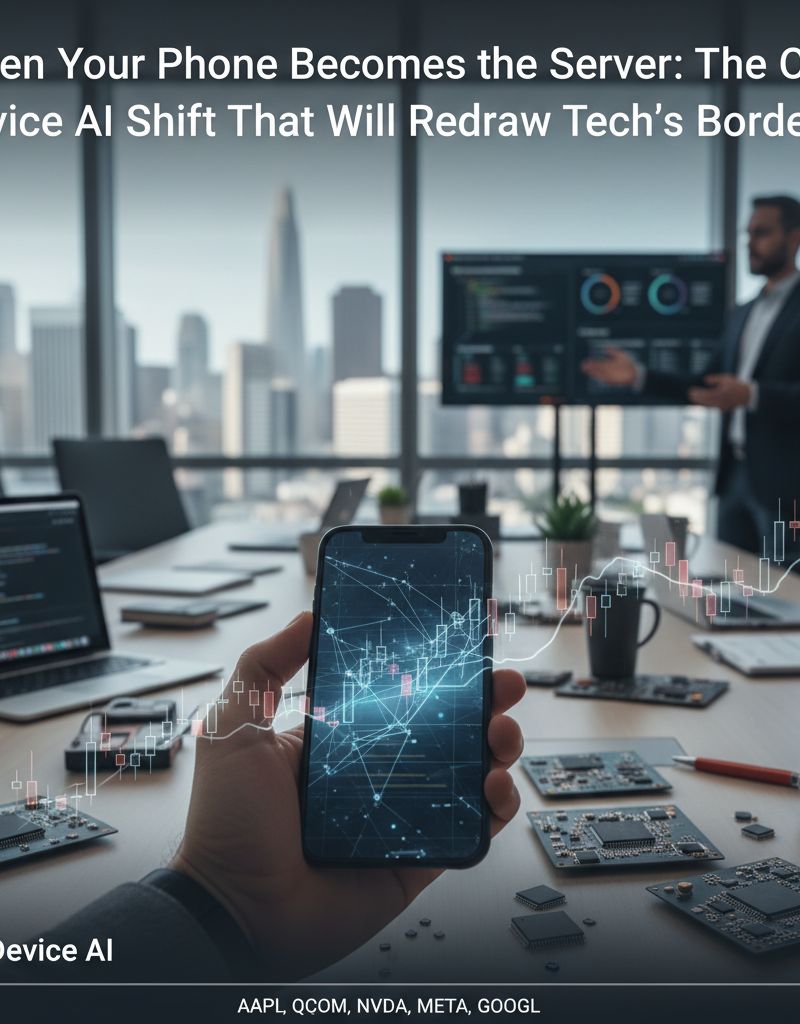
Short version — smartphones are moving from being remote clients for cloud models to running generative models locally. That shift matters for privacy, responsiveness, and who actually captures value across the stack.
Why now
A decade of steady gains in mobile silicon and model compression has quietly reached an inflection. Neural accelerators that used to handle filters and speech recognition now have enough oomph for compact large-language models on the handset. The result: much lower latency, less sensitive data leaving the device, and a fresh battleground for chip vendors and platform owners.
Early signs
- Google’s on-device Gemini Nano and comparable tiny LLMs prove the idea works for chat and assistant-style tasks.
- Apple’s Neural Engine is being tuned to run generative features locally on iPhones.
- Qualcomm and other silicon firms are shipping NPU upgrades explicitly aimed at efficient model inference.
What this means in practice
Privacy-first features. Running inference on-device keeps personal documents and messages off cloud servers — a real selling point for privacy-minded users.
Snappier interactions. No round-trip to a datacenter makes routine tasks feel instant: rewriting an email, summarizing an article, or making quick image edits.
New developer trade-offs. App authors will juggle model size, battery drain, and how to push updates; the app store becomes the primary route for shipping model improvements. Not every app will want to—nor should it try to—run heavy inference locally.
Winners and losers (it’s complicated)
Likely winners: phone makers that integrate hardware and software tightly, chip companies selling low-power NPUs, and startups that specialize in compression or edge-serving stacks.
Not automatic losers: cloud providers still own the largest models and the training workloads. On-device inference reshapes cloud demand rather than replacing it.
Business-model implications
Subscriptions and in-app purchases become more plausible for some on-device services, because personalization often happens locally and is harder to monetize with ads. Enterprises will favor hybrid architectures: local inference on privacy-sensitive frontlines, cloud for bulk analysis and model training.
Technical limits and caveats
Battery and thermal constraints are real. Sustained inference on a phone is a different problem from the occasional assistant query. And fidelity matters: the biggest, state-of-the-art models still need datacenter GPUs. On-device models will prioritize utility and efficiency over headline-grabbing creativity.
The investment angle
This isn’t just an AI-chip ticker story. The opportunity is an ecosystem play:
- silicon makers that can certify low-power NPUs and sell to handset OEMs;
- platform owners that bundle on-device features and thereby deepen user lock-in;
- infrastructure firms that shift to hybrid offerings and orchestration between device and cloud.
Names to watch and why
- AAPL — tight hardware/software integration gives it a clear path to monetize on-device AI via services.
- QCOM — modem + NPU roadmap positions it well for hardware enablement.
- GOOGL — pushing on-device models into Android while retaining cloud model leadership.
- NVDA — remains central for training and large-model inference in data centers.
- AMZN — AWS’s enterprise reach makes it a likely player in hybrid tooling and deployment.
Longer view
On-device intelligence will coexist with cloud AI. Expect everyday personalization and privacy-preserving tasks to run locally, while the cloud handles the biggest models, multimodal fusion, and continuous training. For investors, the early winners will be suppliers and integrators who enable this hybrid architecture, not companies that only slap AI on their marketing slides.
Final thought
On-device LLMs are practical and commercially meaningful. They cut latency, improve privacy, and open new monetization routes — all while preserving the need for cloud scale. That middle ground is where the most interesting opportunities will appear.