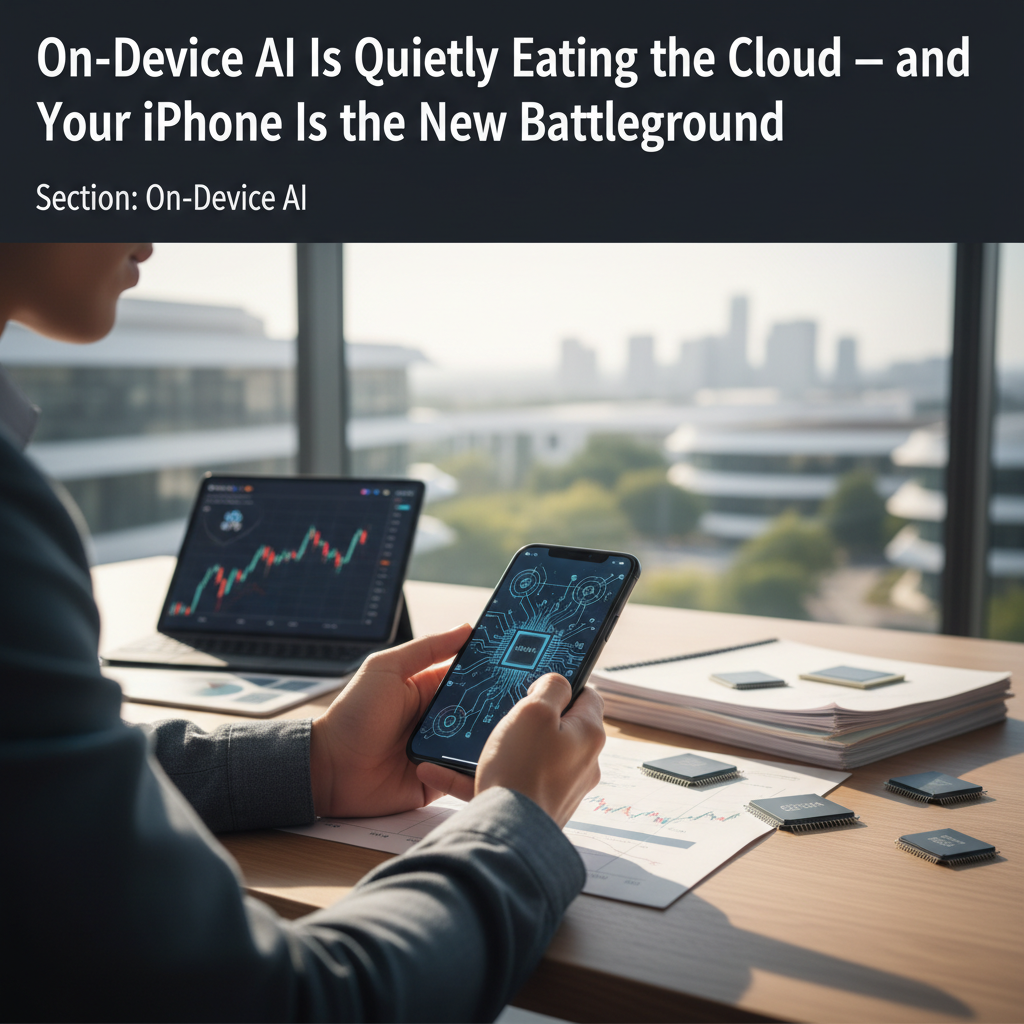
AI is moving off servers and into pockets. It sounds like a small shift until you notice how it reshuffles who captures value, who holds user data, and who gets to charge for AI services.
Smartphone makers, chip architects, and a new class of app developers are quietly tuning generative models to run locally. The payoff is more than snappier replies or offline modes — it’s a structural change in AI economics.
Why this matters
- Low-latency tasks — translation, transcription, real-time image tweaks — suddenly work without a network hop. That feels better for users and trims cloud compute bills.
- Keeping inference on-device keeps raw data on the phone. For people tired of surveillance-by-default, that’s as persuasive an improvement as longer battery life.
- Hardware AI accelerators — think Apple’s Neural Engine, mobile SoCs with NPU blocks, and specialized laptop chips — create product differentiation the way camera ISPs once did. Those hardware differences stick.
What’s interesting is how practical this already is. Short models, quantized weights, clever compression — they’re moving into phones and tablets now.
Winners and losers (roughly)
- Winners: chipmakers and OEMs that ship efficient NPUs plus a deployment stack; app teams that can charge for premium offline features.
- Losers: parts of the cloud stack that depend on volume inference revenue, and startups built on unlimited server-side models without any hardware defensibility.
It’s not absolute — many companies will straddle both worlds — but the direction favors devices that can do useful work without a round trip to the data center.
A few real-world sketches
- On a recent flight I tried a local audio transcript: no upload, instant timestamps, and reasonable battery use. It felt like offline maps all over again — less creepy, more useful.
- Developers are shipping compressed LLMs and quantized vision models that fit inside mobile memory. That slashes dependence on continuous API calls and recurring compute bills.
Cloud isn’t dead
High-end generative models still need big memory, periodic retraining, and centralized orchestration. Expect a hybrid model: devices handle interactive prompts and local privacy-sensitive work; heavyweight training, long-context summarization, and large-batch jobs stay in the cloud.
In practice, though, that hybrid will change margin pools and where monetization happens.
What investors and product leads should watch
- Hardware roadmaps: NPUs per watt, memory bandwidth, and SDK maturity. Those are real, defensible advantages.
- App-store rules and billing models. Apple and Google still gate distribution; their terms shape how on-device monetization actually looks.
- Startups focused on model compression, secure update channels, and cross-device sync. These firms enable the shift and are obvious acquisition targets.
A short historical lens
Remember smartphone cameras: processing moved from brute-force megapixels to smarter on-device pipelines. The firms that owned that stack captured margins and loyalty. On-device AI is tracing a similar path — faster this time, because models and tooling are improving quickly.
Expect two tiers to emerge: seamless, private experiences handled locally, and heavyweight cloud services for scale and periodic retraining. For investors that means thinking beyond model hype — silicon and smart middleware will matter as much as algorithmic novelty.
Read this as a nudge: the next decade of AI returns will be shaped as much by hardware and distribution as by the models themselves.