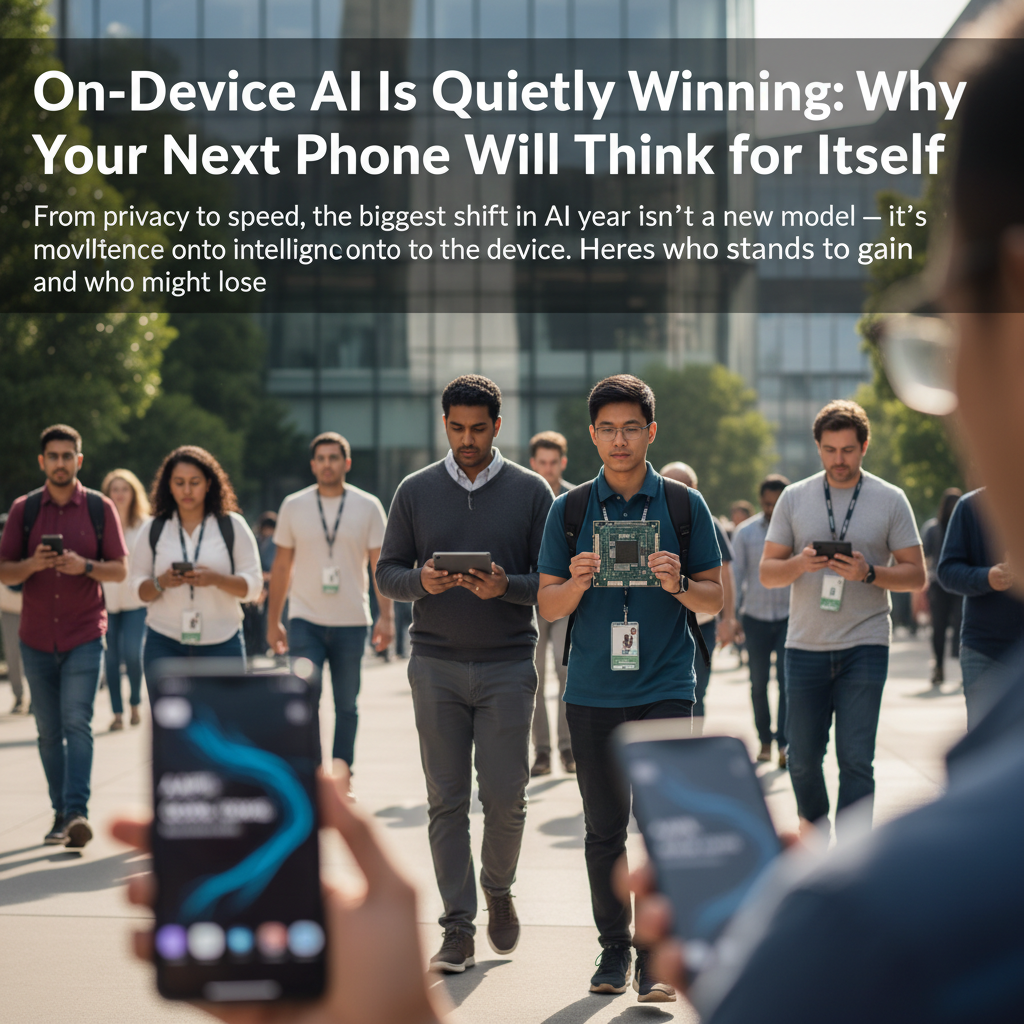
A short truth: AI isn't just about bigger models anymore.
For most people the visible change is simple — faster replies, useful offline features, and fewer privacy headaches. Underneath that, though, an awkward industry pivot is happening: silicon, runtimes, and compact language models are being rebuilt to run where your data already lives — on your phone, laptop, or earbud.
Why on-device matters now
- Latency and offline use. Small tasks — transcribing a voice memo, touching up a photo — no longer need a cloud round-trip. That makes a real difference for everyday apps.
- Privacy as a selling point. Running inference locally means less data leaves the device. Consumers notice this, and regulators do too.
- Cost and resilience. For companies, moving inference to devices trims cloud bills and reduces reliance on central servers. Fewer outages. More predictable margins.
I say this as someone who's watched two forces collide: the old cloud-first economics and the blunt realities of battery, thermals, and app-store rules. Scaling models still matters — but it is only part of the story.
Who’s actually in the race
- Chipmakers that deliver efficient NPUs win over time. Qualcomm’s mobile AI silicon and Apple’s Neural Engine are obvious beneficiaries because developers want predictable performance.
- Software stacks that make deployment painless matter as much as the silicon. SDKs, compilers, and quantization tools are the quiet workhorses that turn research into features people use.
- Cloud vendors don't lose their role — they become training and orchestration backends. Expect hybrids: heavy lifting in the cloud, light smarts at the edge.
Real, not hypothetical, use cases
- Real-time voice transcription that works offline — imperfect, yes, but fast and private enough for most users.
- On-device photo editing that uses generative models to remove objects or change styles without uploading images.
- Assistants that summarize recent messages or emails locally, saving a round-trip and keeping sensitive context on the device.
Notes of skepticism
On-device AI is not a panacea. The best models still require cloud-scale training. Shipping updates is more awkward. Some tasks simply need larger context windows than a phone can hold. Battery and thermal limits are stubborn. And yes — there is a real risk of fragmenting the user experience across devices and chipsets.
What this means for people who build and buy products
- Consumers will get features tied to device capabilities, not only subscription tiers. Your favorite new trick might only run on certain chipsets.
- Developers must choose: aim for the lowest common denominator, or target premium silicon and offer richer experiences. That decision will shape app ecosystems and who can monetize what.
For investors
This looks like a platform fight, not a single-product race. Companies that control both hardware and software, or that have deep mobile relationships, can capture outsized value. Expect incumbents to defend margins by owning more of the stack and distribution, while smaller teams try to win through software innovation and niche focus.
Final thought
In five years on-device AI will feel ordinary — just another app feature, not headline news. But the economic and privacy consequences are significant. If you care about where value accrues, watch the silicon and software pipelines, not only the size of the newest model. My bet is on the quiet winners: the teams that make AI useful and mostly invisible on the devices people already carry.