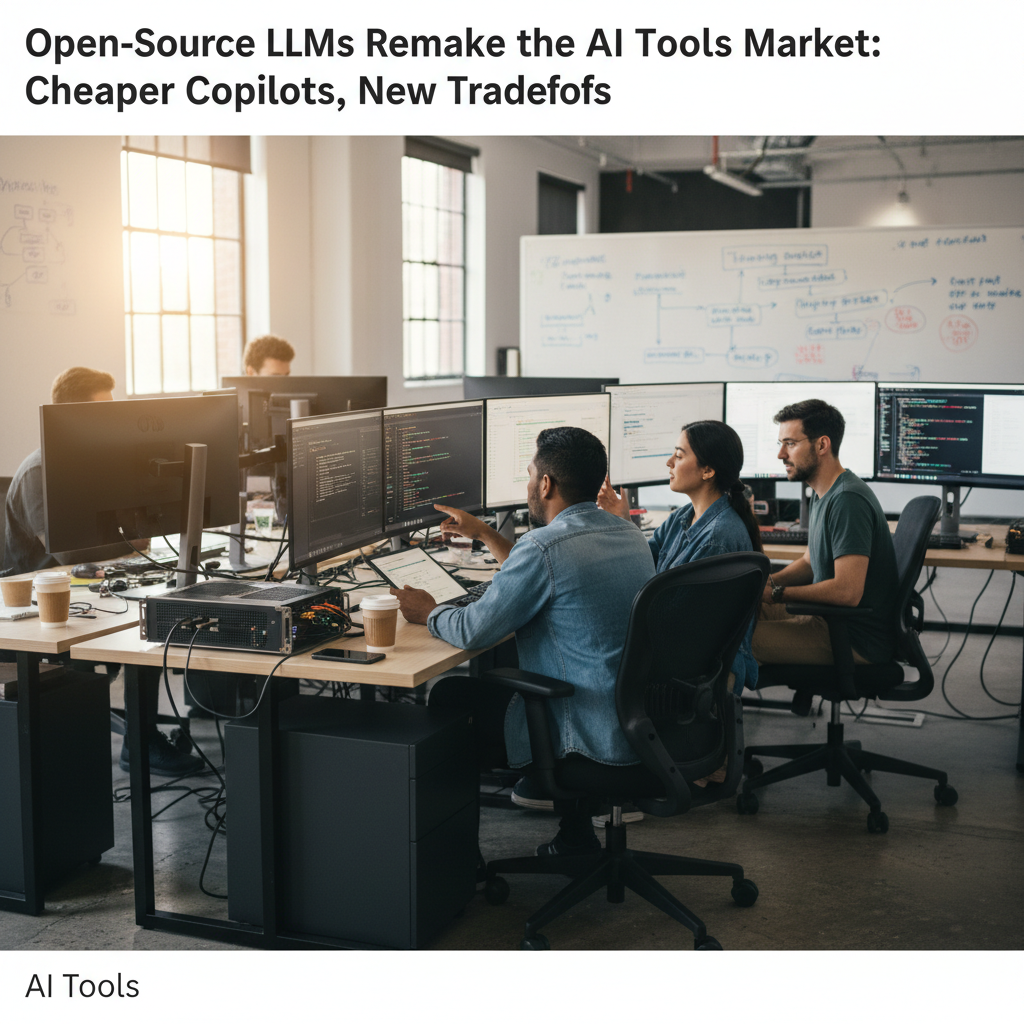
The setup has changed. For the past couple of years the quickest path to an AI-enabled app was an API key and a credit card. That’s still true for many teams, but it’s no longer the only sensible option.
Open-source large language models have gotten surprisingly capable, fast. Around them sits an ecosystem — Hugging Face libraries, quantization tools, inference runtimes and turnkey hosts — that makes it realistic for midmarket teams to run useful copilots on their own infrastructure without bankrupting the company.
Why this matters now
- Lower marginal costs. Organizations that were paying tens of thousands a month for API calls are discovering that self-hosted inference, especially with 8-bit or 4-bit quantization, can slash per-query costs. That arithmetic actually matters when you’re handling high-volume work like support routing, automated content, or code completion.
- Privacy and control. If your data is sensitive, isolation and auditability matter more than convenience. On-prem or private-cloud models cut the surface area for leakage and make conversations with legal and compliance a lot simpler.
- Faster iteration. Open models let product teams fine-tune, add RAG layers, and experiment without waiting on a third party’s roadmap. You can ship changes faster — though that comes with responsibilities.
It isn’t free
Running models yourself doesn’t make costs vanish; it reallocates them. Engineering, MLOps and hardware show up as new line items. Common friction points I keep seeing:
- Model ops. Versioning, drift monitoring and retraining pipelines are real work. Plan for at least one senior ML engineer per critical model.
- Hardware and latency. Inference at scale still needs GPUs or carefully tuned CPUs. Cloud GPU rental is fine for bursts; for steady loads it becomes expensive.
- Quality gap. The latest closed models still outperform open ones on certain tasks. Open weights are improving fast, but for some use cases the difference will be noticeable.
A short history that helps explain this
We’ve seen this pattern before: software that started as third-party hosted services drifting back toward customer-controlled deployments — email, CRM, storage. The promise of simplicity gave way to hybrid models and on-prem options when control and cost mattered. AI is repeating that arc, just compressed into months instead of years.
Who benefits — and who loses
Winners
- Small and mid-size companies with steady workloads and engineering capacity. They can cut costs and win on privacy.
- Toolmakers building modular pieces — inference runtimes, model observability, lightweight fine-tuning — will find demand.
Losers
- Pure API-only businesses that relied on usage fees will need to add value layers or carve a niche to survive.
- Tiny teams without ML expertise may still prefer hosted APIs despite higher marginal costs. Sometimes convenience beats thrift.
Concrete places to watch
- Hugging Face and similar hubs are now the default marketplace for open models and tooling.
- Companies like Runway and Stability AI show how models can be productized for creative use cases; enterprises gravitate toward vendors that bundle deployment and compliance.
- Infrastructure providers — NVIDIA, cloud vendors, edge accelerator makers — remain central. GPU availability, efficient tensor runtimes and edge hardware determine who can scale cheaply.
Investor and product thinking
- Investors should look at companies that simplify orchestration and observability for open models, and those that shrink the engineering burden of self-hosting.
- Product leaders need to evaluate total cost of ownership, not just API sticker price. Staffing, monitoring, and fallback plans when accuracy drops are part of the bill.
So where does this leave us
Open-source LLMs change the calculation. The choice is no longer simply API or nothing. More often it’s layered: API for quick wins, self-host for scale and privacy, hybrid when you need both. Expect a crowded market as vendors race to hide the messy model-ops work and make operating a copilot feel as painless as subscribing to one.
Quick action checklist
- Audit current API spend and traffic patterns.
- Prototype a small self-hosted model with quantized weights to test cost parity.
- Put monitoring in place for hallucinations and latency before you roll anything out widely.
This is the kind of technical curve that separates opportunistic adopters from durable competitors. The teams that win will be those that master both product design and the plumbing under the hood.