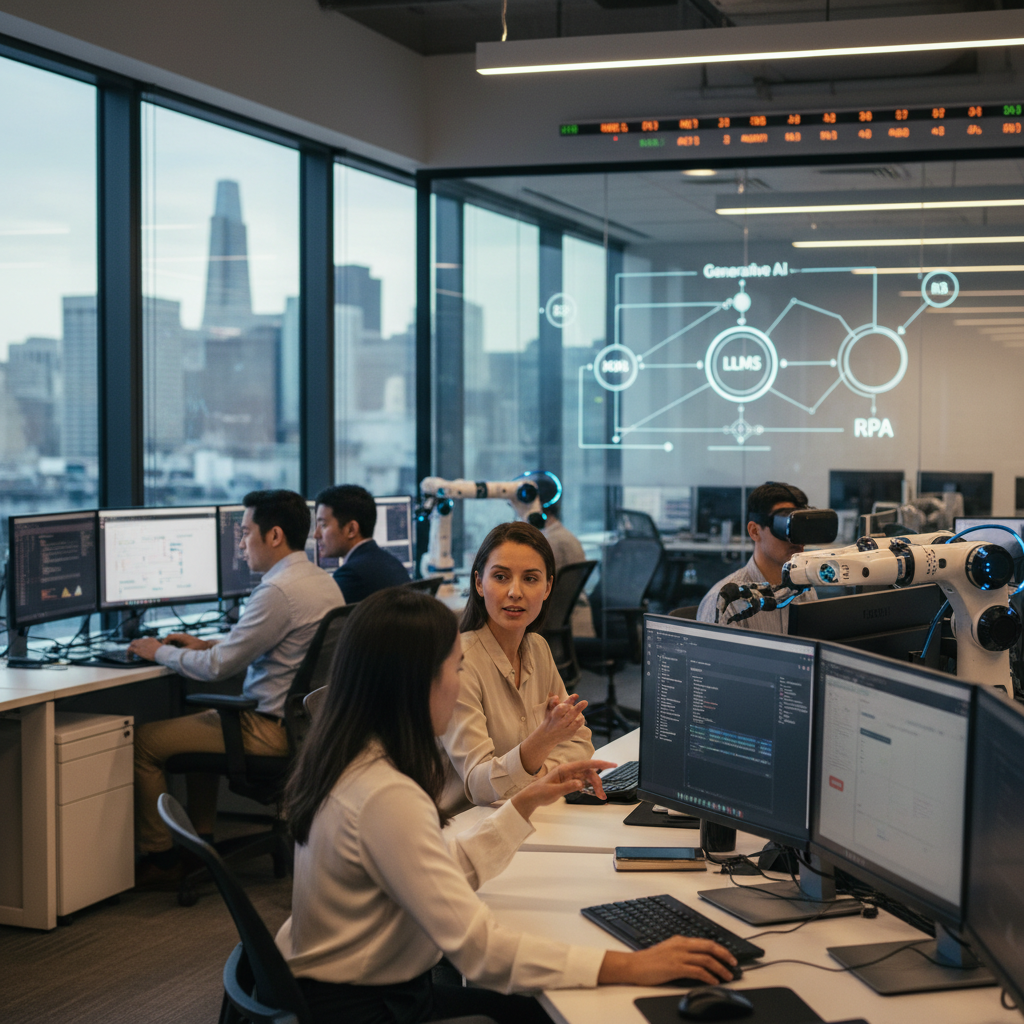
The pitch, in one line: marry rule-based robots with large language models so the messy, unstructured work that broke first-generation RPA finally becomes automatable.
For years RPA sold big cost wins on predictable tasks. It worked — until brittleness, constant exceptions, and expensive scaling made further gains disappear. Now teams are wiring LLMs into workflows — not to replace RPA, but to make it less fragile and more adaptive.
What’s actually changing
- Enterprises are pairing RPA engines with LLMs for things like document understanding, conversational handoffs, and resolving exceptions. Imagine invoices that used to require a human glance, customer emails that kick off multi-step processes, or freeform CRM notes that finally turn into structured records.
- Major cloud and automation vendors now offer native connectors to models, so you can call a model from a process instead of building sprawling rule trees that break as soon as the input shifts.
Real examples that matter
- Accounts payable: a model extracts line items from PDF invoices; the bot posts entries to the ERP; and an AI-driven confidence score sends only low-confidence cases to humans. Fewer touchpoints. Humans focused where judgment actually matters.
- Customer support triage: a conversational model summarizes intent and fetches context; RPA then executes the follow-ups — token resets, refund processing, whatever the script dictates.
Why this sticks now
- Models are simply better at reading messy text and inferring intent. That addresses RPA’s biggest blind spot.
- Cloud APIs, cheaper compute, and off-the-shelf connectors make integration far less painful than before.
- Macro pressures — limits on hiring, tighter margins, and demand for speed — are forcing organizations to automate beyond routine tasks.
Not a cure-all
- Hallucinations and drift remain real. Model outputs can be incorrect or inconsistent, so you trade one form of checking for another.
- Compliance and auditability complicate things. Rule-based bots were straightforward to trace; generative pieces require logging, deterministic checks, and explainability practices.
- Hidden costs add up: inference fees, pipelines to re-train or fine-tune, and governance overhead that many CIOs underbudget.
A short history, so we don’t get carried away
RPA’s first wave shaved FTE costs using screen-scraping and macro-like automations. It failed to scale because business processes are noisy and changeable. The current wave feels different because some of that noise can now be modeled. Still, patterns repeat: early wins, then a plateau once ops, governance, and talent constraints show up.
Practical playbook for CIOs and operators
- Start with hybrid pilots. Pair an LLM with RPA on a contained use case — invoices, returns, onboarding — and measure end-to-end error rates, not just raw throughput.
- Build guardrails: require minimum confidence thresholds, deterministic fallbacks, and clear human-in-the-loop escalation paths.
- Invest in monitoring and data ops. Track model drift, shifting input distributions, and the downstream errors those shifts produce.
- Upskill teams for prompting and evaluation. These become operational skills on par with traditional automation development.
Investment and market angle
Public automation vendors are already priced for this pivot. Those with deep cloud partnerships and native model connectors have an edge for enterprise rollouts. Long term, winners will be the firms that combine automation with strong governance and vertical expertise — not just the vendors with the largest model.
Where this lands
This is not the grand reinvention some marketing promises imply. It is a meaningful, incremental shift: previously unautomatable parts of workflows can now be handled, but only if organizations accept new risks and build the operational muscle to manage them. The opportunity is real, but so is the discipline required.
Actionable takeaways
- Pick one messy workflow and instrument it end-to-end for a 90-day pilot.
- Require auditable fallbacks for any generative step.
- Budget for model ops and monitoring, not just license fees.
Pedro Marini