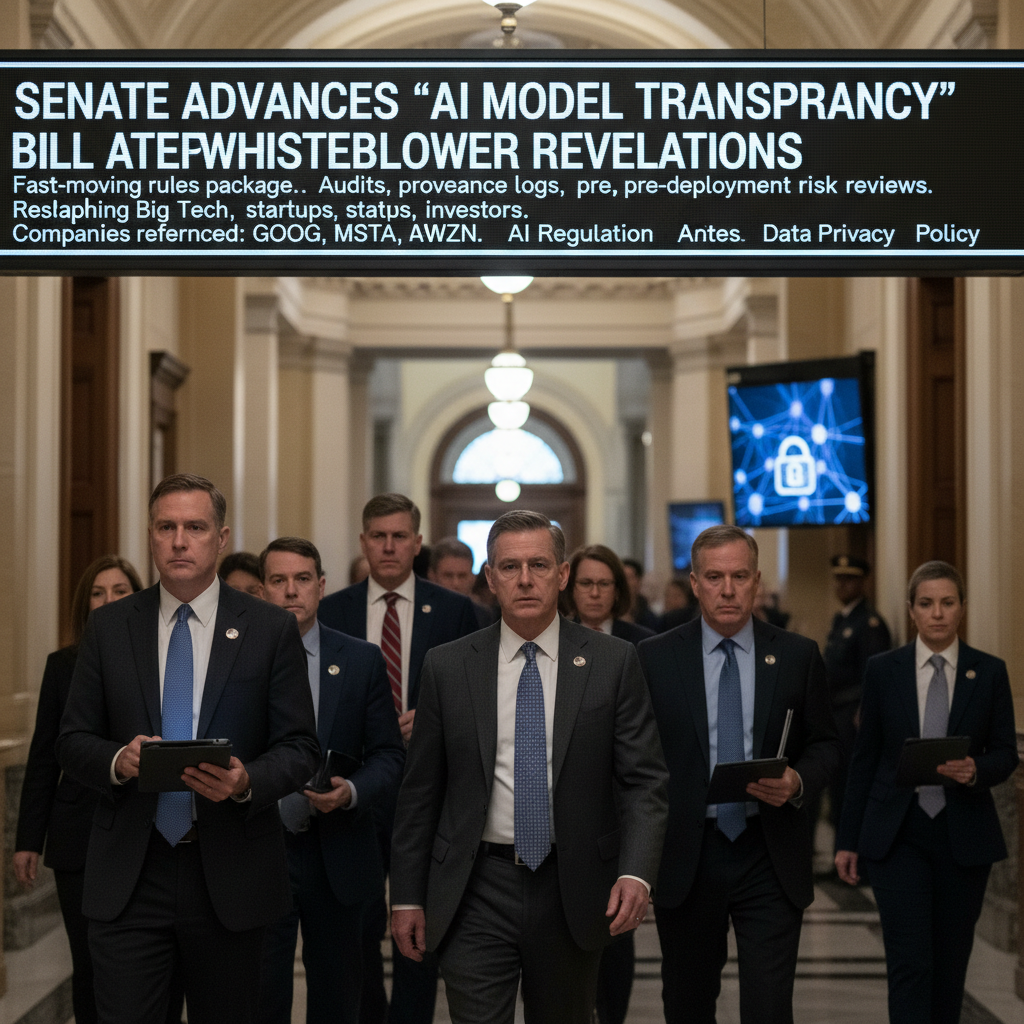
Washington — The Senate took a big step today toward passing the so-called AI Model Transparency Act, a bipartisan package that would force firms to document datasets, publish model provenance logs and put high‑risk models through third‑party audits before wide deployment.
Lawmakers framed the bill as a response to recent whistleblower revelations and some high‑profile failures that exposed gaps in how foundation models are built and overseen. If enacted, it would be the most consequential U.S. regulation of AI since Congress began tackling online privacy a decade ago.
What the bill would require (headline items)
- Pre‑deployment risk assessments for models that cross specified size or revenue thresholds.
- Provenance logs showing data sources, labeling practices and any major retrains.
- Independent audits for models judged to pose high risks — bias, misinformation or systemic harms.
- A limited “right to audit” for certain government and nonprofit actors, plus mandatory remediation timelines.
- Enforcement authority for the Federal Trade Commission and civil penalties for noncompliance.
Why this matters now
Two forces have collided: public alarm after whistleblower disclosures about undisclosed training data, and the sheer economic scale of modern models. Senators pitched the bill as a pre‑emptive fix — designed to prevent cascades of harm that could erode market trust and public services. Think of it like a Sarbanes‑Oxley moment for models: stricter controls after a credibility shock. What’s interesting is how that analogy only goes so far; models aren’t ledgers, and the enforcement challenges will be different.
Market and industry implications
- Big Tech: Firms with deep compliance budgets — Alphabet, Microsoft, Amazon and Meta — are best positioned to absorb these rules. That could widen incumbent advantages. At the same time, disclosure requirements may surface previously opaque practices.
- Chips and services: In the near term, chipmakers and cloud providers could see more demand for costly re‑training and secure infra. That’s a tailwind for companies like NVIDIA.
- Startups: Smaller teams risk heavy compliance burdens or long audits, slowing product cycles and complicating venture decisions. Some may pivot away from high‑risk use cases to avoid the hassle.
Political and legal friction
Expect amendments and court fights. Civil liberties groups like the transparency but worry about exposing sensitive data; industry lobbyists are already pushing carve‑outs for trade secrets and national security. The bill’s text tries to thread that needle, but key questions remain: how big is a regulated model, how detailed must provenance be, and who gets to label something “high risk”? Those answers will determine whether the law mostly protects incumbents or actually builds a safety floor.
A few historical comparators
- GDPR pushed firms in Europe to rethink data handling; this U.S. effort reads more targeted at model behavior than at personal data alone.
- Sarbanes‑Oxley (2002) responded to a loss of trust with audit and reporting burdens that reshaped corporate governance. This bill could do something similar for model development — though the mechanics will differ.
What investors should watch next
- Committee vote timing and any startup carve‑outs.
- How thresholds are defined (model size, user base, revenue) — those lines will move markets.
- Amendments that narrow public disclosure to protect trade secrets.
What this could mean
This isn’t a minor tech‑policy tweak. It’s an attempt to put legal guardrails around arguably the most generative and unpredictable technology in the market. Short‑term winners look to be vendors of secure cloud, audit services and chips; losers could include moonshot startups that can’t absorb long compliance cycles. For lawmakers the test is whether the bill actually reduces harms without freezing innovation — a tough balance, and one that will shape U.S. AI policy for years.
The Senate’s timetable is tight; expect floor debate and heavy lobbying in the coming days.