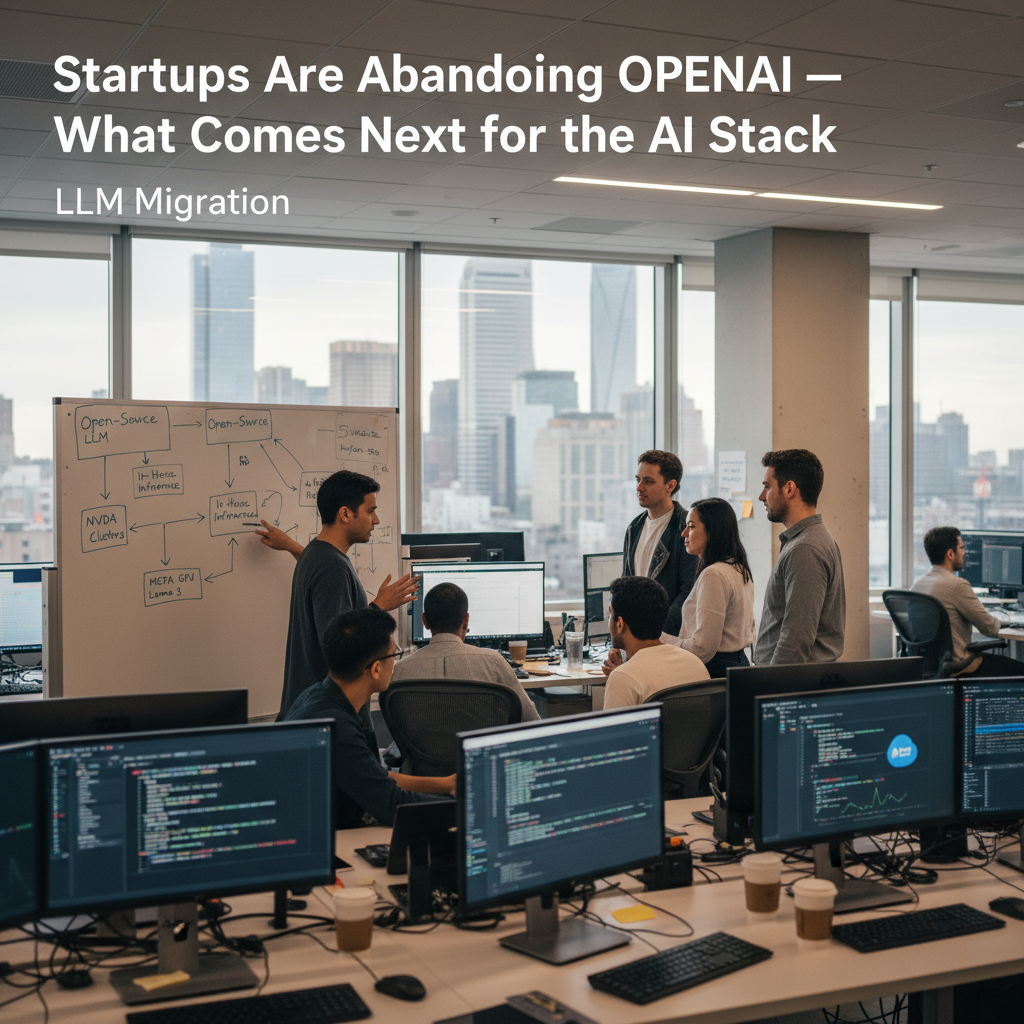
The last two years have started to feel less like a creative boom and more like a market correction dressed up as innovation. Startups that once treated OpenAI as a fast lane to generative features are quietly reworking their stacks. It isn’t ideology driving this so much as plain finance, plus a desire for control and easier compliance.
Why they’re switching
Open-source large language models have stopped being academic curiosities. For teams squeezed by rising API bills and tightening unit economics, they are a practical alternative. Running an open model or doing inference in-house tends to buy three things right away:
- Cost predictability. Per-token bills swing. At scale, fixed infrastructure and sensible capacity planning can be a lot cheaper.
- Customization. Fine-tuning or retrieval-augmented approaches on private weights reduce hallucinations tied to generic APIs.
- Data and compliance control. Startups in finance, healthcare, or government-adjacent work prefer in-house models to limit third-party data exposure.
That said, this isn’t a universal migration. The switch requires engineering time, MLOps skill, and hardware commitments. Early-stage teams face a different trade-off than growth companies already shouldering hefty AI bills. In practice, though, the story is messier than a clean cutover.
What founders are actually doing
I talked with a number of founders and engineers. Their playbook looks familiar:
- Ship fast on a cloud API to validate the idea.
- Once usage crosses a threshold, port the heavy flows to an open model and run inference with a managed provider or on dedicated GPUs.
- Hybrid mode: keep sensitive or high-volume work on private inference, and leave experimental or low-volume features on external APIs.
One stealth fintech told me they halved monthly AI spend after shifting core scoring to a fine-tuned open model, while leaving the conversational UX on a third-party API. Not a universal win, but a meaningful shave.
Winners and losers in the stack
- Cloud providers still win on convenience and reliability. Their inference margins, though, are coming under pressure.
- GPU vendors stay central. Expect demand to tilt toward inference-optimized chips and rack-scale solutions instead of pure training clusters.
- Inference marketplaces and model hubs are gaining traction as intermediaries — a middle path for teams that want lower cost without building full ops from scratch.
What this means for investors
Money follows economics. Startups that can lock in predictable AI costs and show defensible fine-tuning — true vertical expertise, proprietary retrieval stores, or latency advantages — will command healthier multiples. Companies that remain hostage to rising token bills will face margin skepticism from acquirers and late-stage investors. It’s a numbers game more than a narrative one.
Risks and counterpoints
- Quality gap. The best closed models still lead on some benchmarks. For customer-facing products that gap can translate into fewer users and slower growth.
- Talent squeeze. Running models at scale needs MLOps engineers — a scarce, expensive hire.
- Fragmentation. A fractured model ecosystem increases integration and maintenance work, which can slow down feature velocity.
What to watch next
- Pricing changes from major API providers. Small tweaks there can flip the economics back overnight.
- New inference hardware and startups promising cloud-like reliability at lower cost.
- Regulatory nudges around data residency and model provenance that could force in-house operation for certain industries.
The real point
This feels less like a revolt and more like maturity. Startups are learning something simple: generative AI is a product lever, not a free lunch. Control over the model and the economics of inference are becoming routine operating decisions — the same way hosting and database choices mattered a decade ago. For founders and investors the question has shifted from whether to use models to where they should run them and who ends up paying the bill.