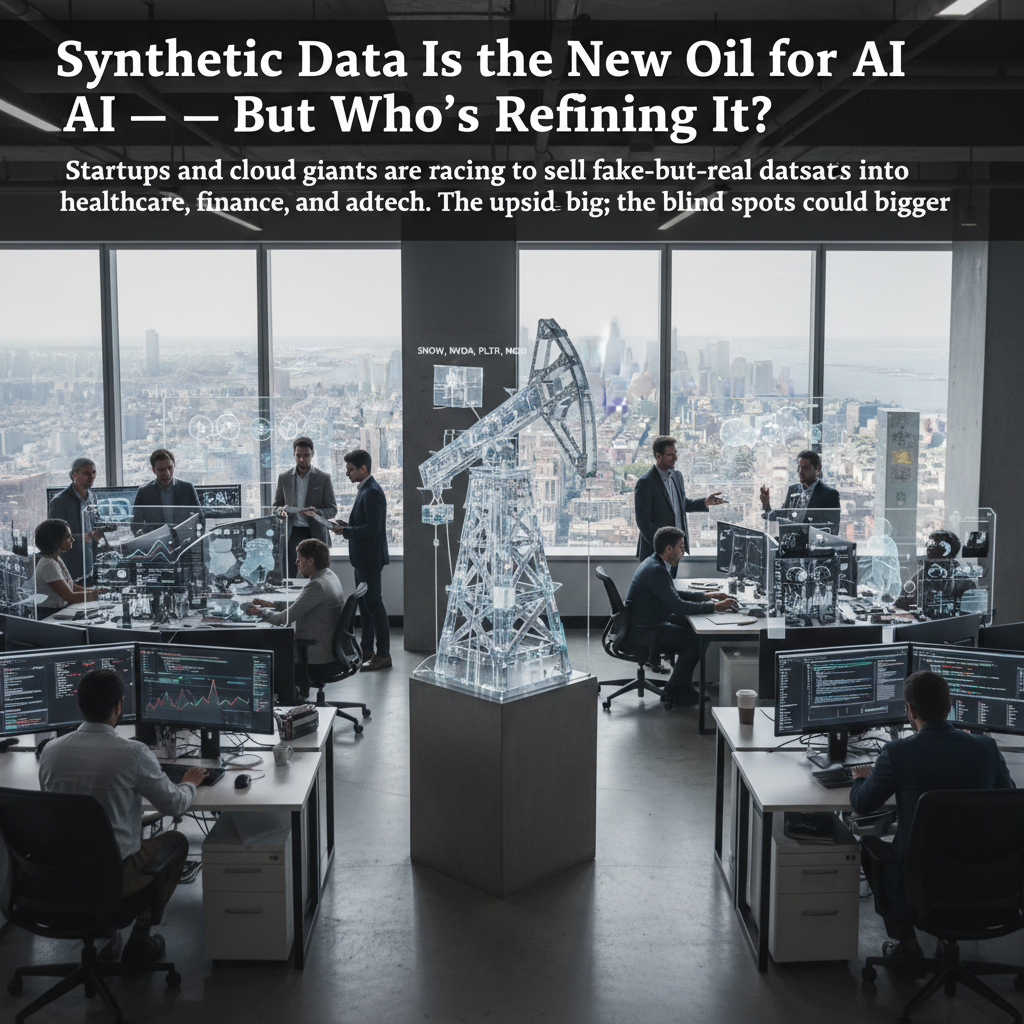
Synthetic data has slid from a niche research trick into a boardroom staple. Investors keep pouring money into companies that promise privacy-safe, labeled datasets on demand, and cloud vendors are building marketplaces to sell model-ready inputs. Sounds like efficiency and compliance — until you peek under the hood.
This isn’t merely a technical convenience. Think back to the ad-tech gold rush of the early 2000s, when raw user logs suddenly became a new asset class. Synthetic data feels like a subtler sequel: instead of swapping identities, firms are packaging distilled behavior, demographic patterns, and rare edge cases models crave. The twist is the product is deliberately unreal while still statistically plausible.
Why companies are buying synthetic data now
- Less privacy friction: hospitals and banks can share usable datasets without handing over real patient or customer records.
- Faster labeling: simulators and generative models can seed training sets for rare events — think fraud spikes or safety failures.
- Scale and cost: generating data is far cheaper than recruiting and annotating human subjects at volume.
Concrete examples
- Healthcare startups prototype diagnostic models on synthetic patient records to avoid months of IRB and legal hurdles.
- Fraud teams inject synthetic anomalies to teach detection systems to spot novel attack patterns, without risking real customers.
- Autonomous vehicle groups stitch together edge-case scenarios — icy curves, odd roadworks — so models see dangers they might otherwise never encounter.
But the upsides come with real caveats.
The invisible risks
- Bias amplification: if the generator learned from biased inputs, the synthetic output can lock in and multiply those biases.
- Distribution drift: generated scenarios often fail to capture future real-world shifts, leaving models brittle when behavior or markets change.
- Provenance opacity: tracing a sample back to the original records is often lossy, which makes audits harder than firms admit.
What’s interesting here is how regulators are responding. Treating synthetic outputs as automatically safe can be a legal mirage; some frameworks will examine whether data is meaningfully derived from individuals. So compliance teams need new standards for provenance, testing, and documentation — not just the mantra synthetic equals private.
How investors are parsing the market
There are three broad plays emerging, and they’re starting to diverge in real ways.
- Marketplaces and warehouses: platforms that host and distribute curated datasets.
- Domain specialists: vendors that sell tailored generators and augmentation tools for industries like health, finance, or autonomous vehicles.
- Validation tooling: startups that certify synthetic quality, quantify bias, and provide lineage.
Watch Snowflake and Palantir — their products sit at the crossroads of storage, sharing, and model tooling. Nvidia matters on the compute side; you don’t generate massive image or video datasets without GPUs. Expect many private firms to become acquisition targets for the big cloud and enterprise players.
Questions boards and CFOs should be asking
- How do you validate synthetic data against real-world model performance?
- What controls measure and mitigate bias introduced during generation?
- Do contracts demand lineage disclosure so auditors can reconstruct provenance if needed?
There’s a neat paradox at the center of this trend: synthetic data promises to free innovation from privacy constraints while creating a new kind of opacity. For operators that means moving fast, but with healthy skepticism. For investors it means betting on companies that solve trust — not just generation.
If you care about AI that actually works in regulated industries, the smarter wager isn’t necessarily the loudest generator. It’s the firm that can prove its data is trustworthy, auditable, and resilient when the real world bends.
Watchlist and near-term signals
- In the short run: expect more partnerships between synthetic vendors and cloud marketplaces.
- Medium term: due diligence and third-party validation will drive M&A activity.
- Longer term: how regulators define synthetic data will shape which business models survive.
Pedro Marini