Why this matters now
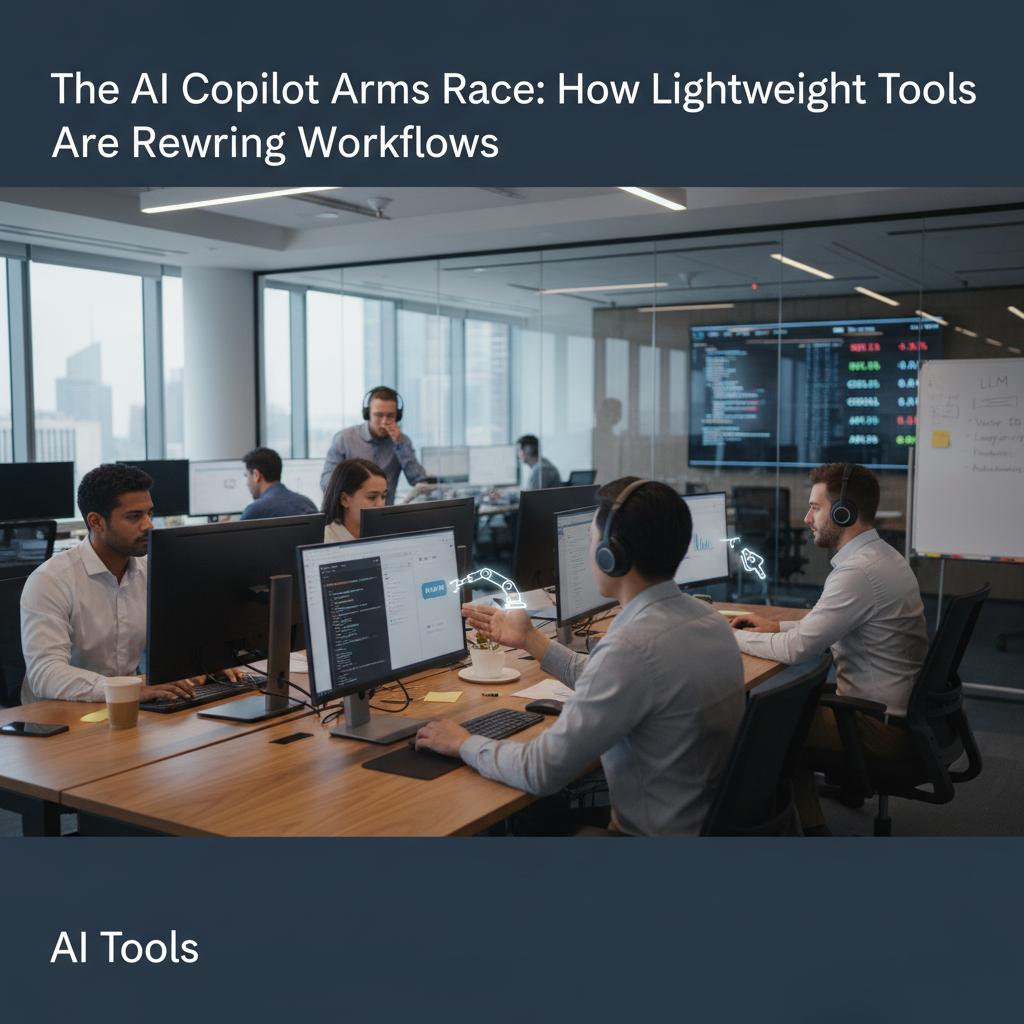
AI copilots have stopped being abstract demo reels on slide decks. They're small, focused assistants now embedded in email, CRMs, IDEs and browsers, shaving minutes off routine work and changing how knowledge gets handled. The result is a fast-moving market: startups and Big Tech are racing for control of the human-in-the-loop workflow — not just features, but the places where people actually do their work.
A short history, because context matters
This wave follows three earlier shifts: the SaaS boom, the API economy, and the open-source LLM era. It’s the macro-to-micro swing after the platform consolidation of the 2010s. Back then software scaled by piling modules onto big suites. Today, scaling often means replacing tiny friction points with context-aware assistants that sit inside the tools people already use.
Who’s building what
- Big Tech: Microsoft is spreading Copilot through Office and Azure; Google is folding Gemini into Workspace; Apple is more cautious but moving (yes, even Apple). These moves are less about single features and more about lock-in and data flows.
- Verticals and startups: legal, finance, engineering teams are deploying private copilots — fine-tuned or open models behind company firewalls. Think code copilots in IDEs or contract-review tools for law firms.
- The plumbing: LangChain-style orchestration, vector databases like Pinecone, Milvus, Weaviate, and inexpensive fine-tuning pipelines are the quiet enablers behind the scenes.
The practical upside — and the catch
- Productivity: drafting, summarization, retrieval — all noticeably faster for specific tasks. In some workflows, time savings multiply.
- Fragmentation risk: dozens of niche copilots, each with different behaviors, can become a cognitive tax rather than a help.
- Hallucinations and liability: domain-specific fabrications remain a real threat in compliance-heavy sectors like finance and healthcare.
A concrete example
A mid-sized law firm replaced a first-pass document review team with a private LLM pipeline. Reviews took half the time. Sounds great, except partners now spend more time validating edge cases. The savings were real, but oversight didn’t vanish — it shifted. That’s the practical lesson: efficiencies arrive, but responsibility moves.
Market implications
There are obvious knock-ons. More demand for GPUs and specialized instances benefits cloud providers and hardware vendors. Software winners will be those that combine deep integration, reliable retrieval, and enterprise controls — the rest risk fragmentation.
Expect budget changes too. IT spend will tilt away from generic SaaS seats toward AI integration and compute. Firms that skip governance will pay: lost productivity, regulatory headaches, or both.
What executives can do, now
- Audit friction points: find three repetitive, skilled-talent tasks and pilot a private copilot for each. Small experiments beat big bets.
- Prioritize retrieval accuracy: get vector search and provenance right before you scale. Garbage in, messy out.
- Set guardrails: logging, model versioning, and human-in-the-loop gates for anything high-risk.
Counterpoints worth weighing
- Overreliance can hollow out institutional memory. If copilots become the main repository for tacit knowledge, explainability suffers.
- Integration costs are real. When legacy systems and compliance enter the equation, implementation can be slower and pricier than vendors promise.
The point is simple: this is not just another upgrade cycle. Copilots change where value is created and where risk concentrates. Treating them as mere feature toggles is a fast route to being outpaced by teams that view them as new, governed infrastructure — instrumented, measurable, and held to account.