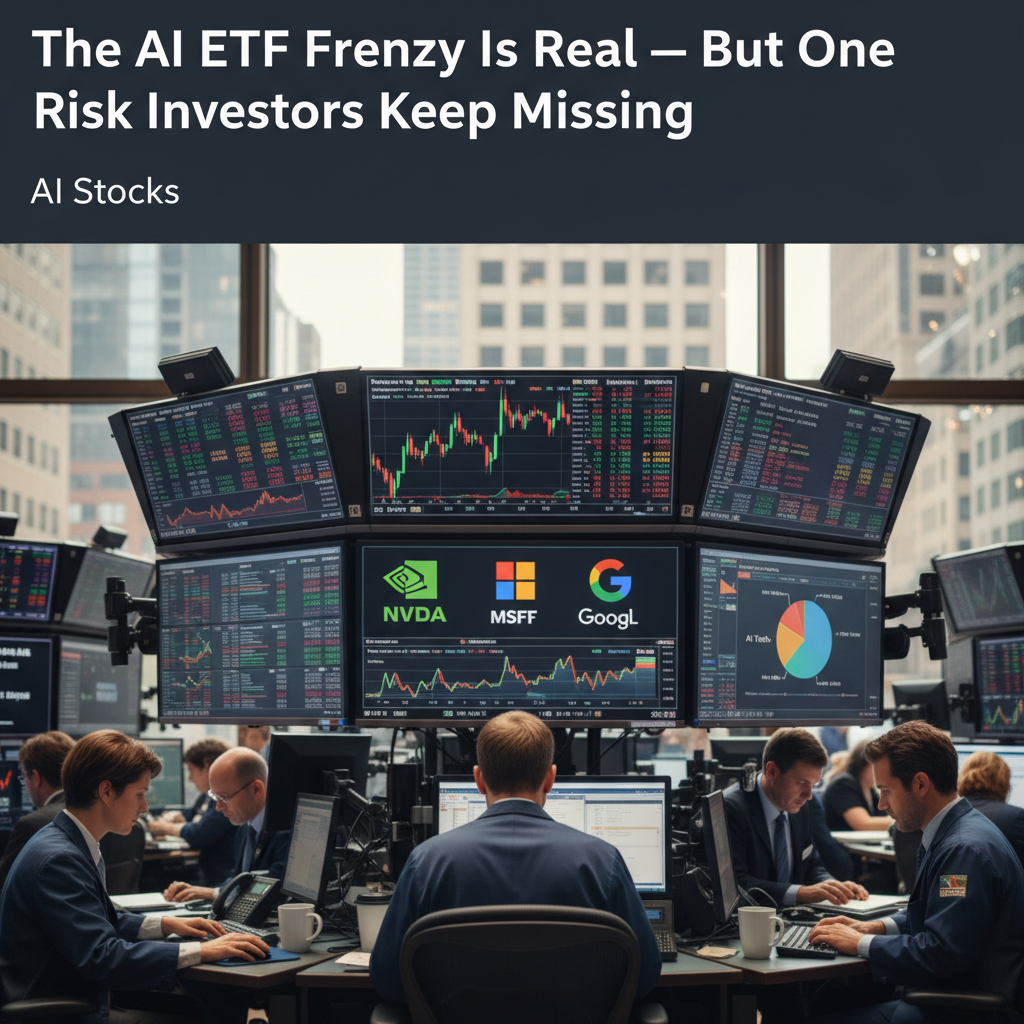
The headline is obvious: money is pouring into AI-focused ETFs. What gets less attention is where the cash actually lands: a very small group of chipmakers and cloud platforms that provide the compute and models powering generative AI.
I’m not lecturing against AI investing. I own positions in some of the obvious winners and I get the logic — network effects, concentrated talent and scale matter. Still, the market’s pattern right now is eerily familiar to earlier concentration episodes — think late 1990s tech or the FAANG-dominated years — when a handful of names carried entire sectors.
Why this concentration should give you pause
- Many so-called AI ETFs are basically index-like lists: they pick companies with high AI exposure. In practice, that exposure often collapses into the firms selling silicon and cloud services.
- When a few stocks make up 20–40 percent of a fund, the ETF stops acting like broad-theme exposure and starts behaving like a concentrated bet on those companies.
- Those companies are not immune to shocks. Think chip cycles, geopolitics, export controls, regulatory attention, and the hard work of turning research lead into reliable profits.
The historical parallel matters. Dominance can last, but it can also be fragile. Microsoft and Amazon took years to fully monetize their cloud advantages; Cisco around 2000 shows scale isn’t the same as durable upside. What’s different today is how quickly markets bake in fast payoffs — which makes disappointment more punishing.
There are fair counterarguments
- For capital-intensive tech, winner-take-most dynamics make concentration rational. Big positions can be a reasonable way to capture the economics of AI.
- Some investors want concentrated exposure and accept the higher volatility in return for the chance of outsized returns.
Still, buying concentration for convenience is risky. Lots of retail investors pick ETFs as an “easy” solution and assume they’ve bought diversification. Often they haven’t.
Practical things to do
- Look at the top 10 holdings. If one name is above 10 percent, you’re materially concentrated.
- If you want broader exposure to smaller AI plays, consider equal-weighted ETFs or thematic active funds rather than the chip-and-cloud heavy funds.
- Use sensible position sizing and regular rebalancing so momentum doesn’t turn into accidental overexposure.
- If you’re sophisticated and heavily exposed to a single name, collars or puts can blunt downside risk.
A short, simple case
Picture someone buying an AI ETF in late 2023 expecting broad industry gains. If that ETF was 35 percent weighted to one chipmaker, a 20 percent drop in that stock slices the fund even if everything else is fine. It surprises people, but it’s just arithmetic.
My bottom line — and a small qualification
AI is a real structural shift in computing and business, and it deserves capital. But how you own it matters. If your AI ETF is essentially a bet on three stocks, treat it like a bet on three stocks and size it accordingly.
I say this as someone bullish on AI but wary of markets compressing complex innovation into a few ticker symbols. There’s money to be made, yes — but discipline will separate returns from regret.