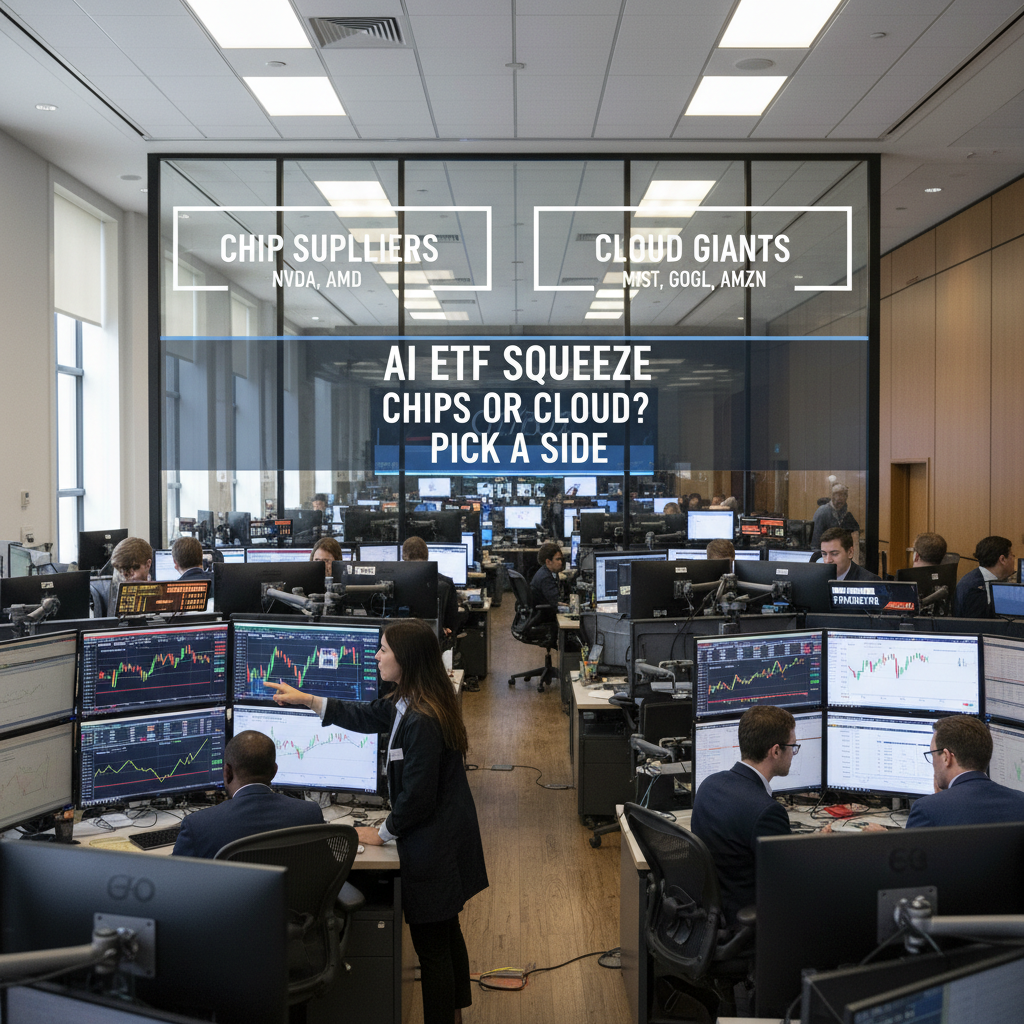
The market for AI-themed ETFs matured faster than most people anticipated, and that speed has revealed a clean fault line. Money is flowing into two very different bets: the raw compute layer dominated by chipmakers, and the application layer run by cloud and software platforms. It sounds technical, but at heart this is an old tradeoff — boom-and-bust hardware profits versus slow-building, recurring software cash flow.
Why the split matters
At first investors chased broad AI funds hoping to catch the next generative AI winners. Soon they noticed something obvious: concentration. A few chip and cloud names now make up a big slice of many AI ETFs, but they behave very differently.
- Chipmakers are a capacity story. Training and inference need GPUs, accelerators, and fabs. That brings sudden, large revenue jumps for suppliers — and with that comes capital intensity, cyclicality, and real sensitivity to supply-chain shocks.
- Cloud and software firms sell the finished product: AI features in apps, platform services, ads and enterprise contracts. Growth tends to be steadier, margins stick, and returns compound over time — though valuations often bake in a lot of optimism.
What’s interesting is how simple the choice feels once you see it: buy the railroads or buy the storefronts. Different risks. Different payoffs.
Practical distinctions many investors miss
- Expense ratios and overlap matter far more than the marketing pitch. Two ETFs that both claim to be AI can hold very different baskets — one heavy on Nvidia and AMD, another on Microsoft and Alphabet. Look at how much overlap you already own.
- Turnover and tax drag. Thematic funds that rebalance to chase whatever is hot can generate capital gains for holders.
- Geopolitics and concentration. Semiconductors run through Taiwan and South Korea. That’s real geopolitical exposure, something many cloud-native names largely avoid.
Concrete examples
Nvidia is almost a toll booth on AI compute: surging demand, pricing power, and a dominant position in the accelerators people want. Microsoft, by contrast, sells the finished product — AI-infused Office, Azure credits, enterprise deals that produce recurring revenue.
It’s a familiar pattern dressed up in newer labels: rails versus apps. In the 1990s you could own the internet through infrastructure or platforms. The returns and risks then were different; they’re different now too, but the logic is similar.
The messy middle
Not everything fits neatly into chips or cloud. Equipment makers, middleware providers, and specialized enterprise AI vendors sit in a fuzzy middle. Some ETFs tilt toward that middle to avoid single-name concentration. That can be sensible — but it also means they might lag during both a hardware surge and a cloud-led rally.
Implications for portfolios
- Decide whether you want cyclical exposure or durable cash flow. If you want the former, overweight chipmakers and equipment; if the latter, favor cloud and enterprise software.
- Size positions deliberately. Because AI bets are concentrated, even a small overweight can create outsized portfolio risk.
- Consider active managers for thematic exposure. Passive AI ETFs often end up as lists of the biggest winners — and that can mean buying stocks after much of the upside is already priced.
The upshot: AI ETFs are not a single asset class — they’re a menu. Knowing whether you’re buying compute, platforms, or the messy middle changes expected volatility, tax outcomes, and how you should size positions. Treating AI ETFs as interchangeable is an invitation to be surprised when market leadership shifts. Pick with intent, and you’ll likely get more durable results.
Pedro Marini