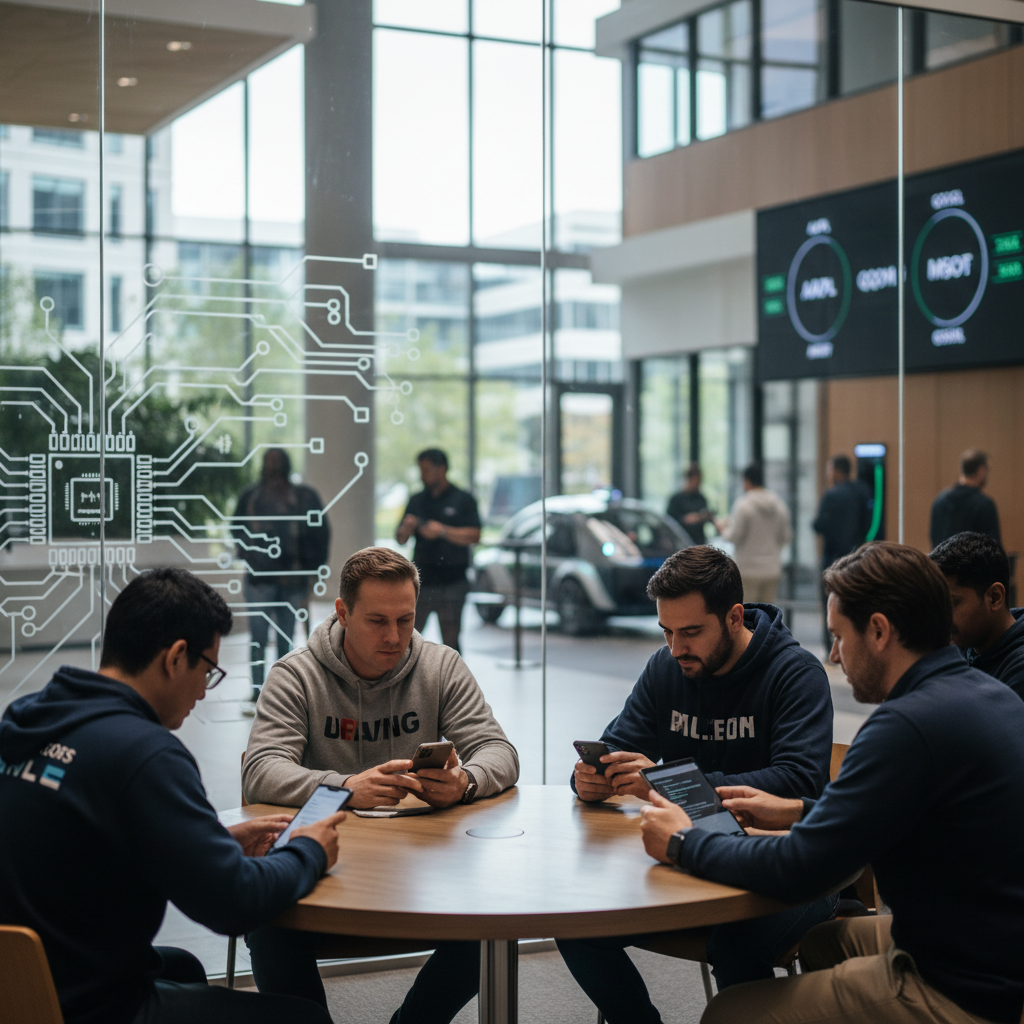
The moment is noisy but decisive. For the last decade the loudest AI stories were about cloud scale: sprawling data centers, racks of GPUs, and the hyperscalers that rent them. Now a quieter flip is happening — and it matters for privacy, margins, and who ends up controlling the next generation of apps. Large language models are moving onto devices.
This is not hypothetical. Smartphones already run trimmed-down LLMs for real-time transcription, on-device assistants, and generative camera features. Automakers are wiring conversational copilots into cars that will be offline a lot of the time. Wearables are beginning to ship small-scale generative capabilities that must respect private health signals. Those everyday requirements are pushing investment into on-device inference, specialized NPUs, and model compression techniques.
Why this matters
- Privacy without constant clouding. Running inference locally keeps sensitive signals on device and reduces regulatory headaches. That alone changes the business math for companies that built models around moving data into cloud pipelines.
- New profit pools beyond model creators. If intelligence lives on silicon, chip designers and OS owners gain bargaining power. The victor won’t always be the team that built the model but the platform that ships the developer tools and distribution.
- Latency and reliability as product virtues. Instant voice control, offline navigation — these aren’t just marketing tags anymore. They’re core product distinctions.
Three forces colliding
- Model engineering. Pruning, distillation, quantization — these techniques have matured quickly. What used to need dozens of GPUs can now be squeezed into a tiny fraction of the power budget.
- Silicon specialization. Apple’s Neural Engine, Qualcomm’s AI blocks, and a host of dedicated modules are turning raw performance into a targetable feature for developers.
- Platform economics. App stores and OEMs can reframe monetization: paid copilots, subscription assistant features, higher-margin hardware bundles. That changes how value is captured.
A few reminders against the hype
- Don’t expect the cloud to disappear. Heavy training, long-tail analytics, and models that require continuous retraining will stay in data centers. The likely architecture is hybrid: local inference with periodic cloud updates.
- Shipping models to millions of devices raises security and update headaches. Patch cadence and model drift stop being purely engineering nuisances and become product risks.
- Battery and thermal constraints are real. High-throughput inference on phones and watches comes with physical trade-offs; not every feature scales smoothly.
What this means for investors and product teams
- Keep chipmakers and middleware players on your watchlist alongside model vendors. Bets on silicon and developer SDKs often behave like platform plays.
- Look for partnerships that bundle AI with hardware — those deals reduce churn and increase customer lifetime value.
- Expect regulators to shift focus from raw data collection toward model behavior at the edge. Explainability and safe-fail mechanisms will be compliance levers.
A historical aside
This isn’t a simple reversion to dumb clients and smart servers. Think of it as a rebalance, like past inflection points: mainframes to client–server, client–server to cloud, and now cloud to an intelligent edge. Each shift shuffled winners and produced surprising losers.
On-device LLMs tilt power toward the companies that control silicon, distribution, and developer tooling. That opens room for nimble startups that pair clever models with optimized runtimes, while forcing incumbents to adapt. Expect the next five years to be messy, fast, and — for those who can master both the model and the metal — very profitable.