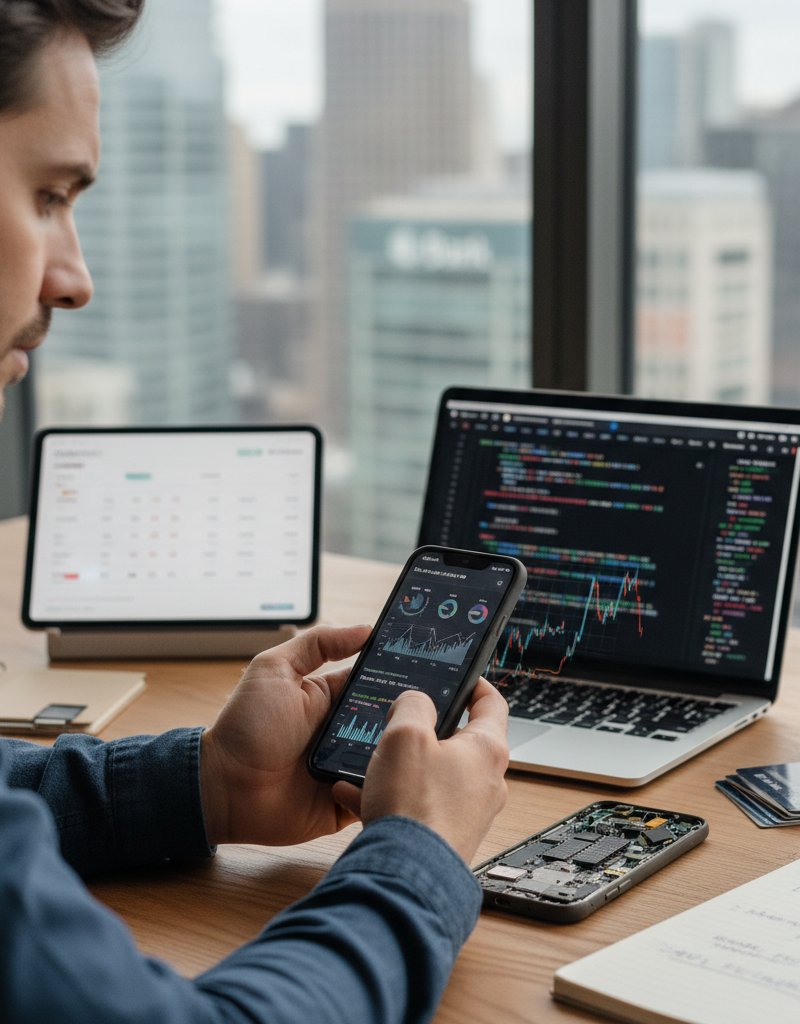
Phones are about to get a different kind of smarts — and it won’t all live in the cloud.
For the last ten years the story of AI has been centralized: massive models, sprawling data centers, and APIs that stitched intelligence into apps. That story is shifting. New, compact models, dedicated neural processing units, and tighter software toolchains are pushing real generative and reasoning work onto devices themselves. The payoff isn’t only speed. It changes product design and business strategy in ways that matter.
Why on-device matters now
- Latency and reliability. No round trip to a remote server means near-instant responses and true offline use — handy on planes, in hospitals, or when the network flakes out.
- Privacy as a feature. Running inference locally keeps sensitive data on the device, which users like and regulators are starting to demand.
- Cost and economics. Less cloud compute shifts variable costs and opens alternative pricing ideas for companies.
Think of this like a transistor moment: intelligence migrating out of centralized rooms into hardware people physically hold.
Who’s running the race
- Hardware leaders: firms shipping NPUs and more efficient mobile GPUs will have an edge. Investors are watching their margins and roadmaps closely.
- Software winners: toolchains that can shrink models without wrecking capability, and runtimes that translate across iOS, Android, and low-power silicon.
- Platform players: operating systems that embed AI frameworks will attract developers and, not coincidentally, lock in ecosystems.
Trade-offs matter. Power draw, thermal limits, and the need to keep models current are real constraints. A phone can transcribe in real time or touch up photos locally with surprising quality. But large-context reasoning, heavy multimodal fusion, and models that require near-constant retraining will still lean on the cloud — at least for now.
Concrete use cases already shipping
- Offline real-time transcription and voice assistants for basic commands.
- Local photo editing and upscaling driven by small generative models.
- Personal knowledge graphs and private summarization of emails and notes stored on device.
Market and regulation
Chipmakers, OS vendors, and app ecosystems are in position to capture much of the value. That reshuffles who benefits from AI beyond the handful of cloud providers. Also expect privacy rules to push firms toward offering local-processing options; on-device inference can be a compliance advantage, not just a marketing line.
Counterpoints and risks
Some argue cloud models will remain dominant because of scale, continuous learning, and massive context windows. They have a point. The likely outcome is hybrid: small models on device for immediacy and privacy, larger clouds for deep knowledge, long contexts, and ongoing training. Also, security and update mechanics for on-device models are nontrivial — firmware, signing, and patch paths matter.
What product teams and investors should keep an eye on
- Mobile NPU roadmaps and tooling from major silicon vendors.
- New ways apps might charge for premium offline features.
- Startups shipping lightweight, generalist models tuned for phones.
- Security audits and firmware/update practices that keep models safe and fresh.
This doesn’t kill cloud AI. It just signals a new phase: smarter splits between edge and server. For users, that means faster, more private experiences. For companies and investors, value shifts toward silicon, OS integration, and software optimization — a subtle but big change in how the AI economy will be structured.
Expect headlines to drift from sheer cloud scale toward edge finesse. The smartphone in your pocket is quietly becoming the default place for a lot of everyday intelligence.