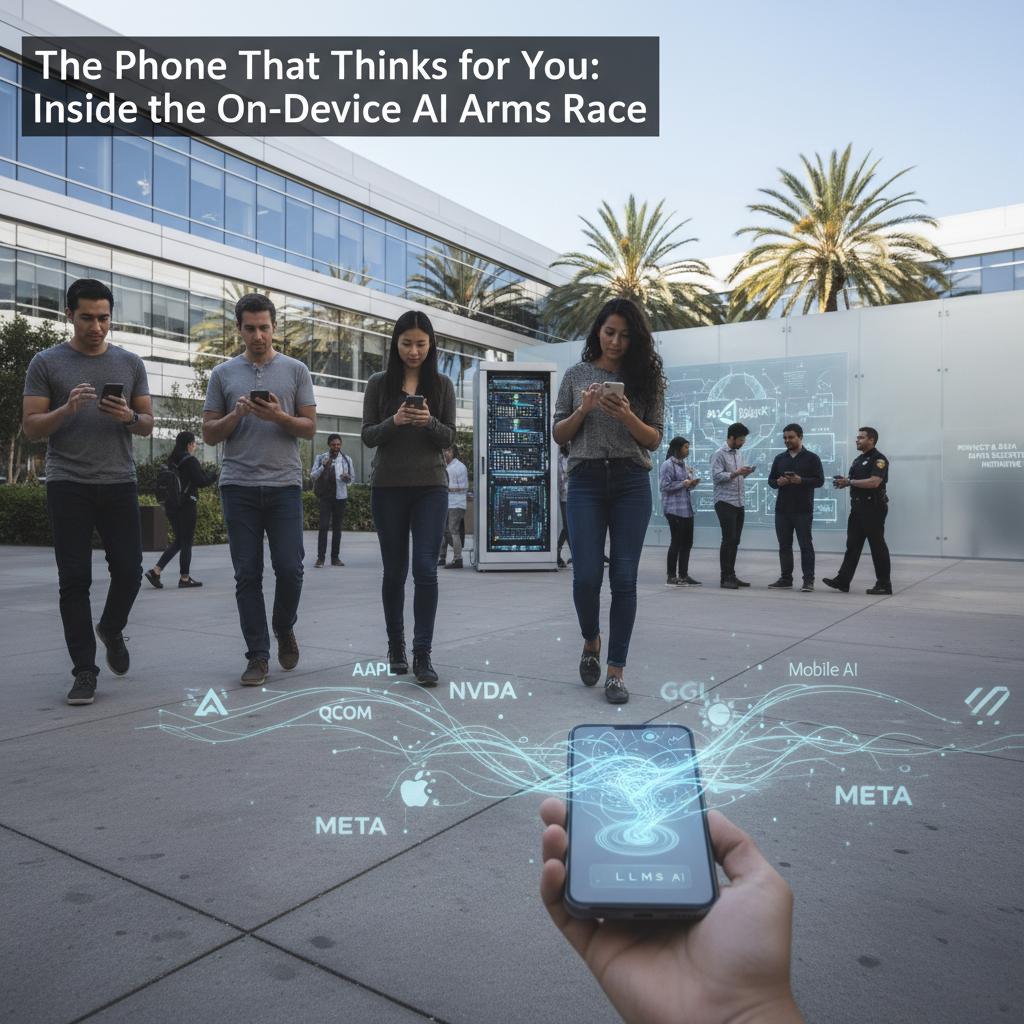
The short version: your next phone might not just talk to AI in the cloud — it could run it on the device itself. That move from remote servers to on-device inference is arriving faster than many expected, and it shifts who owns privacy, latency, and the economics of AI.
Mobile silicon has done the heavy lifting, quietly. Over the last few years vendors slipped dedicated neural processors, wider memory pipes, and matrix accelerators into chips. At first those changes were sold as photo and battery wins. Now they serve as the plumbing for small but capable language models that can summarize a meeting, draft an email, or power private search without a round trip to a data center.
Under the hood: the toolkit
- Model compression — quantization and pruning can shrink models dramatically while keeping useful behavior. A roughly 70 percent drop in memory use often decides whether a model can run locally or must live in the cloud.
- Architecture tweaks — tiny transformer variants and Mixture of Experts layers let engineers trade latency for accuracy in ways a big cloud model can’t afford.
- Hybrid approaches — in practice many apps run a local model for snappy, private tasks and call the cloud for heavy lifting or current facts. That gap is spawning a new layer of middleware: someone needs to glue those pieces together.
What’s interesting is how these pieces combine. Small models on-device handle the frequent, private stuff; the cloud remains for scale and freshness. That dichotomy matters more than it first appears.
Why now
Three things collided: better chips from major vendors, a flood of compact open models from research labs, and rising demand for privacy-first features. Together they create new product angles for device makers and shift value away from pure cloud inference toward hardware and on-device software.
Winners and losers
- Chipmakers are in a sweet spot. Vendors selling NPUs and tuned mobile SoCs suddenly have leverage over the user experience.
- App developers stand to deliver lower-latency, cheaper features if they can integrate compact models. But the engineering bar goes up — on-device debugging, model updates, and thermal constraints are not trivial.
- Cloud inference providers will feel margin pressure from repeat queries, though they remain essential for training and for services that truly need scale or the freshest data.
Reality check
On-device AI is not a cure-all. Battery drain and thermal throttling are real, and keeping models up to date is tricky. Expect a tug-of-war: manufacturers pushing for bigger local models, regulators asking for clearer privacy guarantees and auditability, and users caught in the middle.
Things users will actually notice
- Live transcription and private summaries of calls that never leave the handset.
- Personal assistants that work offline and save carrier data.
- Creative tools on-device that can sketch a poster or generate short captions without sending content to a server.
For investors
This trend rearranges who captures value. Don’t just buy the obvious chip names; watch the software stacks that make efficient deployment possible on phones and the IP firms focusing on quantization and inference. Partnerships between silicon vendors, OEMs, and model creators will decide who gets recurring revenue from the on-device stack.
A few caveats
People do care about privacy, but many still prefer cloud services that are always current. Economically, updates favor centralization for the largest, most current models. The future will be hybrid — not all local, not all cloud.
What this means
On-device AI is moving beyond demos into real product differentiation. It will reshape mobile hardware, alter the app economy, and eat into some cloud revenue. The winners will be the companies that combine efficient silicon, pragmatic model design, and clear, user-facing privacy approaches. For users: smarter phones that keep more data closer to home. For investors: a new layer of value to watch between chips, tooling, and cloud orchestration.