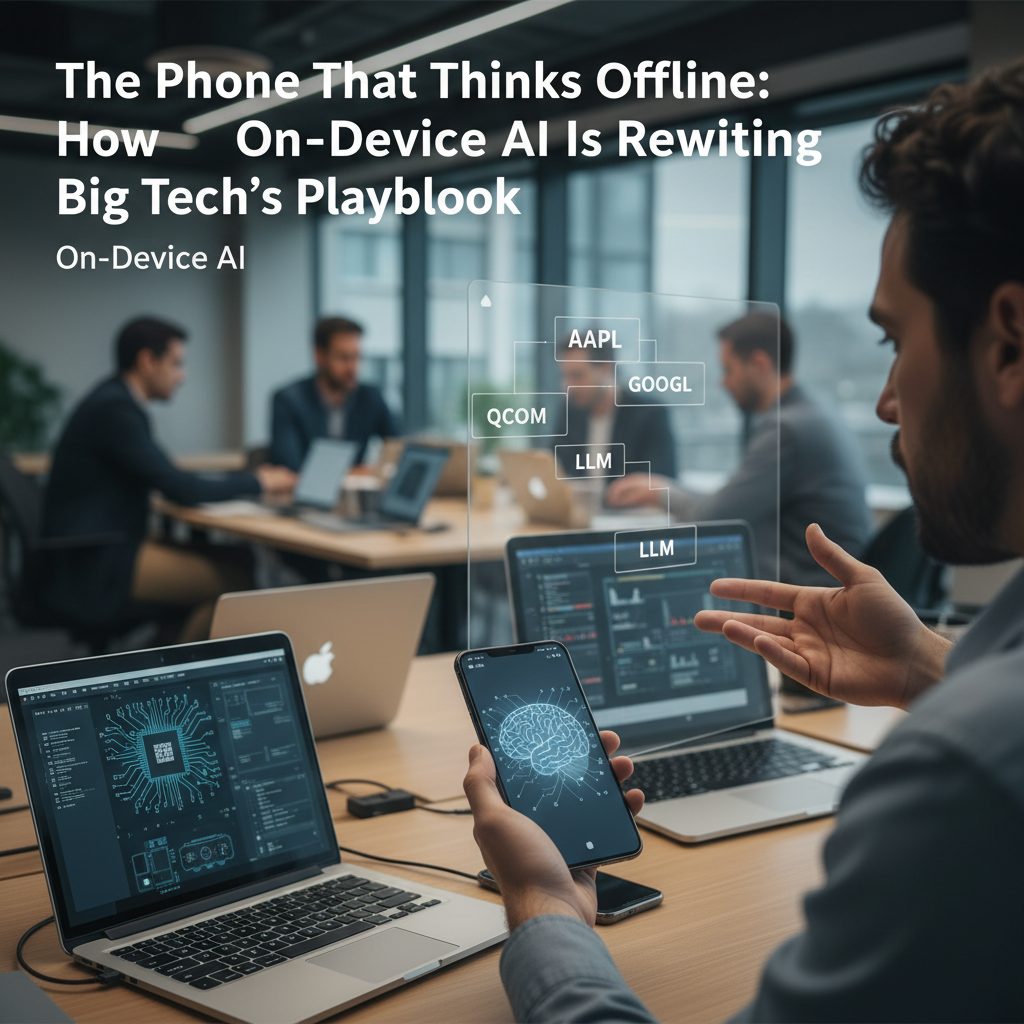
On-device AI is no longer an experiment. What began as cute demos — tiny models that handled voice commands or fixed up photos — is maturing into full language and vision models that can actually run on a phone or laptop.
Edge compute matters because it rewrites three things people care about: latency, privacy, and control. That reshuffle carries political, regulatory, and financial consequences you won’t see reflected in a single quarter’s numbers.
Where we stand
- Apple’s Neural Engine and the M-series chips normalized on-device number crunching; Qualcomm and Google are pushing NPUs into Android phones. At the same time, smaller, more efficient LLMs from both open and commercial labs make local inference plausible for real-world tasks.
- Real examples already work: a phone that summarizes a long email thread without ever touching the cloud; a camera app that classifies medical images on the device; instant translation that survives noisy streets because there’s no round trip to a server.
Why this shift accelerates quickly
- Speed and economics. Running inference locally slashes round-trip latency and removes per-call cloud fees. For heavy consumer usage, that changes the unit economics of services that today rely on cloud GPUs.
- Privacy and compliance. Processing on the device sidesteps some data-transfer rules and narrows the attack surface for breaches — a genuine selling point for vendors pitching premium privacy.
- Platform dynamics. If useful models can run offline, app-store dynamics and the data moats Big Tech leans on begin to look less secure. Developers can ship privacy-first features that undercut cloud subscription models. That matters more than it sounds.
Winners, losers, and the messy middle
- Chips matter. Expect better margins for firms that control efficient on-device silicon or license top-tier NPUs. It’s not a simple transistor count contest — software integration and system-level efficiency win.
- Cloud vendors aren’t going away. They’ll still be essential for training, large updates, and heavy multiuser services. In practice the near-term equilibrium looks hybrid: some work happens locally, and the rest stays in the cloud.
- Startups get opportunities. Lower latency and offline capabilities open new consumer and enterprise use cases — field diagnostics, offline CRM assistants, and other niches that sit outside the core of cloud giants.
Risks and second-order effects
- Battery and thermal limits still cap model size. Progress will be steady, not instantaneous.
- Fragmentation risk. If vendors optimize different NPUs and formats, developers could face an Android-like compatibility headache for models.
- New security vectors. Local inference reduces some risks but creates others — model tampering and local data poisoning become real threats.
What to watch next
- How models are packaged and whether on-device formats converge; cross-vendor libraries would speed adoption.
- The new consumer features makers use as on-device differentiators in flagship phones and laptops.
- Partnerships between chipmakers and app platforms — those deals are likely the short-term catalysts that push this into the mainstream.
This is a quiet tectonic shift: the same technology that once centralized intelligence is being pushed back into users’ devices. For investors that means looking beyond cloud revenue and asking whether a company controls the silicon, the software stack, and the developer ecosystem needed to make offline models genuinely useful. For users it promises faster, more private features — and a bumpy period of competing standards before things settle down.