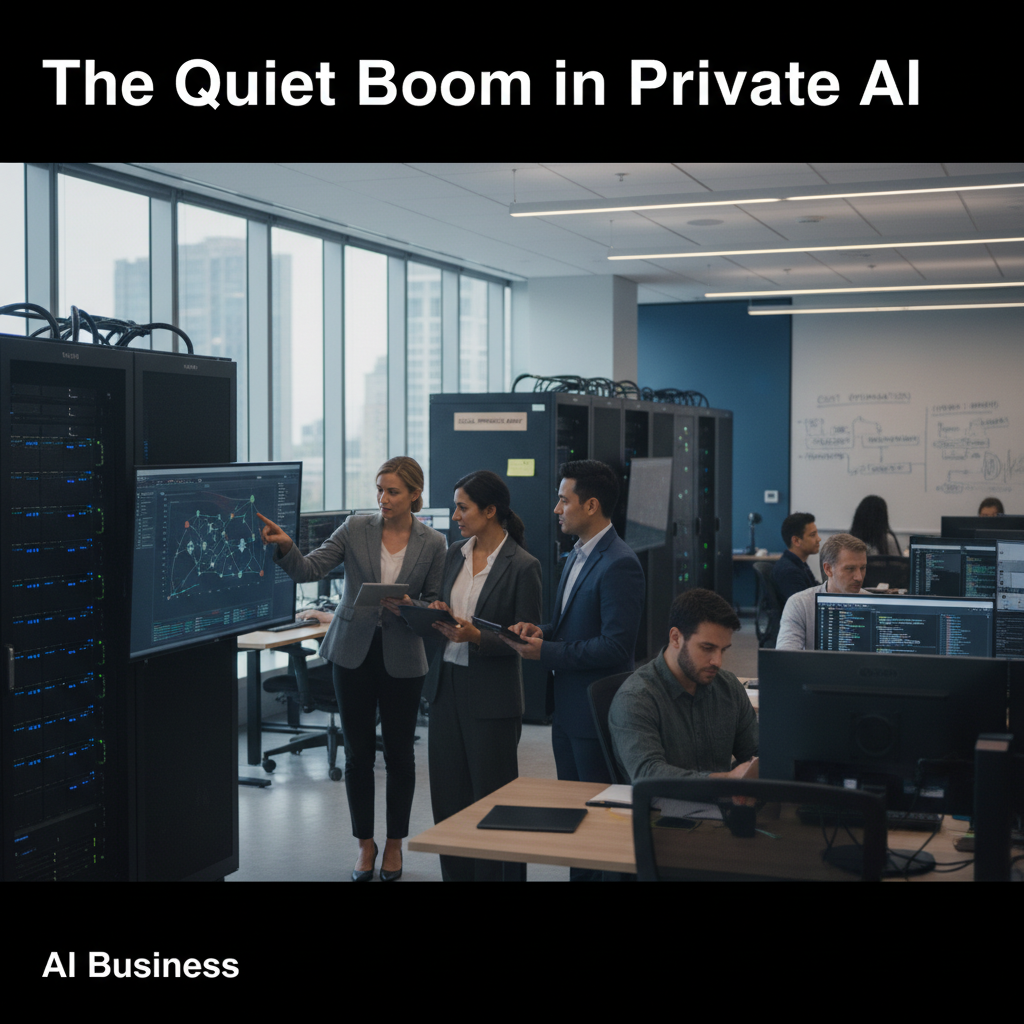
The last place you expected an AI arms race? Your office basement.
A quiet but consequential shift is happening in the AI tools world: more companies are running models privately — on-prem, in customer-controlled clouds, or on dedicated inference servers — rather than routing everything through public APIs. It’s not sexy. It’s pragmatic. And it’s picking up speed.
Three forces have come together to make this sensible.
- Models are finally good enough. Open weights and smaller-footprint models now cover many business needs that once demanded the biggest cloud models.
- Running inference is cheaper and faster. Better quantization, efficient runtimes (the GGML/llama.cpp lineage and friends), and broader access to GPU spot markets make local inference cost- and latency-competitive.
- Compliance and risk control matter. Legal and security teams prefer predictable data flows. Hosting models cuts exposure and simplifies audits.
That doesn’t mean public APIs are dead. For experimentation and truly massive scale, the big clouds still win. But for features where latency, predictable cost, or data sensitivity actually move the needle — internal assistants, contract review, customer support augmentation — private inference is rapidly becoming the sensible default.
You’ll start to see this show up in everyday enterprise workflows:
- Sales teams routing CRM context through a locally hosted model to generate pitch drafts in under 200 ms, sidestepping cloud round trips and vendor retention policies.
- A small fintech running nightly reconciliation queries against private ledgers with a vectored LLM, keeping client data in-house.
- Design shops spinning up GPU VMs for image and multimodal inference to iterate quickly and avoid per-image API bills.
There are trade-offs. Don’t pretend it’s all upside.
- Setup isn’t trivial. Procuring GPUs, securing models, and tuning quantization consumes engineering time and expertise.
- Keeping models fresh takes discipline. Public APIs push improvements continuously; private stacks need a cadence for updates, validation, and rollback.
- Safety and guardrails aren’t automatic. Some protections are built into managed services — when you host, you’re responsible for equivalent checks.
Why this matters to investors and cloud providers
The revenue patterns shift. Instead of pure API call volume, value migrates toward managed inference, governance layers, and hybrid products. Vendors already respond with appliances, GPU subscriptions, and partner stacks that run inside customer environments.
A short playbook for teams thinking about private inference
- Start with one high-value use case (contract search, a support agent) and benchmark latency and cost against a public API.
- Use distilled or quantized models to validate performance; scale up to larger weights only if you need the extra capability.
- Treat model governance like core infra: logging, rollback, and periodic safety checks are not optional.
The bigger picture
This feels like a maturity move. In the 2010s companies fled their own datacenters for public clouds. Now parts of the AI stack are migrating back under direct control because speed, privacy, and cost certainty matter in ways they didn’t before.
If you’re a founder or CIO: don’t idolize the biggest model. Map decisions to where latency, legal risk, or predictable cost actually affect your product. Private inference isn’t boutique any longer; it’s a practical competitive lever.
Expect the market to bifurcate — large centralized APIs for scale and ongoing model R&D, and private inference for sensitive, latency-critical, or cost-stable workloads. In practice, betting on both is often the smartest play.