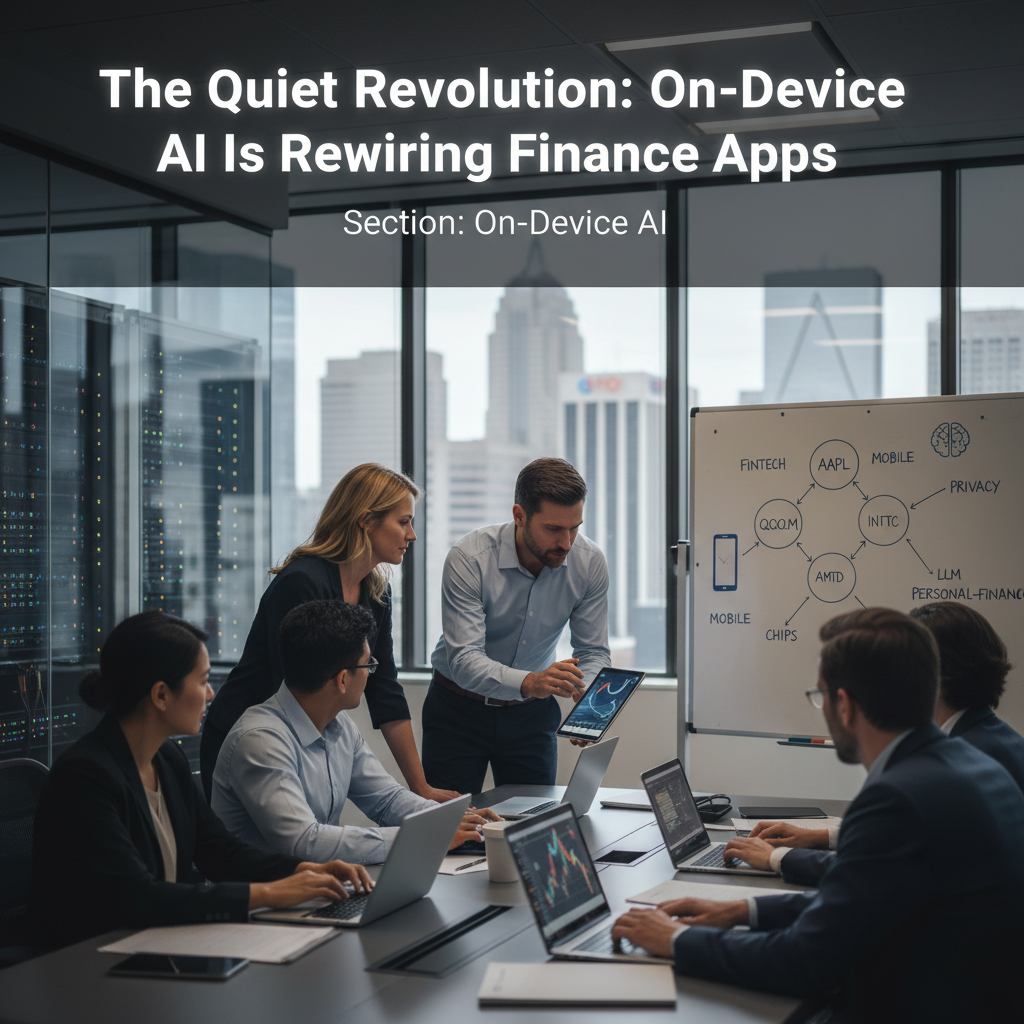
A subtle shift is under way. For years, serious AI in finance mostly lived in the cloud: big models, big servers, predictable latency. That setup still matters. But a quieter change is happening — compact LLMs and multimodal models are now practical on phone and laptop NPUs. Not a dramatic overnight revolution. Rather a steady rewiring of how financial apps behave.
Why it matters now
- Lower latency. Instant transaction categorization, voice-driven payments, real-time fraud flags — often without the round trip to a server.
- Privacy by default. Sensitive financial data can be analyzed locally, which eases some regulatory and reputational risks.
- Cost compression. Fewer cloud calls cut compute bills for services that scale to millions of users.
Think of it like swapping a commuter train for a bike on the last mile: slower than a freight locomotive, yes, but far nimbler and more private for a lot of day-to-day tasks.
Concrete use cases already appearing
- Personal finance assistants that summarize spending and prepare tax notes entirely offline.
- Biometric and behavioral fraud detection that fuses local sensor data with models that never leave the device.
- Faster onboarding: ID checks and form autofill with live, on-device verification instead of queuing servers.
The tradeoffs are real
- Model capability versus battery and storage. The best models still need pruning; higher privacy often means lighter, less nuanced outputs.
- Update friction. Pushing model changes through app stores or OS channels is messier than swapping a container in the cloud.
- A compliance paradox. Local processing can simplify privacy, but auditors and regulators may still want centralized logs — a real wrinkle for banks.
Winners, losers, and the gray middle
- Chipmakers and OS vendors stand to gain if they provide powerful, energy-efficient NPUs and usable developer tooling. Expect smartphone SoC vendors and laptop makers to push SDKs hard.
- Cloud incumbents keep the edge on heavyweight tasks and cross-user learning, so hybrid architectures will stay common for now.
- Small fintechs can differentiate on privacy and UX without a giant cloud bill — but only if they can manage model updates and edge validation well.
A short history lesson
On-device intelligence is not new. Mobile inference began a decade ago with tiny image-recognition models. What’s different now is scale and architecture: modern NPUs have more parallelism, compression techniques are better, and developer frameworks exist that simply weren’t around five years ago. This is evolution, not reinvention — yet evolved systems often displace incumbents faster than people expect.
What to watch next
- Tooling and frameworks that let developers swap between local and cloud models with minimal friction.
- Regulatory guidance about local processing and auditability for financial workflows.
- Battery and thermal improvements that make sustained on-device inference practical for longer sessions.
A closing thought
On-device AI in finance is an incremental disruption. No single headline will capture it. Instead, hundreds of small changes — speedier, more private interactions; new engineering demands; closer partnerships with chip and OS vendors — will add up. Not everything moves to the edge, but enough will shift to reshape who wins the next generation of fintech interfaces.