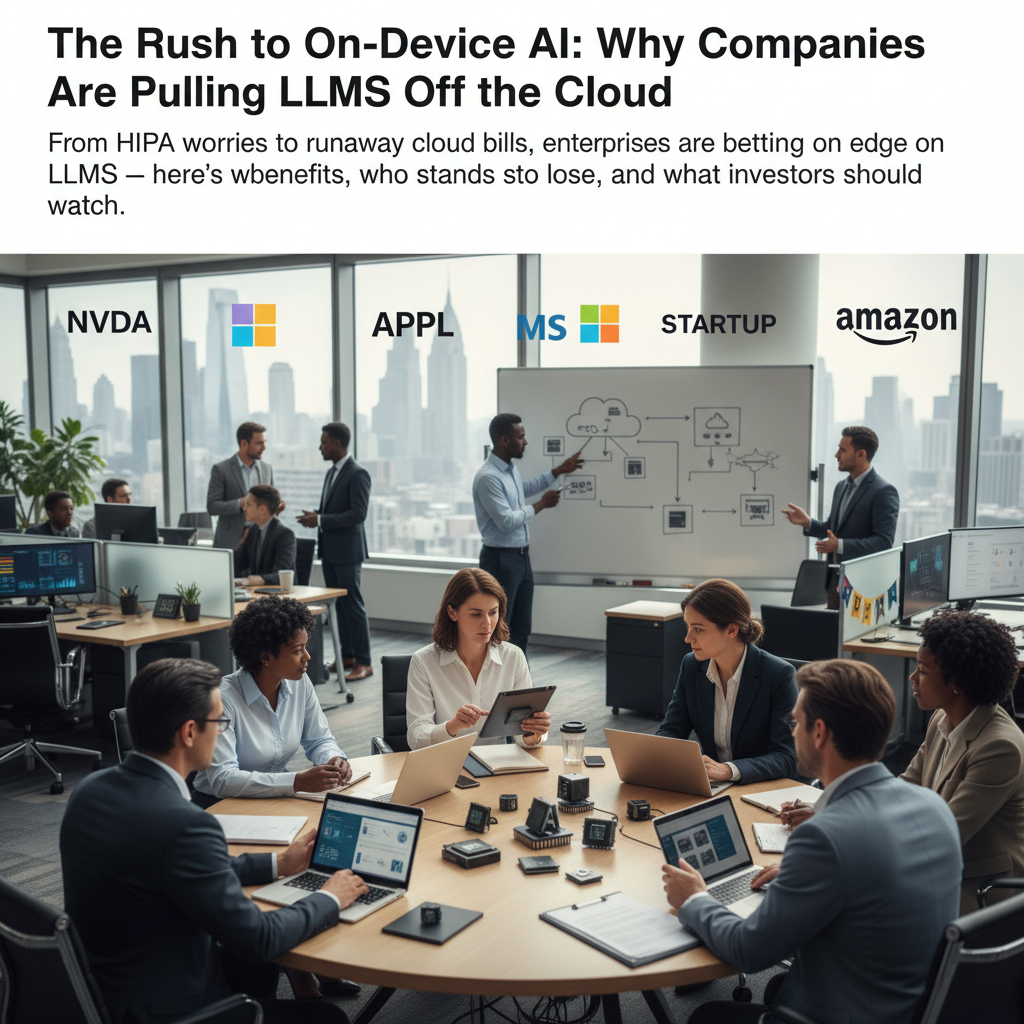
Short answer: enterprises are shifting workloads back to devices and private infrastructure — not because it's fashionable, but because privacy, latency, and predictable costs are beginning to matter more than the convenience of cloud-hosted LLMs.
Right now
Cloud-native LLMs drove the early enterprise wave. Over the past 18–24 months, a countertrend has accelerated: companies are putting smaller, optimized models on devices, in-branch servers, or behind corporate firewalls. This is a practical move, not an ideological one — tighter regulation, sensitive customer data, and surprise cloud bills when models misbehave are forcing the change.
Why it matters — three practical forces
- Privacy and regulation. In health, finance, and government, compliance is real and granular. Running inference locally avoids many data-egress headaches and makes audits simpler.
- Latency and reliability. For real-time interfaces and decisioning, milliseconds matter. Edge models cut round trips and lessen dependence on flaky internet connections.
- Cost predictability. Usage-based invoices can spike in ways enterprises hate. CapEx for on-prem hardware or one-off device integrations often looks cheaper and more predictable over time.
Concrete examples (industry patterns, not vendor hype)
- Regional banks testing local LLMs for document triage and pre-checks so sensitive records never leave their control.
- Hospital systems running clinical summarization on-prem to keep PHI inside the network.
- Retail chains deploying edge models for in-store inventory recognition and cashier assistance to avoid latency and recurring cloud costs at scale.
Winners and losers — practical bets
Winners
- Chip makers and accelerators. Firms that sell efficient inference silicon and appliances win when companies buy hardware instead of cloud credits.
- Niche model vendors. Startups delivering compact, privacy-aware LLMs and simple offline update tooling will find customers open to multi-year deals.
- Systems integrators and managed service providers. Hybrid, bespoke deployments need expertise, and that implementation spend flows to integrators.
Losers
- Pure cloud incumbents that depend only on consumption pricing may see slower growth in regulated verticals where data must stay put.
- Very large, hungry models without clear marginal gains for specific domain tasks; they become hard to justify on cost and latency grounds.
Counterpoints and limits
On-device inference is not a cure-all. Heavy training, huge multimodal workloads, and centralized model fine-tuning still make cloud scale compelling. Also, model drift, update cadence, and fleet management introduce new ops headaches; enterprises trade predictable cloud upgrades for patching and version control at scale. Security improves in some ways — less egress risk — but complicates in others: device theft, rogue insiders, and verifying updates are real concerns. In practice, the story is messier than a simple cloud-versus-device headline.
Investor implications — what to watch
- Hardware demand. Expect sustained orders for inference-optimized GPUs, NPUs, and ASICs; semiconductor players tied to inference should see tailwinds.
- Software ecosystem. Tools that make secure deployment, monitoring, and partial/differential updates easy are likely acquisition targets.
- Cloud providers. They will push hybrid and edge services hard to keep enterprise accounts; watch product moves and pricing shifts.
A quick historical frame
This resembles past cycles — client-server, then centralized, then distributed again with mobile. AI is repeating that arc: cloud for scale, then selective redistribution when control, cost, and latency matter. The pattern is familiar, but the economics and privacy stakes are higher this time.
The upshot
On-device and hybrid LLMs will not replace cloud AI, but they will redirect pockets of enterprise spend toward chips, middleware, and systems integrators instead of pure cloud consumption. Smart operators and investors should focus on the middleware and hardware that make hybrid deployments manageable, rather than choosing cloud or device as an ideological position.
Quick notes to bookmark
- Expect steady demand for inference silicon and compact LLMs.
- Watch startups that simplify fleet updates and privacy-preserving inference.
- Cloud vendors will adapt; the market will sort into hybrid winners and a few narrow losers.