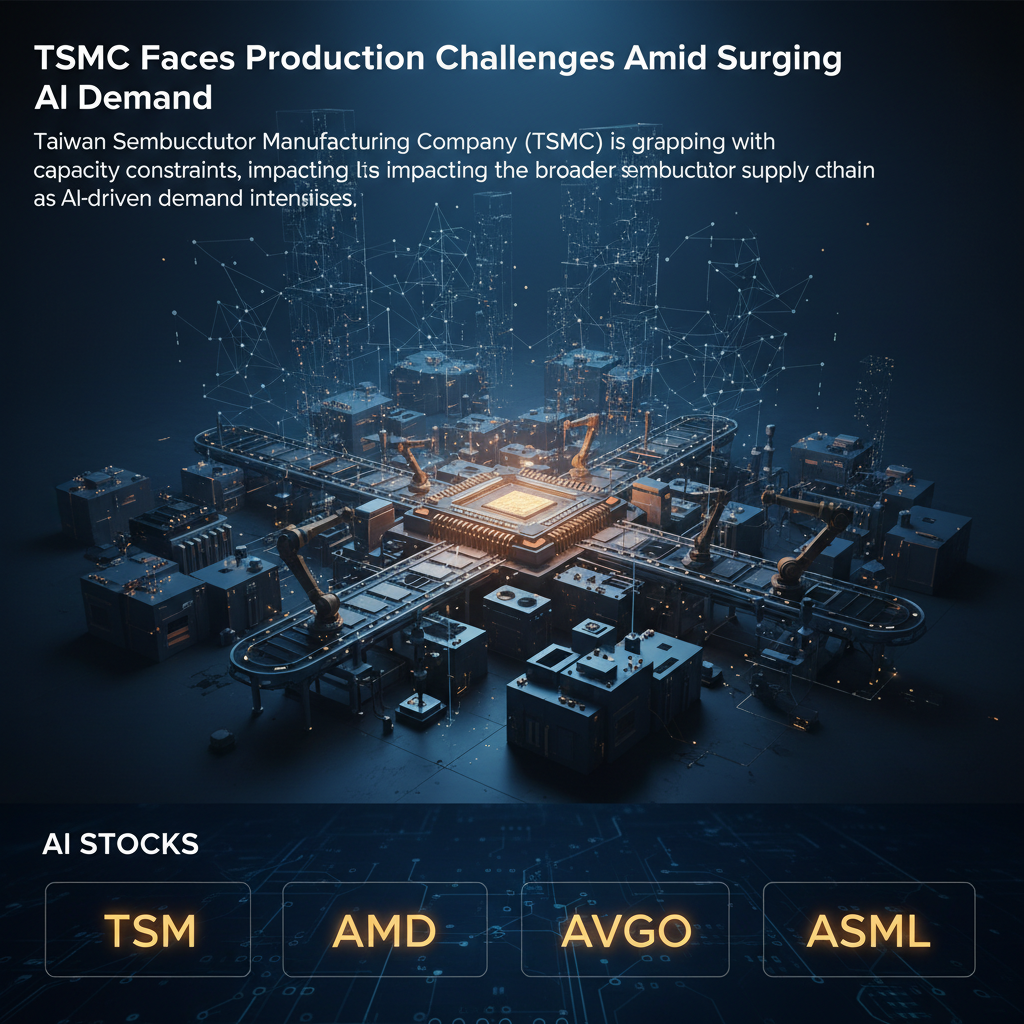
TSMC, the world's largest contract chip manufacturer, is facing significant challenges in meeting the escalating demand for high-end semiconductors, particularly those crucial for Artificial Intelligence (AI) applications. Despite aggressive expansion efforts, including plans for new fabs in Arizona and Japan, the company's advanced packaging capacities, such as CoWoS (Chip-on-Wafer-on-Substrate), are reportedly operating at full utilization with lead times extending into 2025.
Industry analysts indicate that this bottleneck is largely driven by unprecedented orders from AI powerhouses like Nvidia and AMD, who rely on TSMC for their cutting-edge GPUs and accelerators. Data from Susquehanna Financial Group suggests that lead times for some advanced nodes have stretched to 6-8 months, up from a historical average of 2-3 months.
The implications of TSMC's capacity limitations ripple through the entire tech ecosystem. Companies like AMD and Broadcom (AVGO), who depend on TSMC for their chip fabrication, could experience delays in product launches and constrained revenue growth. This situation also places pressure on equipment suppliers such as ASML, whose lithography machines are vital for TSMC's manufacturing processes.
While TSMC announced capital expenditure plans for 2024 at approximately $28 billion to $32 billion, a slight decrease from 2023's $30.4 billion, a substantial portion is allocated towards expanding advanced process technologies and packaging capabilities. However, the time required to bring new facilities online and fully ramp up production means that near-term supply relief remains uncertain.
The tight supply environment is further exacerbated by geopolitical considerations and the ongoing push for localized semiconductor manufacturing. Governments worldwide are offering substantial incentives to attract chip production, but these long-term strategies do not immediately address current supply-demand imbalances. The strain on TSMC's capacity underscores the critical role it plays in global technological advancement and the inherent complexities of the semiconductor supply chain.
TSMC's reported Q4 2023 revenue of $19.62 billion, exceeding analyst expectations, reflects robust demand for its technologies. However, the company's outlook emphasizes that while AI demand is strong, capacity expansion, particularly for advanced packaging, continues to be a key hurdle in fully capitalizing on this growth.