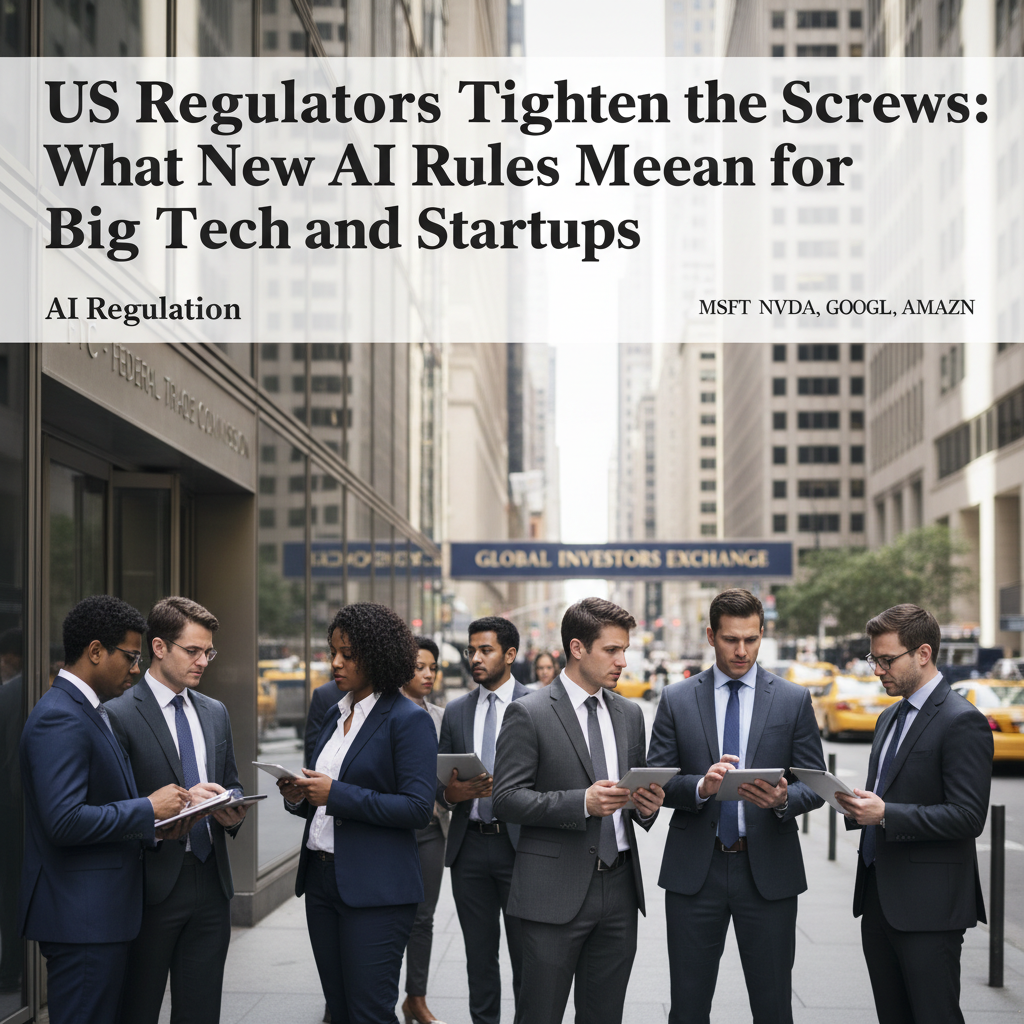
The flashpoint
This year US regulators moved from warnings to actual rulemaking. The Federal Trade Commission has floated unusually sharp language against deceptive AI practices, states are drafting disclosure requirements for synthetic content, and Congress is circling a bipartisan framework for liability and safety testing. It won’t be one neat federal law; expect a growing, messy patchwork that decides who pays to comply and who pays when things go wrong.
Why this matters now
- Consumer trust is fraying. Deepfakes, biased hiring models and opaque credit algorithms have produced headline harms. Regulators react to visible damage faster than industry self-policing usually does.
- Markets are sensitive. AI-heavy stocks already price in upside and regulatory risk. A seemingly narrow rule can ripple through valuations, squeeze margins or shift demand.
- Startups face a cliff. Big incumbents can eat audit bills; smaller vendors often cannot. For many young companies, costly compliance or being sold to a larger player are the realistic paths.
Concrete implications for companies and investors
- Big tech (Microsoft, Google, Amazon) will bear compliance costs but widen their advantage. They have the legal teams, the engineering bandwidth to build provenance features, and can sell compliance-as-a-service to smaller customers. Think GDPR-era cloud plays—those incumbents benefited by standardizing security.
- Chipmakers such as NVIDIA gain indirectly. Compute needs don’t disappear; if regulation nudges workloads into certified providers, cloud and data-center demand could rise.
- Watermarking, provenance and compliance tooling will be takeover targets. Expect consolidation around startups that can verify training data, produce auditable model cards, or attach real-time provenance to content.
- Regulatory uncertainty will widen dispersion in public returns. Short-term volatility will spike around rule releases and enforcement actions; long-term winners will be those that turn compliance into product differentiation rather than a cost center.
Historical parallels — and a caveat
Remember GDPR in 2018. Early predictions of catastrophe proved overstated: privacy-first firms found fertile ground, some ad-tech players were squeezed, and big platforms commoditized compliance. What’s different with AI is speed. Models can produce physical and financial harm in real time, which ups the chance of faster, tougher enforcement.
Still, regulation can be practical. Seatbelt rules looked intrusive at first; now they’re standard equipment. Labeling synthetic media might feel awkward initially, but it could normalize provenance in advertising and journalism and actually boost trust in those markets.
Two scenarios to watch
- Baseline: Congress or regulators set federal transparency rules; companies ship standardized model cards and provenance layers. Compliance costs are meaningful but manageable. Winners: cloud providers, compliance-tool vendors, established enterprises that can absorb the changes.
- Aggressive enforcement: Broad liability attaches to model outputs, creating legal exposure for creators and platforms. That favors vertically integrated firms that can internalize risk. Independent marketplaces and small vendors get squeezed.
Practical steps for founders and investors this week
- Build basic auditability into data pipelines. Simple metadata and logging cut down legal tail risk.
- Add watermarking and provenance now. Retrofits are more expensive and slower.
- Stress-test models for disparate impact and financial harm; document what you did and why. Paper trails matter.
- Track rule timelines, not headlines. Drafts shift; enforcement guidance and consent decrees reveal where regulators will actually focus.
Regulation is coming in pieces, but the vector is clear: more transparency, more accountability, more protection for consumers. That will create friction — and opportunity. Treat compliance like an obstacle and you’ll pay for it. Treat it like a trust signal and it can become a competitive advantage.
Pedro Marini