The Quiet Build-Out
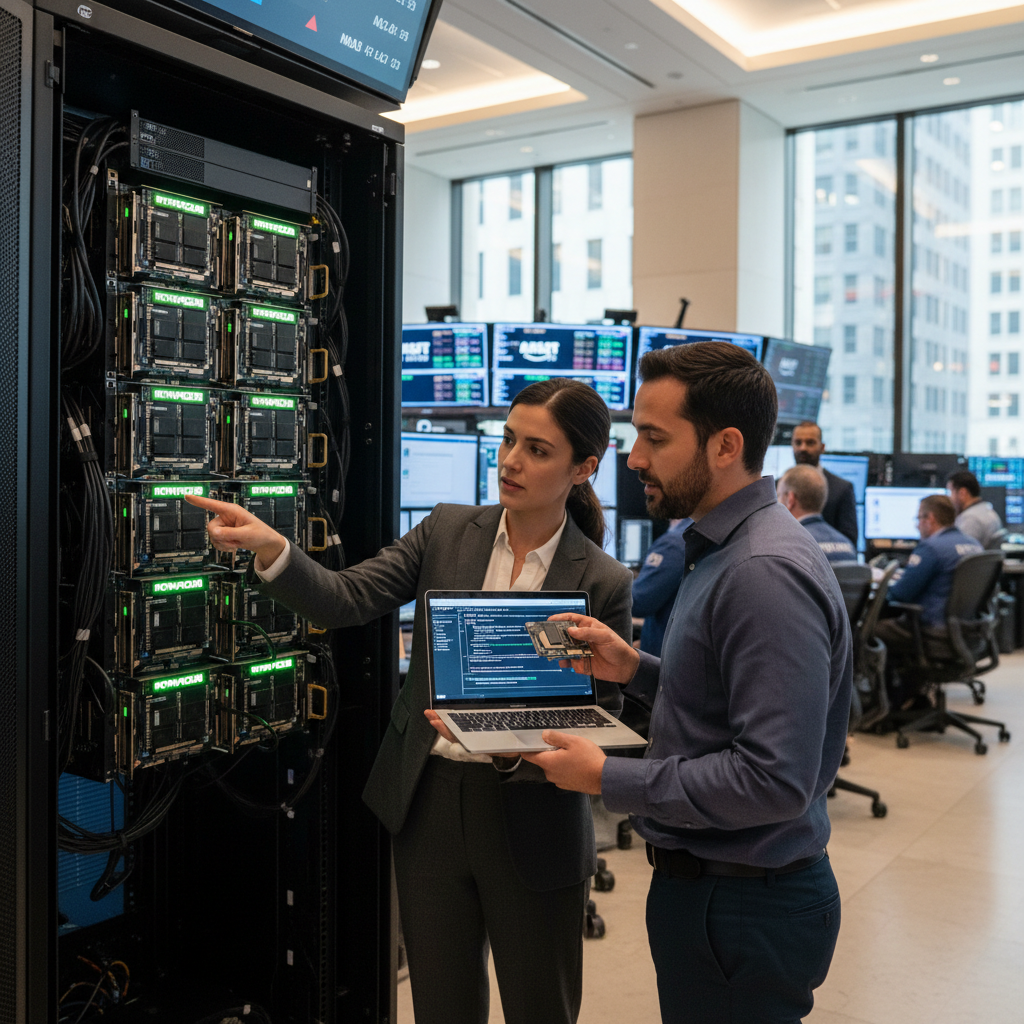
Wall Street has always paid for an edge. Lately that edge looks less like a clever model and more like raw compute — racks of GPUs, bespoke models, on-prem clusters tucked away in data centers. There’s no shiny press release here. This is infrastructure work, slow and structural, with real market consequences.
Why it matters now
The last decade put data into everyone’s hands. The next one is about who can actually run the heavy lifting. Retail traders don’t get the same seat at the table. Three forces are converging:
- Nvidia-driven hardware scarcity. GPUs are the choke point for both training and inference. Whoever controls the chips shapes latency and scale.
- A widening split between cloud and on-prem. Big banks cover both bases: they buy hardware and lock in multi-year cloud deals with Microsoft and Amazon. The result is different capabilities across firms, not just different strategies.
- Growing model complexity and secrecy. Firms are stitching together proprietary LLMs and ensembles that replace simple quant factors, and that makes what’s happening inside a black box.
A quick historical note: finance has run these kinds of arms races before. The quant era centralized returns, then colocation and faster feeds amplified the winners in the 2000s. The pattern repeats, but the scope is broader now. This isn’t only about shaving microseconds; it’s about predictive layers that reach into portfolio construction, risk management, and client-facing systems.
Real implications — what investors and regulators should watch
- Concentration risk. Heavy dependence on one GPU vendor and a few cloud providers creates systemic exposure that’s easy to overlook until something breaks.
- Crowded AI trades. When many firms adopt similar model architectures and training sets, their signals correlate. That can magnify drawdowns when models flip.
- Talent and cost asymmetry. Small shops can’t match the compute budgets of the big players. Alpha gets harder to find at scale.
- Regulatory blind spots. Existing model-risk frameworks weren’t designed for auto-updating LLMs that feed trading decisions. Governance needs to be more continuous, not just periodic checkboxes.
Not everything points toward catastrophe. Cloud vendors are making specialized chips and pay-as-you-go inference more accessible, which lowers the bar for startups to prototype and iterate. Open-source models are chipping away at vendor lock-in — think of it as a Linux moment for finance. But that freedom brings fresh headaches: operations, compliance, and hidden variability in performance.
Signals worth watching
Earnings reports and balance sheets will show some clues. Rising capex on hardware or long-term cloud commitments from banks and funds matters. Hiring patterns too — a wave of AI engineers on trading desks is a clear sign the build-out is accelerating. Also, watch for vendor partnerships and procurement contracts; they tell you who’s buying compute, not just who’s buying software.
Failure modes
If multiple firms adopt similar LLM-based signals trained on overlapping data, you get feedback loops. A stress or surprise in one model can cascade faster than in the old quant era. The next flash event might not be an execution bug; it could begin with a shared loss prediction or hedging model that everyone relied on.
Where this leaves us
This feels like the biggest infrastructure shift since markets went real-time. For investors it creates a new kind of moat — and a new fragility. For regulators it means moving from static checklists to ongoing oversight. For everyday investors, the practical lesson is simple: pay attention to who owns the compute, not just who wrote the code.
Quick signals
- GPUs and cloud deals are becoming the competitive edge.
- Concentration and correlated models raise systemic risk.
- Open-source opens doors but adds operational complexity.
- Track capex, hiring, and cloud commitments for early warning signs.
Keep an eye on the chip suppliers and cloud partners. The fight for market alpha is increasingly a fight for compute.