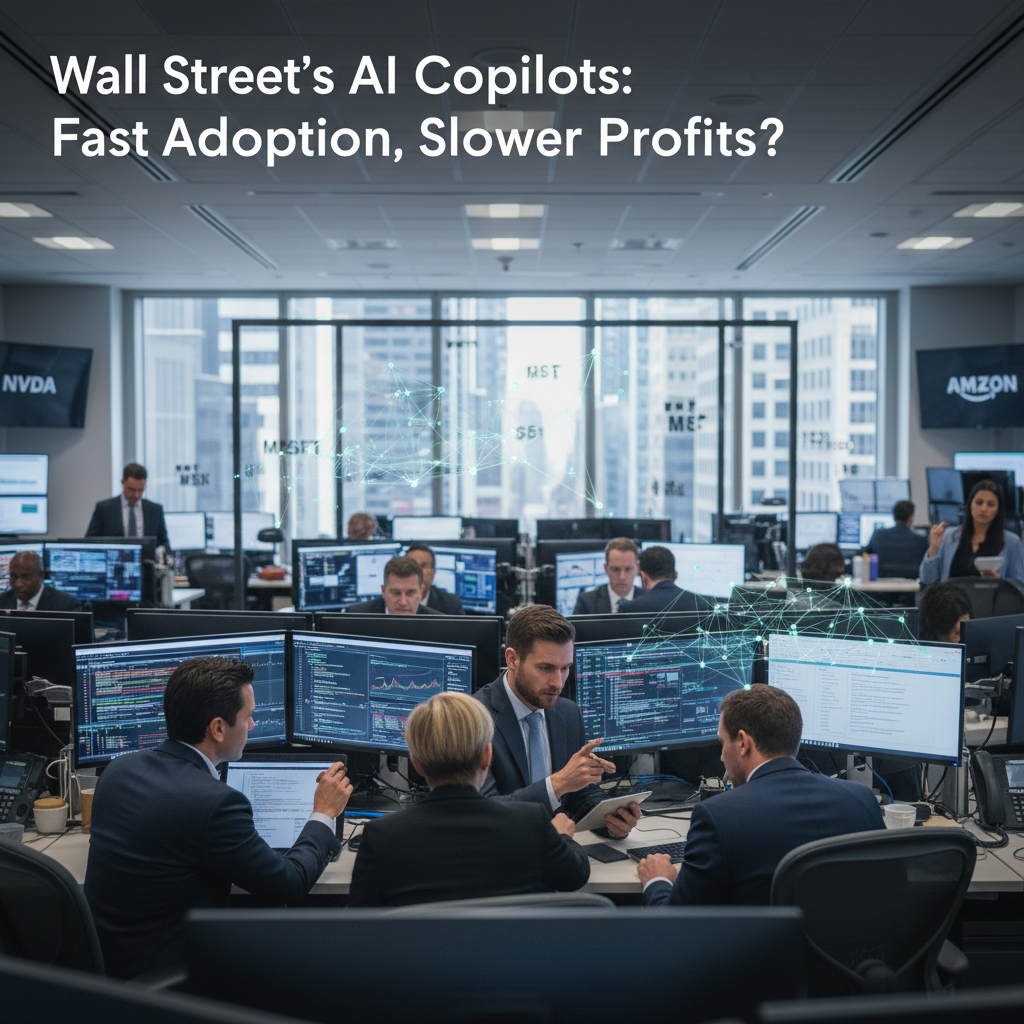
Why everyone on Wall Street is suddenly talking to a bot
The last 18 months have felt a bit like a relay race. Cloud providers handed banks the underlying models, vendors wrapped them in slick front ends, and now sales desks and wealth teams are trying to sprint with the baton. The upside is obvious — faster client memos, automated research syntheses, cheaper onboarding — but the finish line for real, repeatable profits is farther away than the vendor slide decks imply.
Not just a productivity story
It’s easy to sell these deployments as pure efficiency hacks. In practice, the business case usually breaks into two practical channels:
- Revenue: sharper, faster client outreach and smoother product recommendations can lift fee income.
- Cost: fewer hours spent on repetitive tasks and a lower dependence on offshore research teams.
That said, neither channel converts automatically. Pilots show strong adoption, but turning pilot enthusiasm into measurable AUM gains or permanent FTE reductions has been uneven at best.
Three frictions investors rarely see in press releases
- Data gravity and quality. Banks sit on mountains of sensitive transaction and client data. Dumping that into a model without careful preprocessing and lineage is a fast route to hallucinations — and to regulatory headaches.
- Compliance and auditability. LLM outputs don’t come with neat rule traces. Firms have to build decision logs, human-in-the-loop gates and audit trails. It’s doable, but costly and fiddly.
- Model risk and vendor lock-in. Relying on hosted models shifts operational risk toward cloud providers. A change in model behavior, API terms or pricing can ripple through downstream workflows overnight.
Call it lessons from the derivatives era: complexity can buy efficiency, but opaque assumptions bite later.
What success looks like — three pragmatic examples
- A mid-size wealth manager kept one deployment narrowly scoped to client meeting notes and compliance redaction. Advisors prepared faster, trade decisions were unchanged. Small scope, clear guardrails.
- A sell-side desk used models to auto-digest research and flag oddities, but kept equities analysts as final arbiters. Research cycles shortened, quality held up.
- A custodian focused on reconciliation and exception handling — pattern-heavy, routine work with little need for creative language — and saw near-term cost savings.
The recurring theme: start with predictable, well-instrumented tasks.
Investment implications
If you want exposure here, think in layers rather than hunting a single winner.
- Chips and infrastructure: higher compute demand favors GPU leaders and large cloud providers.
- Enterprise software: vendors that wrap compliance, monitoring and model governance into recurring products have an edge.
- Traditional banks: winners will be those that pair tech with incentives that actually change advisor behavior.
Smaller fintechs can be nimbler and experiment with vertical models for lending, payments or KYC. They can move fast — but they also face capital limits and scaling headaches.
Regulation will slow, not stop, adoption
Regulators are paying closer attention to explainability and consumer protection. Expect tighter documentation requirements, third-party audits and possibly rules that restrict where models can be used without certified human oversight. That raises compliance costs — and, oddly, builds a moat for vendors that ship auditability out of the box.
Short-term wins — and likely disappointments
Winners in the near term will be places like:
- Internal knowledge retrieval and advisor prep
- Document redaction and KYC automation
- Reconciliation and exception processing
Where hopes will likely fall short: fully autonomous financial advice, unsupervised trade generation, or replacing senior analysts overnight.
This is not a magic switch, but it is a meaningful productivity wave. The firms that win will treat models as components inside controlled workflows: limited scope, ongoing monitoring, and incentives aligned with human operators. That’s how pilots become real value — slowly, and with less fanfare than the marketing materials promise.
Read on if you are positioning capital or building products: start with governance, not chatty demos.