S&P 5005,842.10 0.42%
NASDAQ19,210.55 0.88%
NVDA1,184.22 2.41%
MSFT478.90 0.88%
GOOGL210.11 1.12%
META612.50 0.34%
AAPL239.80 0.21%
AMZN248.66 1.40%
AVGO1,902.40 3.12%
TSLA298.10 1.05%
BTC98,420 1.88%
ETH4,210 2.24%
10Y4.18% 0.02%
DXY104.12 0.18%
S&P 5005,842.10 0.42%
NASDAQ19,210.55 0.88%
NVDA1,184.22 2.41%
MSFT478.90 0.88%
GOOGL210.11 1.12%
META612.50 0.34%
AAPL239.80 0.21%
AMZN248.66 1.40%
AVGO1,902.40 3.12%
TSLA298.10 1.05%
BTC98,420 1.88%
ETH4,210 2.24%
10Y4.18% 0.02%
DXY104.12 0.18%
Back to homepage
AI Stocks

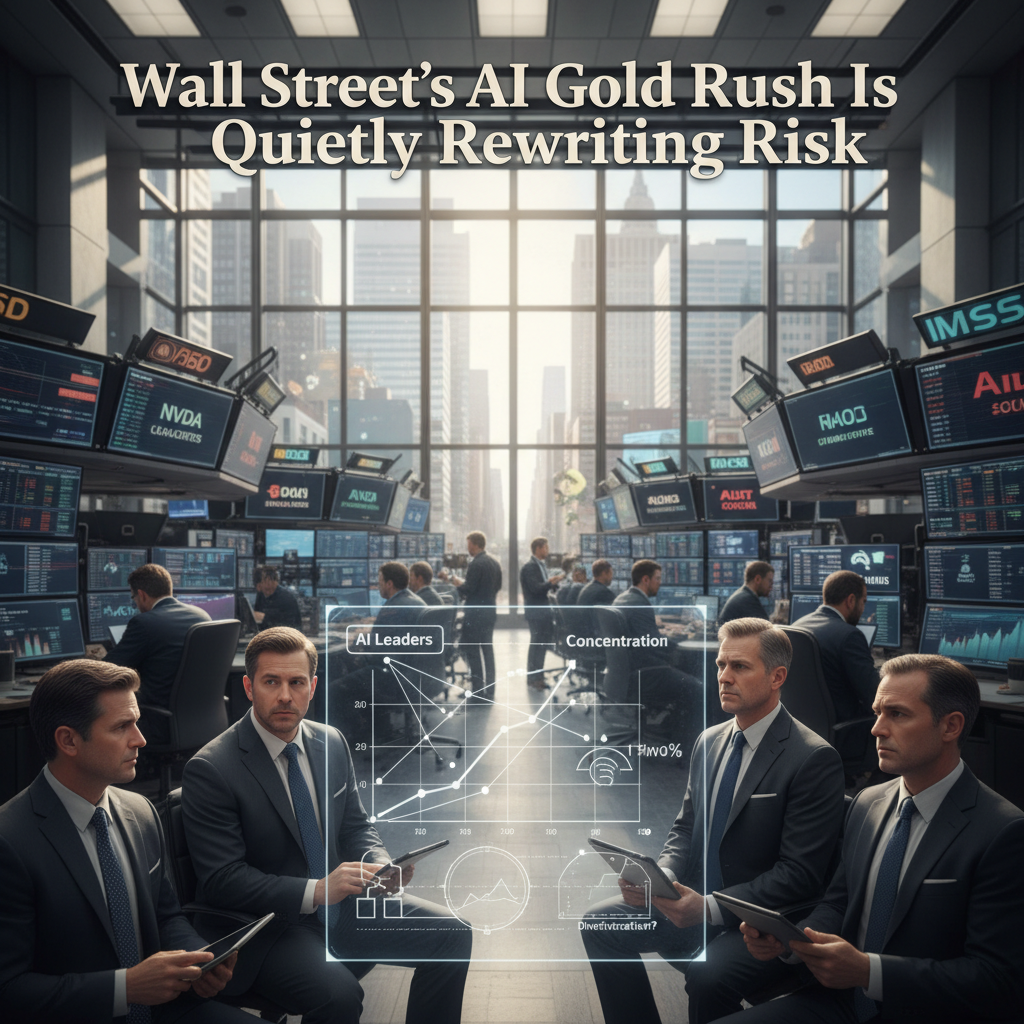
Wall Street's AI Gold Rush Is Quietly Rewriting Risk

As money floods AI leaders and thematic ETFs, concentration is rising. Investors who think AI equals diversification may be mistaken.
P
Pedro Marini
May 30, 2026 · 3 min read
Wall Street's AI Gold Rush Is Quietly Rewriting Risk

Illustration by IMF Alpha editorial · Reviewed by Pedro Marini

Listen to this article
AI narration · ~3 min
Tickers mentioned
NVDA+0.00%MSFT+0.00%GOOGL+0.00%AMZN+0.00%AMD+0.00%

The rush is quieter than a trading floor, louder than a Twitter trend.

Money is flooding a compact set of companies at the center of generative AI — chip designers, cloud hosts and a few dominant software platforms. That concentration is changing not just sector weights, but how portfolios move when the headlines flip.

Why concentration is happening

  • Fund flows follow scope. Thematic AI ETFs and passive products have to hold the biggest players, so demand mechanically piles into the same handful of names.
  • Infrastructure matters more than glamour. GPUs, data centers and cloud tooling are the real choke points; own those and you own essential exposure to the whole AI story.
  • Different time horizons, same direction. Retail FOMO shows up in ETFs and options; quant shops and long-short funds build exposure through factor overlays. They all push the same stock prices.

The real risks baked into everyday portfolios

  • Hidden correlation. Owning several AI funds can feel diversified but often equals multiple tickets on the same suppliers and supply chains. You think you own different bets; in stress you find out you own the same one.
  • Liquidity mismatch. ETFs promise daily liquidity, but the underlying holdings or derivative structures can be thin. That becomes a problem when everyone rushes for the exits.
  • Valuation and crowding. A few names trade on future AI profit narratives rather than steady cash flows. That makes them vulnerable to even small disappointments.

Think late 1990s all over again, but with chips and cloud replacing browsers and dial-up. Then, like now, a tech story sucked in broad capital and squashed dispersion across names. Only difference: speed. Algorithmic positioning and options markets can flip sentiment in hours instead of weeks.

Counterpoints and some nuance

  • AI is not pure hype. There are real productivity gains — especially in cloud-native firms and automation — that can lift earnings over years and justify higher multiples for some companies.
  • Active managers are trying to unbundle exposure. Instead of buying the headline names, some are picking software vendors, services specialists and niche data providers. It’s less flashy — but less correlated too.
  • In practice, though, the story is messier: winners will be uneven, and adoption paths vary sector by sector.

What this means for investors

  • Look beyond sector labels. Two AI ETFs can be more correlated to each other than two broad tech funds. Check actual holdings and common suppliers.
  • Run stress tests focused on market makers and infrastructure providers, not just macro scenarios.
  • Explore ways to get AI exposure without betting the same handful of hardware monopolists — smaller software plays, managed strategies, or targeted private allocations.

A practical closing thought

Markets love stories. AI is a powerful one and it will drive returns for some firms. But narratives mutate. For most investors the smarter move isn’t betting against AI; it’s avoiding the illusion that owning every AI product equals true diversification. Expect headline-driven swings, and for now at least, a market that tends to reward the suppliers more than the users.

Pedro Marini
Advertisement
Continue reading

Related coverage

The IMF Brief · Daily Newsletter

The AI economy, decoded before the open.

Five minutes. One email. The signal cutting through the noise at the intersection of artificial intelligence and Wall Street. Free, forever.

Join 184,000+ readers · No spam · Unsubscribe anytime